U.S. Demolition Operation at The Khamisiyah Ammunition Storage Point, Follow-Up Report: Dec. 5, 2000

Many veterans of the Gulf War have expressed concern that their unexplained illnesses may result from their experiences in that war. In response to veterans’ concerns, the Department of Defense established a task force in June 1995 to investigate incidents and circumstances relating to possible causes. The Office of the Special Assistant for Gulf War Illnesses assumed responsibility for these investigations on Nov. 12, 1996, and has continued to investigate reports of chemical warfare agent incidents.

To inform the public about the progress of these efforts, the DOD is publishing on the Internet and elsewhere accounts that may contribute to the discussion of possible causes of unexplained illnesses among Gulf War veterans, along with documentary evidence or personal testimony used in compiling the accounts. The narrative that follows is an update to the first such account regarding the events at Khamisiyah.

II. Summary

The story of Khamisiyah has three parts: United States military operations (including demolitions) at Khamisiyah; United Nations Special Commission on Iraq (UNSCOM) inspections of Khamisiyah, which brought to light the presence of chemical weapons at various locations on and around the site; and The US government response to mounting indications that US soldiers may have destroyed chemical munitions at Khamisiyah—the details of what the Department of Defense knew, when it knew them, and the actions it has taken.

Immediately following the end of Operation Desert Storm, U.S. Army units occupied an area in southeastern Iraq that encompassed Khamisiyah (also known then as the Tall al Lahm Ammunition Storage Area). Soldiers of the Army’s XVIII Airborne Corps conducted two large-scale demolition operations to destroy the munitions and facilities around Khamisiyah:

  • March 4, 1991. Soldiers destroyed 37 large ammunition bunkers. Later, Iraq declared that one of these, Bunker 73, had contained 2,160 chemical warfare agent-filled rockets.
  • March 10, 1991. Soldiers destroyed approximately 40 additional ammunition bunkers and 45 warehouses. In an open-air location outside the Khamisiyah Ammunition Supply Point (ASP) now known as "the Pit," soldiers also set charges to approximately 1,250 rockets, many of which UNSCOM later found had contained chemical warfare agent.

Soldiers also conducted numerous demolitions to destroy smaller caches of munitions and to test techniques for destroying bunkers. Demolition operations continued in the Khamisiyah area through the middle of April 1991. The soldiers conducting reconnaissance and completing the inventories before these demolitions were confident that they had destroyed only conventional munitions.

Throughout the U.S. occupation of Khamisiyah, including the demolition period, no reports were made of chemical warfare agent detections. Nor were there reports of anyone—soldier or civilian—experiencing symptoms consistent with chemical warfare agent exposure.

In October 1991, March 1992, May 1996, and in 1998, UNSCOM inspected Khamisiyah. In October 1991, Iraqi officials led UNSCOM inspectors to three sites that had contained chemical weapons (Figure 2):

  • Bunker 73, inside the Khamisiyah ASP;
  • The area referred to as the Pit, outside the southeast corner of the Khamisiyah ASP; and
  • An above-ground storage area, approximately 3 kilometers from the Khamisiyah ASP.
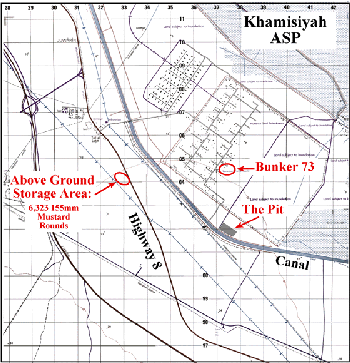
Figure 2. Site locations shown to UNSCOM

Figure 2. Site locations shown to the UNSCOM

Bunker 73. During the 1991 inspection, Iraq claimed that chemical munitions found in the Pit had been salvaged from Bunker 73 and that Coalition forces had destroyed the bunker. UNSCOM could not determine if Bunker 73 contained chemical warfare agents at this time because damaged munitions made it too dangerous to get close enough to sample or take CAM readings. However, on a return visit to the site in May 1996, UNSCOM conclusively determined that debris  (e.g., burster tubes, fill plugs, and plastic inserts) in the rubble of Bunker 73 was characteristic of chemical munitions.

The Pit. In October 1991, UNSCOM inspectors found several hundred 122mm rockets that appeared to have been bulldozed and placed into piles in an excavated area southeast of the main ASP. This area became known as "the Pit." The UNSCOM investigation showed that the intact rockets contained the chemical warfare agents sarin and cyclosarin. During a subsequent visit in March 1992, UNSCOM ordered Iraq to destroy about 500 leaking rockets near the Pit, and ship the remaining rockets to Al Muthanna, Iraq, for destruction. UNSCOM supervised Iraqi destruction of a total of approximately 782 rockets at the Pit and Al Muthanna.

Above-ground storage area. Iraq also showed the UNSCOM team an above-ground storage site about 3 kilometers west of the Khamisiyah ASP that contained 6,323 intact 155mm artillery shells, one of which was leaking mustard agent. No evidence exists that any Coalition forces had been to this site. Again, UNSCOM ordered Iraq to ship these rounds to the destruction facility at Al Muthanna.

In November 1991, US intelligence and DOD became aware of the UNSCOM findings, but at the time, the information did not result in identifying which, if any, US troops participated in the Khamisiyah demolition activities. The lack of U.S. reports of chemical weapons, combined with Iraq’s less than full compliance with UNSCOM, led to doubts about Iraq’s claims that chemical weapons had been at the site when the demolition occurred.

The U.S. government did not immediately make the connection between the chemical munitions found by UNSCOM at Khamisiyah and US demolitions operations there. The following is a chronology of the government response.

  • February 1994 - A request from Congressman Browder to the United Nations (UN) for any reports about chemical weapons found in Iraq after the Gulf War kindled DOD interest in Khamisiyah.  The United Nations responded in April 1994 with a letter that listed Khamisiyah along with other chemical weapons sites.
  • May 1994 - During hearings before the Senate Banking, Housing and Urban Affairs Committee, DOD and Intelligence Community witnesses admitted that UNSCOM found chemical weapons at a location at the time of UNSCOM inspections, but these witnesses were unable to confirm that any US troops were at the site.
  • March 1995 - As a result of presidential concerns and the concerns of two Central Intelligence Agency (CIA) employees, the CIA began a reexamination of relevant intelligence.
  • June 1995 - DOD formed the Persian Gulf Illnesses Investigation Team (later shortened to Persian Gulf Investigation Team (PGIT)) that by October had identified some of the U.S. forces that had occupied the area around Khamisiyah during the Gulf War, including the 37th Engineer Battalion.
  • August 1995 - President Clinton created the Presidential Advisory Committee on Gulf War Veterans’ Illnesses.
  • May 1996 - The CIA and PGIT acknowledged at a Presidential Advisory Committee on Gulf War Veterans’ Illnesses meeting the possibility that U.S. soldiers destroyed munitions at Khamisiyah.
  • June 1996 - DOD confirmed publicly that "US soldiers from the 37th Engineer Battalion destroyed ammunition bunkers [at Khamisiyah] in early March 1991 ... It now appears that one of these destroyed bunkers contained chemical weapons."
  • October 1996 - Deputy Secretary of Defense sent memorandum to 21,000 veterans who had been identified as being within 50 kilometers of Khamisiyah.
  • November 1996 - The Secretary of Defense established the Office of the Special Assistant for Gulf War Illnesses (hereafter referred to as the Office of the Special Assistant) to focus ongoing DOD investigations and expand the investigation into Gulf War veterans’ complaints of undiagnosed illnesses.
  • January 1997 - The Deputy Secretary of Defense sent letters with a survey attached to veterans saying that chemical weapons had been present at Khamisiyah when the demolitions occured and urging them to call the Persian Gulf Incident Hotline with any additional information they may have about the Khamisiyah incident.
  • May 1997 - DOD and CIA conducted open field demolition tests on 122mm rockets at Dugway Proving Ground, Utah, to determine how chemical warfare agents in Iraqi rockets might have been released by demolitions at Khamisiyah.
  • July 1997 - DOD and CIA jointly announced the results of the dispersion modeling for Khamisiyah. Given the unit locations available then, the modeling indicated a hazard area where some 99,000 veterans may have been exposed to low levels of nerve agent.  DOD sent written notices to two categories of veterans:  those in the potential hazard area (approximately 99,000) and those who had received the Deputy Secretary of Defense's letter and survey but were not in the potential hazard area (approximately 10,000).
  • December 1997 - The Department of the Army Inspector General’s "Inquiry into Demolition of Iraq Ammunition" found no empirical evidence that chemical munitions or agents were present at the time of the demolition operations.
  • January 1998 - President Clinton created the Presidential Special Oversight Board for the Department of Defense Investigations of Gulf War Chemical and Biological Incidents to provide recommendations based on its review of Department of Defense investigations into possible detections of, and exposures to, chemical or biological weapons agents, and environmental and other factors that may have contributed to Gulf War Illnesses.
  • January 2000 - DOD completed the remodeling and revised the 1997 hazard areas.

The early work of the Office of the Special Assistant placed an emphasis on researching US military operations at Khamisiyah. On Feb. 21,  1997, we published the first Khamisiyah case narrative. The narrative provided important insights into what actually took place and which US military units were involved. We intensified our efforts to identify and contact the thousands of soldiers potentially involved, and began detailed computer modeling of events in the spring and summer of 1997 to determine the size and path of the potential hazard area created by demolition activities in the Pit. The modeling resulted in DoD sending notification letters to approximately 99,000 veterans.  It is important to note that the modeling process is based on computer simulations and not empirical data.   Results, although based on best science, are predictions and should be evaluated carefully.

Modeling refinements continued through 1998 and 1999. Some of the more significant refinements included revision of meteorological models, an updated CIA estimate of how much chemical warfare agent was released, addition of deposition and decay to the models and consideration of toxicity of both sarin and cyclosarin in the models. The modeling team completed remodeling the Khamisiyah Pit demolition in January 2000 that resulted in redefined potential hazard areas. DoD identified 100,923 veterans in the potential hazard areas who possibly were exposed to low levels of nerve agent. Our fundamental modeling methodology has not changed since 1997. In 2000, like 1997, we used the outer boundaries of the union of the results from different models to define the potential hazard area. This conservative approach gave us greater assurance of identifying US units in the potential hazard area.  The veterans’ notification process is ongoing.

The first narrative left the following five questions for follow-up research:

  • How many chemical warfare munitions were present in Bunker 73 and the Pit at the time of the US demolition operations?
  • Were two separate groups working at the Pit on March 10, 1991?
  • Was there an additional demolition of munitions in the Pit on March 12, 1991?
  • Who were the 15 to 20 engineers assigned to assist the explosive ordnance disposal (EOD) noncommissioned officer in the Pit on March 10 or 12, 1991?
  • What were the weather conditions on the day(s) of the Pit demolition(s)?

This updated narrative includes significant additional information that enabled the Office of the Special Assistant to address each of these five questions and to better understand the effect of the demolition operations on U.S. soldiers.

Additionally, the updated narrative addresses, and assesses, two more questions:

  • Did U.S. forces destroy chemical warfare weapons stored at Khamisiyah?
  • Were U.S. forces exposed to nerve agents as a result of demolition activities?

This narrative includes the following conclusions:

  • Chemical munitions were definitely present at three locations at Khamisiyah.
  • U.S. soldiers definitely destroyed many—but not all—of the chemical rockets at Khamisiyah.
  • Some U.S. ground forces were likely exposed to very low levels of nerve agent from the demolition of rockets in the Pit on March 10, 1991.
  • It is unlikely U.S. ground forces were exposed to chemical warfare agent from the Bunker 73 demolition on March 4, 1991.


Figure 8 shows the key events of the Pre-Desert Shield period. As previously mentioned, when the U.S. Intelligence Community first discovered the Khamisiyah ASP in 1976, they identified it as a storage depot for conventional[12](i.e., non-chemical, non-biological, and non-nuclear) munitions.

Figure 8. Pre-Desert Shield period

Figure 8. Pre-Desert Shield period

In May 1986, the CIA received and distributed a translated Iraqi document to limited policy, intelligence, and DOD officials that stated that Iraq had used the "al-Khamisiyah warehouses" in 1984 and 1985 to store chemical weapons used against Iran. This document stated:

3,975 155-mm mustard-loaded artillery grenades [sic] have been issued (from June 1984 to March 1985) to al-Khamisiyah warehouses. We do not have official data about using this quantity by the third army corps. The warehouses currently have 6,293 150-mm [sic] mustard bombs, enough to meet front demands for four days on a 15-minute mission.[13]

In November 1986, the CIA produced an assessment that used the information from this report to conclude that Iraq had indeed stored chemical weapons during the Iran-Iraq war "at the southern forward ammunition depot located at Tall al Lahm."[14] In this assessment, the CIA not only identified Tall al Lahm as a chemical storage site, but also made the connection between the ammunition depot they called "Tall al Lahm" and Iraq called "al Khamisiyah." However, this connection did not permanently resolve the earlier disconnect in names, which would persist until after the Gulf War. In the same assessment, the CIA also stated that "a new generation of 16 bunkers will expand Iraq's capability to store CW [chemical warfare] munitions at six airfields and at three ammunition storage depots that are strategically located throughout the country." The Intelligence Community called these new bunkers S-shaped bunkers.[15] Khamisiyah had no S-shaped bunkers; the nearest ones were at Tallil airfield and An Nasiriyah ASP SW. The CIA's assessment of Iraq’s report established an important link between chemical weapons storage and al Khamisiyah/Tall al Lahm. However, it also shifted future analyses of potential chemical storage sites to concentrate on locations that had S-shaped bunkers. The analytical bias toward S-shaped bunkers may explain why Khamisiyah was not on any of the lists of suspected chemical storage facilities generated from 1986 to the beginning of the Gulf War in 1990.[16]

IV. Analysis

This investigation sought the answers to two important questions:

  • Did U.S. forces destroy chemical weapons stored at Khamisiyah?
  • Were U.S. forces exposed to nerve agents as a result of demolition activities?

To assess the likelihood U.S. forces destroyed chemical weapons stored at Khamisiyah, we wanted to establish that U.S. troops conducted demolition operations there and chemical warfare agents were present during the demolitions.

U.S. Army engineers and explosive ordnance disposal personnel conducted two large-scale demolitions at Khamisiyah: one on March 4, 1991, and a second on March 10, 1991. Only bunkers were destroyed on March 4, 1991. The Pit, warehouses, and most of the remaining bunkers were destroyed on March 10, 1991. Hundreds of personal interviews of commanders, operations officers, noncommissioned officers, enlisted personnel, and NBC specialists from the engineer and EOD units confirmed the demolition operations. The 37th Engineer Battalion videotape of March 4, 1991 bunker inventories and subsequent bunker explosions, narrated by an engineer unit commander, provides insight into the magnitude of the effort required to destroy the Khamisiyah ASP. Personal diaries added details to the daily events of U.S. units involved in destroying the bunkers and warehouses. Unit logs and records and declassified intelligence documents further identified US participants in the Khamisiyah demolition operations.

During this investigation, we discovered significant evidence to support the presence of chemical weapons at Khamisiyah. Although U.S. forces did not identify chemical weapons during their inventory or demolition activities, subsequent UNSCOM inspections from October 1991 through the summer of 1998 documented chemical weapons in Bunker 73, the Pit, and at an open storage location three kilometers west of the main storage area. At the open storage location, UNSCOM inspectors tested a leaking 155mm artillery shell with a CAM and determined it contained the blister agent mustard. They also tested the 122mm rockets in the Pit and found they contained a mixture of the nerve agents sarin and cyclosarin. In May 1996, UNSCOM inspectors determined that some damaged rockets in the remains of Bunker 73 were chemical weapons, based on the rockets’ physical characteristics (high-density polyethylene inserts, burster tubes, and fill plugs). UNSCOM inspectors found additional nerve agent-filled rockets during their 1998 excavation of Bunker 73 and the Pit.

Intelligence Community reports and photographs and UNSCOM information were crucial in assessing whether U.S. forces destroyed chemical weapons at Khamisiyah. Bunker 73’s debris contained whole and fragmentary 122mm rockets bearing characteristics of chemical weapons. The rockets were thoroughly mixed in the debris and it is unlikely Iraq placed them there after the demolition to discredit the U.S. or deceive UNSCOM inspectors. UNSCOM unearthed chemical rockets in Bunker 73’s location, leaving no doubt at least some of the munitions in the bunker were chemical weapons when U.S. Army engineers destroyed it. We are less certain about the existence of chemical weapons in the Pit. Iraq claimed that they moved chemical rockets from Al Muthanna to Bunker 73 and then moved them to the Pit when some began to leak. Iraq officials took UNSCOM inspectors to the Pit in October 1991 and showed them several piles of rockets, which UNSCOM tested and found chemical warfare agents. In February 1992, UNSCOM found additional chemical warfare weapons buried in the Pit’s sand walls. The inspectors also found chemical weapons in a 1998 excavation of the Pit. It would be difficult, if not impossible, for Iraq to have buried those chemical weapons in the Pit, either to embarrass the U.S. or deceive the UNSCOM inspectors.

V. Assessment

We have assessed that chemical warfare agents were present at Khamisiyah and U.S. soldiers definitely destroyed many, but not all, of the chemical agent weapons in the Pit and Bunker 73.  It is likely that the demolition of rockets in the Pit exposed some US units to very low levels of chemical warfare agents. UNSCOM inspectors verified the presence of chemical warfare agent rockets in the Pit, and our own investigation, supported by other DOD organizations and Intelligence Community investigations, have left little doubt that US units damaged or destroyed some of these rockets on March 10, 1991.

It is unlikely that the destruction of Bunker 73 exposed any U.S. military units to a chemical warfare agent. Units in the area evacuated to a safe distance from the storage area before the explosion. The demolition virtually destroyed Bunker 73 and the rains that followed would effectively have dissipated any chemical warfare agent vapors that might have escaped the force of the demolition. Winds blew whatever chemical agent vapors were present in the atmosphere away from U.S. units. In 1999, the CIA's estimated amount of agent release was 5 percent of that estimated in 1996, further reducing the possibility for exposure.  No evidence exists any soldiers at Khamisiyah exhibited symptoms consistent with exposure to a chemical warfare agent.

At the conclusion of the Gulf War, the UN created UNSCOM to identify and destroy Iraq’s chemical and biological weapons and ballistic missiles. UNSCOM obtained Iraq’s weapons declarations and inspected nuclear, biological, and chemical production facilities. In October 1999, the United Nations discontinued UNSCOM inspections and weapons destruction missions.

Sections III E through H of this narrative and the CIA’s, "Khamisiyah: A Historical Perspective on Related Intelligence" (posted on GulfLINK on April 9, 1997), recount in detail the events that led to the discovery of chemical weapons destruction at Khamisiyah. Analysis of historical documents indicates that DOD received and retransmitted messages containing details of UNSCOM inspections to USCENTCOM and other unified and specified commands. DOD, USCENTCOM, and the State Department did not recognize the significance of UNSCOM’s discovery of chemical munitions destruction at Khamisiyah. DOD, in conjunction with the Intelligence Community and State Department, should monitor events in US-occupied areas during deployments and after redeployments to prevent another incident like Khamisiyah.

We adopted the IDA panel recommendation to use an ensemble of weather and dispersion models combined with global data sources to assess the possible dispersion of chemical warfare agents. The methodology for modeling the release of agent is a process that uses:

  • A source characterization to describe the type and amount of agent released, and how rapidly it discharged;
  • Data from global weather models to simulate global weather patterns;
  • Regional weather models to simulate the weather in the vicinity of the suspected agent release;
  • Transport and dispersion models (often simply called dispersion models) to project the possible spread of the agent as a result of the simulated regional weather; and
  • A database of Gulf War unit locations to plot probable military unit locations in relation to the hazard area and estimate possible exposures.

Figure 54 depicts the methodology we use to estimate possible hazard areas and, in the process, possible exposures of military units.

Figure 54. Process for modeling possible chemical warfare agent releases

Figure 54. Process for modeling possible chemical warfare agent releases

The methodology uses two types of models: weather models and dispersion models. The weather models allow us to simulate the weather conditions in specific areas of interest by approximating both global and regional weather patterns. Based on the weather generated by a global model, a regional weather model predicts the local weather conditions in the vicinity of a possible chemical warfare agent release. Both the global and regional weather modeling is supplemented by actual, although quite limited, weather measurements from the Persian Gulf and surrounding regions.

The dispersion models allow us to simulate how chemical warfare agents may move and diffuse in the atmosphere given the predicted local weather conditions. These models combine the source characteristics of the agent—including the amount of agent, the type of agent, the location of the release, and the release rate—with the local weather from the regional models to predict how the agent might disperse. Running one dispersion model with the weather conditions predicted by one regional model results in a prediction of a unique downwind hazard area. Running each dispersion model with the weather from each of the different regional weather models results in a set of unique hazard areas. We overlay all of these hazard areas to create a union, or composite, of the various projections. The resulting composite graphic provides the most credible array of potential agent vapor hazard areas for determining where military units might have been exposed.[255] This is the basic process for all of our modeling efforts.

Regional weather models, sometimes called mesoscale meteorological models, generate the estimated local weather conditions in the detail required by the dispersion models. To predict detailed local atmospheric conditions, regional models take the outputs from global models to yield weather estimates where the resolution can be reduced to a few kilometers.

We use three regional models: 

  • The Coupled Ocean-Atmosphere Mesoscale Prediction System (COAMPS) developed and run by NRL;[259]
  • The Operational Multi-scale Environmental Model with Grid Adaptivity (OMEGA) developed for the DTRA[260] and run by SAIC; and
  • The Mesoscale Model, Version 5 (MM5),[261] developed by Pennsylvania State University and the National Center for Atmospheric Research (NCAR), a subordinate element of NOAA.

These models simulate atmospheric conditions for advanced, high-resolution weather forecasting. They have the ability to simulate local weather conditions to a few square kilometers. Although these models operate differently, they all produce the detailed meteorological data needed to run the dispersion models. Because of differences in input data, modeling processes, and the physical process assumptions, each regional model produces different results. However, careful analysis of each simulation has shown that the outputs among the regional models are generally consistent.

Dispersion models predict possible downwind hazard areas. These hazard areas indicate how the chemical warfare agent disperses over time due to prevailing local atmospheric conditions. Dispersion model results depend on both the local weather descriptions, created by the regional weather models, and other modeling assumptions, including:

  • Source characterization. The dispersion models require detailed source information that characterizes the agents and their conditions and mechanisms of release. Such collective information is referred to as the source term or source characterization. Source characterization defines the quantity and characteristics of the possible chemical warfare agent release, including such technical details as the amount of agent in a weapon, total amount of agent released as a vapor or liquid, the purity of the agent, and how quickly it was released. It also identifies the date and time of release. For our modeling efforts, the CIA provides source characterization data, developed in coordination with our analysts. Data from publicly released reports by the United Nations Special Commission on Iraq also contribute to the source characterization.
  • Removal Mechanisms. Chemical warfare agents are highly reactive chemical compounds. The very chemical and physical properties that make them dangerous also make them susceptible to reacting with substances in the environment. These reactions, in turn, may result in significant reductions in the agent’s effectiveness. The overall effect of this interaction is an estimated reduction (or removal) of the agent available over time (sometimes called degradation) to create a potential exposure hazard. Earlier modeling did not consider this deterioration, but our current modeling includes degradation in the environment to be more realistic and better reflect what happens under real world conditions, making our current hazard area predictions more accurate.
  • Exposure Thresholds. Chemical warfare agents are substances that are intended for use in military operations to kill, seriously injure, or incapacitate through physiological effects. Therefore, a large body of scientific research and public health information is available that addresses thresholds such as exposure concentration, exposure duration, and exposure dosage (concentration accumulated over time). These thresholds include the General Population Limit (GPL) and the First Noticeable Effects (FNE)[262] values for chemical warfare agents. By incorporating these values into the simulation runs of the dispersion models, we are able to define the boundaries of the potential exposure hazard areas.

We use two dispersion models: 

  • The Hazard Prediction and Assessment Capability (HPAC)[263] or, more specifically, the Second Order Closure, Integrated Puff (SCIPUFF) transport module of HPAC run by DTRA; and
  • The Vapor, Liquid, and Solid Tracking (VLSTRACK)[264] model maintained by the Naval Surface Warfare Center (NSWC) in Dahlgren, VA.

Because of their different inherent assumptions, these two dispersion models generate slightly different results even with the same weather inputs and source characterization. An analogy would be different weather models produce different forecasts even when using the same observed data. As a result, combining all regional weather models with each dispersion model can create multiple distinct hazard areas.

The IDA technical review panel hypothesized that because of the uncertainty of modeling and because of the consistency of the simulations, the results of each simulation are equally likely to accurately reflect what may have really occurred.[265] Therefore, we combine all hazard projections generated by HPAC or VLSTRACK to create a single hazard area combining all exposure areas from all of the dispersion model runs. This approach provides a high probability that the exposure area included all units possibly exposed. Figure 55 depicts the process for creating a composite hazard projection.

Figure 55. Example of processes for creating a composite hazard area

Figure 55. Example of process for creating a composite hazard area

Weather models represent our best attempts to approximate actual atmospheric conditions. They do not replicate reality with absolute certainty, but modern modeling techniques enable us to generate reasonably close approximations. We simulate regional weather conditions using weather modeling. Dispersion models then work with the simulated weather to project the overall agent distribution in the area. The composite hazard projection area represents an average picture. Since the atmosphere is inherently turbulent in nature, the actual concentration of agent within the hazard area might not be the same throughout the projected area. As a result, modeling predicts that the concentration of chemical warfare agent is at the exposure threshold throughout the hazard area, even though the agent may not necessarily be everywhere in the area. We can only conclude that individuals within the hazard projection area may have been exposed to the calculated concentration of agent multiplied by the time of exposure across the entire hazard area.

CIA estimated the quantity, type, and storage configuration of chemical warfare agents stored at the sites under investigation. The source characterizations tend to overstate the size of the release to minimize risk of failing to identify all of the agent that might have been released. Presenting a composite of the different modeling results is another method to minimize the risk of missing veterans who may have been in a hazard area. This is because if we are to err, we would prefer to identify a veteran incorrectly as possibly exposed rather than fail to recognize a veteran who was exposed.

In April 1997, the Office of the Special Assistant needed to have available improved unit locations to accurately identify veterans to complement the ongoing DOD/CIA modeling effort to better reflect the potential downwind hazard area. Specifically, the Office of the Special Assistant needed to determine the veterans’ unit locations during the period March 10 - 13, 1991. Although veterans were either assigned or attached to specific units during the Gulf War, a unit’s location on a specific day may not, necessarily, pinpoint where an individual soldier was on that day. For example, a precise record of a location for a soldier on patrol or in transit to another location would not exist.

To assist in identifying additional unit locations and to verify existing locations in the Persian Gulf Registry, the Office of the Special Assistant and the Department of the Army began a coordinated effort to assemble former Gulf War brigade, divisional, and non-divisional operations officers (G3s/S3s). Initially, the Office of the Special Assistant and the Department of the Army brought operations officers from the XVIII Airborne Corps—whose area of responsibility included Khamisiyah during March 10 - 13, 1991—to USASCURR to review, refine, and enhance their units’ location information. G3s and S3s from the 101st Airborne Division, 24th Infantry Division, 82nd Airborne Division, XVIII Airborne Corps’ separate brigades, combat support and combat service support units, the 2nd Armored Cavalry Regiment, and the 1st Cavalry Division met in small groups for a week at a time to review the information contained in the unit locations registry. The productive results of this first series of conferences and the realization, in July 1997, that the Khamisiyah potential hazard area extended beyond the original estimate of a 50-kilometer radius convinced the Office of the Special Assistant and Department of the Army leadership that they needed to continue the conferences for other Army units that deployed during the Gulf War. Thus, the G3/S3 conferences for unit location database improvement continued from September 1997 through June 1998 as the Office of the Special Assistant and the Department of the Army brought back VII Corps and Echelons-Above-Corps operations officers to review their unit locations and to enhance the database. This effort significantly enhanced the USASCURR database and was the basis for reducing the uncertainties associated with locating U.S. units around Khamisiyah during the demolitions. While the G3/S3 conferences ended in June 1998, the Office of the Special Assistant and USASCURR continue to work together to improve the locations and personnel databases.

The USASCURR now has more than 855,000 unit locations in its database of daily unit locations during the war. The U.S. Army Center for Health Promotion and Preventive Medicine combined USASCURR’s unit locations with DMDC’s registry of Gulf War Veterans and the 1997 and 2000 modeling results to produce graphic representations of the potential hazard areas for March 10 - 13, 1991.

When we assisted DMDC to provide better linking of individual veterans to units, we filled in major gaps in identifying assigned and attached unit personnel. The combined improvements in unit location data with unit manpower information has resulted in Table 7:

Table 7. Unit location data and manpower information improvements

Issue July 1997 June 2000
 Unit locations in KTO 610, 000 855, 000
 G3/S3 conferences to update locations  Only XVIII Airborne Corps Army complete
Air Force personnel  None except major air force bases 85%
 Resolution Mostly battalion & Higher Nearly all Company 
Veterans linked to unit Major gaps Much improved