Reportable Medical Events at Military Health System Facilities 2024 Annual Review, January 1, 2024–December 31, 2024

Image of 4RMEs. Reportable medical events are recorded in the Disease Reporting System internet by health care providers and public health officials throughout the Military Health System.

This month’s edition of the MSMR Reportable Medical Events at Military Health System facilities feature provides an overview of annual data for 2024 for active component service members and MHS beneficiaries. RMEs are reported in the Disease Reporting System internet by health care providers and public health officials throughout the MHS for monitoring, controlling, and preventing the occurrence and spread of diseases of public health interest. These reports are validated by the Defense Health Agency–Public Health.

The DRSi collects reports on over 70 different RMEs, including infectious and non-infectious conditions, outbreak reports, sexually transmitted infection risk surveys, and tuberculosis contact investigation reports. A complete list of RMEs is available in the 2022 Armed Forces Reportable Medical Events Guidelines and Case Definitions.1 Data reported in this report are considered provisional and do not represent conclusive evidence until case reports are fully validated.

Top 5 RMEs in 2024, by MMWR Week, for ACSMs and MHS Beneficiaries
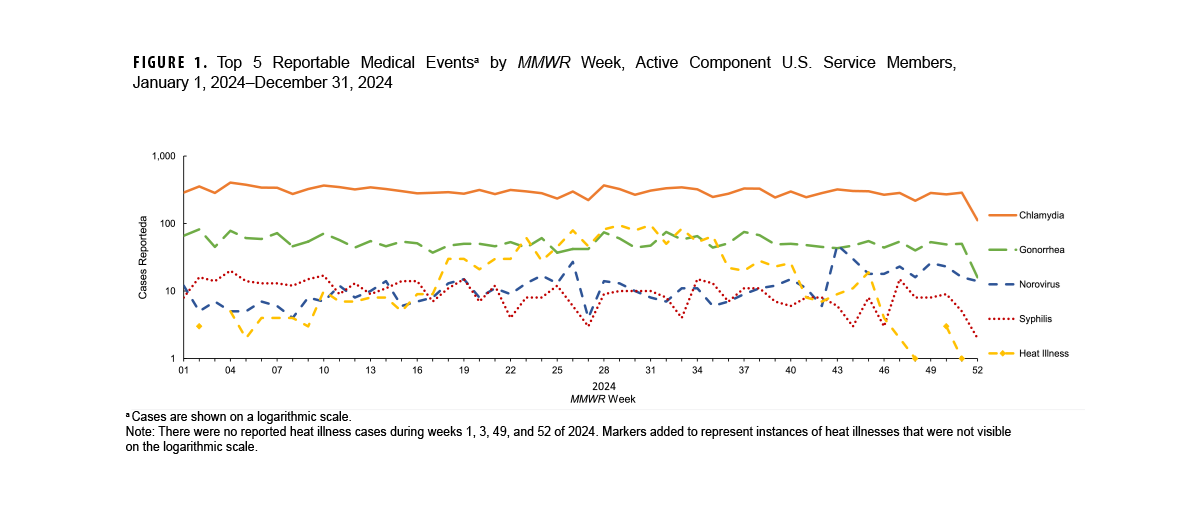
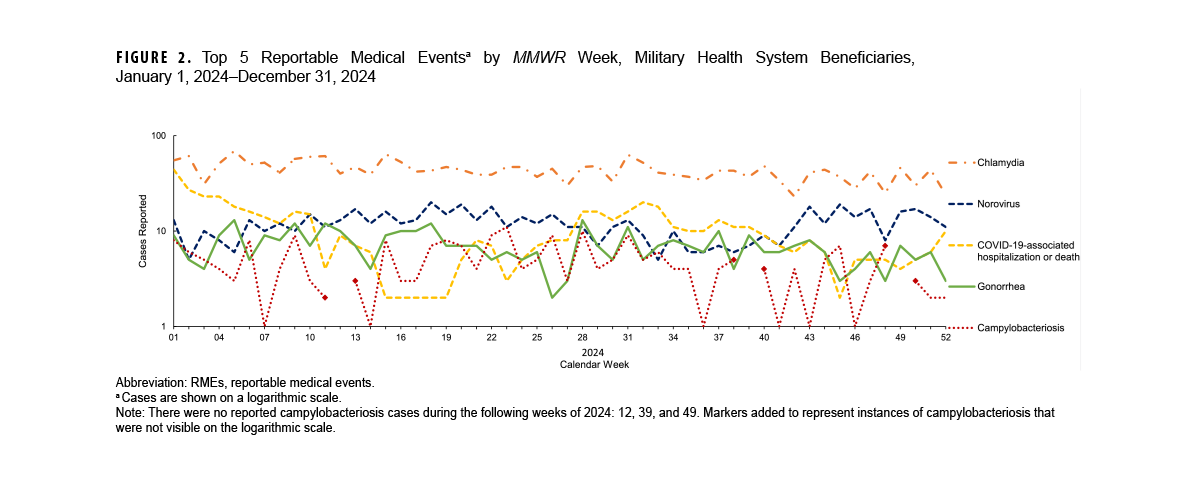
FIGURE 1. Top 5 Reportable Medical Events by MMWR Week Among Active Component U.S. Service Members, January 1, 2024–December 31, 2024. This graph comprises five lines on the horizontal, or x-, axis that depict case counts for the five most frequent reportable medical event conditions among active component service members during 2024. The horizontal, or x-, axis is divided into 52 units of measure, each representing an individual week during the year. The vertical, or y-, axis is presented on a logarithmic scale, in segments of 1 through 10, then 10 through 100, and 100, through 1,000. Chlamydia was the most common reportable medical condition, with counts consistently around 300 cases per week. Gonorrhea was generally the second most common reportable medical event, with cases averaging just below 100 per week, but heat illnesses surpassed gonorrhea for 11 weeks, from week 25 through 35, but then gradually fell again to the lowest position on the graph during the winter months. Norovirus and syphilis cases were generally the third and fourth most common conditions, with the exception of the summer weeks when heat illnesses rose in incidence, averaging around 10 cases per month each. Norovirus and syphilis diverged in the last weeks of the year, with norovirus cases rising in weeks 42 and 43, and remaining slightly elevated for the rest of the year, while syphilis cases declined noticeably in the last two weeks of the year.The top five RMEs reported to DRSi in 2024 are displayed on the following page, by week, for ACSMs and MHS beneficiaries. The top five RMEs reported for ACSMs were chlamydia, gonorrhea, norovirus, heat illness, and syphilis (Figure 1). Among MHS beneficiaries, the top five RMEs reported were chlamydia, norovirus, COVID-19-associated hospitalization or death, gonorrhea, and campylobacteriosis (Figure 2). FIGURE 2. Top 5 Reportable Medical Events by MMWR Week Among Military Health System Beneficiaries, January 1, 2024–December 31, 2024. This graph comprises five lines on the horizontal, or x-, axis that depict case counts for the five most frequent reportable medical event conditions among Military Health system beneficiaries during 2024. The horizontal, or x-, axis is divided into 52 units of measure, each representing an individual week during the year. The vertical, or y-, axis is presented on a logarithmic scale, in two segments, of one through 10, then 10 through 100. As in the active component population, chlamydia was the most common reportable medical condition, but with lower counts, just above 50 cases per week. Norovirus was generally the second most common condition, averaging around 10 cases per week. COVID-19-associated hospitalization or death showed the greatest variability, beginning the year as the second most common condition, with numbers slightly below those of chlamydia, but falling gradually to become the lowest position on the graph by week 15. COVID-19-associated hospitalization or death remained the lowest-charting condition for five weeks until rising again to regain the second highest position by week 28, where it remained until week 40, but at lower numbers than before, between 10 and 20 cases per week. During the last 10 weeks of the year COVID-19-associated hospitalization or death showed high variability but ended the year nearly tied with norovirus as the second highest condition. Gonorrhea case numbers were somewhat lower than those of norovirus, generally between five and 10 throughout the year. Campylobacteriosis was generally the lowest charting condition on the graph, fluctuating between zero and 10 cases throughout the year.
Ratios of RMEs for 2024 Compared to 2023 for ACSMs and MHS Beneficiaries

The current ratio data are based on incidence counts comparing year 2024 to 2023; low numbers for many conditions limit data interpretation and are not included in the figures. Conditions with less than 10 medical event reports per year, as well as COVID-19-associated hospitalizations and deaths, and syphilis, were excluded from the ratio comparisons. COVID-19-associated hospitalizations and deaths were excluded due to changes in the case definition in May 2023; syphilis cases were excluded due to changes in case validation processes implemented in January 2024. Ratios presented in Figures 3 and 4 include any RMEs that had, at minimum, a 30% increase or decrease in MERs in 2024 compared to MERs in 2023.
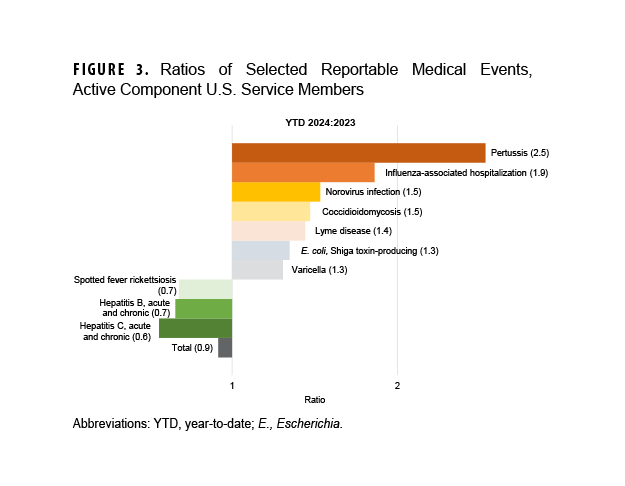
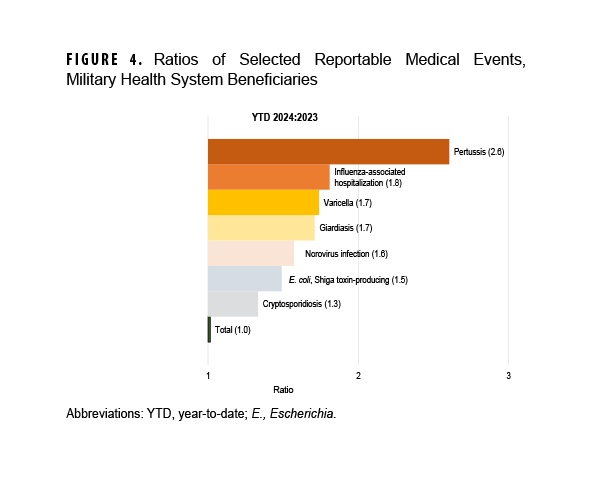
FIGURE 3. Ratios of Selected Reportable Medical Events, Active Component U.S. Service Members. This bar chart presents 11 horizontal bars, with the x axis demarcated by the numbers 1 and 2. The horizontal bars are stacked vertically, from greatest to least, to illustrate the ratios of reportable medical events to one another. Pertussis is the highest and longest bar, representing the greatest ratio to the other conditions, of 2.5. Influenza-associated hospitalization presents the next highest ratio, of 1.9. The next five bars—norovirus, coccidioidomycosis, Lyme disease, Shiga toxin-producing E. coli and varicella—constitute the middle range of ratios, between 1.5 and 1.3. Three bars—spotted fever rickettsiosis, acute and chronic hepatitis B, and acute and chronic hepatitis C—constitute the lower range of ratios, of 0.7 or 0.6. The total ratio is 0.9.FIGURE 4. Ratios of Selected Reportable Medical Events, Military Health System Beneficiaries. This bar chart presents eight horizontal bars, with the x axis demarcated by the numbers 1 and 2. The horizontal bars are stacked vertically, from greatest to least, to illustrate the ratios of reportable medical events to one another. As in the active component population graph, pertussis is the highest and longest bar, representing the greatest ratio to the other conditions, of 2.6. Influenza-associated hospitalization presents the next highest ratio, of 1.8, again comparable to its ratio among the active component population. The next bar, varicella, has a higher ratio, 1.7 than in the active component population, and is nearly tied with giardiasis, which does not appear on the active component graph. The following two bars, norovirus and Shiga toxin-producing E. coli, are again comparable to their ratios in the active component population. The final bar, representing cryptosporidiosis, with a ratio of 1.3, does not appear on the active component graph. The total ratio is 1.0.

For ACSMs, the total number of MERs submitted to DRSi in 2024 decreased by 8.4% compared to 2023. Cases of pertussis and influenza-associated hospitalizations had the most prominent increases in 2024 compared to 2023, with 153% and 86% increases, respectively. Increases of case counts in 2024 were also seen for norovirus infections (53%), coccidioidomycosis (47%), Lyme disease (44%), Shiga toxin-producing E. coli (35%), and varicella (31%) (Figure 3).

Three RMEs decreased among ACSMs in 2024 versus 2023: spotted fever rickettsiosis (-32%), acute and chronic hepatitis B (-34%), and acute and chronic hepatitis C (-44%). 

For MHS beneficiaries, the total number of MERs submitted to DRSi in 2024 increased by 1.6% compared to 2023. Like ACSMs, MHS beneficiaries also saw the most prominent increases for cases of pertussis and influenza-associated hospitalizations in 2024, with 161% and 81% increases, respectively. Increases were also seen for varicella (74%), giardiasis (71%), norovirus infections (57%), Shiga toxin-producing E. coli (49%), and cryptosporidiosis (33%) (Figure 4). There were no substantial decreases in specific RMEs in 2024 versus 2023 for MHS beneficiaries.

Like the DHA-PH, the Centers for Disease Control and Prevention have reported similar trends for increased incidence of pertussis, influenza-associated hospitalizations, and norovirus. According to preliminary CDC data, as of week 52 of 2024 over 6 times as many cases of pertussis had been reported compared to the same period in 2023.2 An increase in influenza-associated hospitalizations was reported during the 2023-2024 influenza season compared to the 2022-2023 influenza season.3 The CDC also noted an increase in norovirus outbreaks between August 1 and December 11, 2024, with 495 outbreaks versus 363 during the same period the preceding year.4

For questions about this report, please contact the Disease Epidemiology Branch at the Defense Centers for Public Health–Aberdeen. Email: dha.apg.pub-health-a.mbx.disease-epidemiologyprogram13@health.mil

Authors' Affiliation

Disease Epidemiology Branch, Defense Centers for Public Health–Aberdeen, MD: Ms. Aguirre, Mr. Allman, Mr. Marquez, Ms. Kotas, Dr. Ambrose

References

  1. Armed Forces Health Surveillance Division. Armed Forces Reportable Medical Events: Guidelines and Case Definitions. Defense Health Agency, U.S. Dept. of Defense. Accessed Feb. 28, 2024. https://health.mil/reference-center/publications/2022/11/01/armed-forces-reportable-medical-events-guidelines 
  2. Centers for Disease Control and Prevention. Pertussis Surveillance and Trends. U.S. Dept. of Health and Human Services. Accessed Jan. 21, 2025. https://www.cdc.gov/pertussis/php/surveillance/index.html 
  3. Centers for Disease Control and Prevention. About Estimated Flu Burden. U.S. Dept. of Health and Human Services. Accessed Jan. 21, 2025. https://www.cdc.gov/flu-burden/php/about/index.html 
  4. Centers for Disease Control and Prevention. NoroSTAT Data. U.S. Dept. of Health and Human Services. Accessed Jan. 21, 2025. https://www.cdc.gov/norovirus/php/reporting/norostat-data.html

You also may be interested in...

Report
Jul 1, 2022

MSMR Vol. 29 No. 07 - July 2022

.PDF | 1.67 MB

A monthly publication of the Armed Forces Health Surveillance Division. This issue of the peer-reviewed journal contains the following articles: Surveillance trends for SARS-CoV-2 and other respiratory pathogens among U.S. Military Health System Beneficiaries, Sept. 27, 2020 – Oct. 2,2021; Establishment of SARS-CoV-2 genomic surveillance within the ...

Article
Jun 1, 2022

Morbidity Burdens Attributable to Various Illnesses and Injuries, Deployed Active and Reserve Component Service Members, U.S. Armed Forces, 2021

As in previous years, among service members deployed during 2021, injury/poisoning, musculoskeletal diseases and signs/symptoms accounted for more than half of the total health care burden during deployment. Compared to garrison disease burden, deployed service members had relatively higher proportions of encounters for respiratory infections, skin ...

Article
Jun 1, 2022

Absolute and Relative Morbidity Burdens Attributable to Various Illnesses and Injuries, Non-service Member Beneficiaries of the Military Health System, 2021

In 2021, mental health disorders accounted for the largest proportions of the morbidity and health care burdens that affected the pediatric and younger adult beneficiary age groups. Among adults aged 45–64 and those aged 65 or older, musculoskeletal diseases accounted for the most morbidity and health care burdens. As in previous years, this report ...

Article
Jun 1, 2022

Absolute and Relative Morbidity Burdens Attributable to Various Illnesses and Injuries, Active Component, U.S. Armed Forces, 2021

In 2021, as in prior years, the medical conditions associated with the most medical encounters, the largest number of affected service members, and the greatest number of hospital days were in the major categories of injuries, musculoskeletal disorders, and mental health disorders. Despite the pandemic, COVID-19 accounted for less than 2% of total ...

Article
Jun 1, 2022

Hospitalizations, Active Component, U.S. Armed Forces, 2021

The hospitalization rate in 2021 was 48.0 per 1,000 person-years (p-yrs), the second lowest rate of the most recent 10 years. For hospitalizations limited to military facilities, the rate in 2021 was the lowest for the entire period. As in prior years, the majority (71.2%) of hospitalizations were associated with diagnoses in the categories of mental ...

Article
Jun 1, 2022

Ambulatory Visits, Active Component, U.S. Armed Forces, 2021

In 2021, the overall numbers and rates of active component service member ambulatory care visits were the highest of any of the last 10 years. Most categories of illness and injury showed modest increases in numbers and rates. The proportions of ambulatory care visits that were accomplished via telehealth encounters fell to under 15% in 2021, compared ...

Article
Jun 1, 2022

Medical Evacuations out of the U.S. Central and U.S. Africa Commands, Active and Reserve Components, U.S. Armed Forces, 2021

The proportions of evacuations out of USCENTCOM that were due to battle injuries declined substantially in 2021. For USCENTCOM, evacuations for mental health disorders were the most common, followed by non-battle injury and poisoning, and signs, symptoms, and ill-defined conditions. For USAFRICOM, evacuations for non-battle injury and poisoning were ...

Article
May 1, 2022

Update: Sexually Transmitted Infections, Active Component, U.S. Armed Forces, 2013–2021

This illustration depicts a 3D computer-generated image of a number of drug-resistant Neisseria gonorrhoeae bacteria. CDC/James Archer

This report summarizes incidence rates of the 5 most common sexually transmitted infections (STIs) among active component service members of the U.S. Armed Forces during 2013–2021. In general, compared to their respective counterparts, younger service members, non-Hispanic Black service members, those who were single and other/unknown marital status, ...

Article
May 1, 2022

The Association Between Two Bogus Items, Demographics, and Military Characteristics in a 2019 Cross-sectional Survey of U.S. Army Soldiers

NIANTIC, CT, UNITED STATES 06.16.2022 U.S. Army Staff Sgt. John Young, an information technology specialist assigned to Joint Forces Headquarters, Connecticut Army National Guard, works on a computer at Camp Nett, Niantic, Connecticut, June 16, 2022. Young provided threat intelligence to cyber analysts that were part of his "Blue Team" during Cyber Yankee, a cyber training exercise meant to simulate a real world environment to train mission essential tasks for cyber professionals. (U.S. Army photo by Sgt. Matthew Lucibello)

Data from surveys may be used to make public health decisions at both the installation and the Department of the Army level. This study demonstrates that a vast majority of soldiers were likely sufficiently engaged and answered both bogus items correctly. Future surveys should continue to investigate careless responding to ensure data quality in ...

Refine your search