Reportable Medical Events at Military Health System Facilities 2024 Annual Review, January 1, 2024–December 31, 2024

Image of 4RMEs. Reportable medical events are recorded in the Disease Reporting System internet by health care providers and public health officials throughout the Military Health System.

This month’s edition of the MSMR Reportable Medical Events at Military Health System facilities feature provides an overview of annual data for 2024 for active component service members and MHS beneficiaries. RMEs are reported in the Disease Reporting System internet by health care providers and public health officials throughout the MHS for monitoring, controlling, and preventing the occurrence and spread of diseases of public health interest. These reports are validated by the Defense Health Agency–Public Health.

The DRSi collects reports on over 70 different RMEs, including infectious and non-infectious conditions, outbreak reports, sexually transmitted infection risk surveys, and tuberculosis contact investigation reports. A complete list of RMEs is available in the 2022 Armed Forces Reportable Medical Events Guidelines and Case Definitions.1 Data reported in this report are considered provisional and do not represent conclusive evidence until case reports are fully validated.

Top 5 RMEs in 2024, by MMWR Week, for ACSMs and MHS Beneficiaries
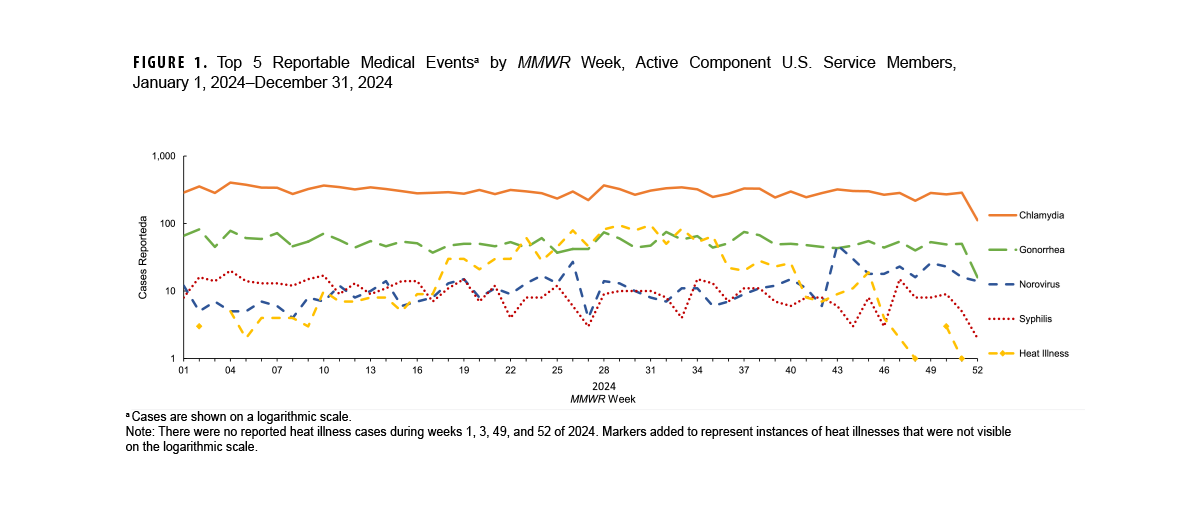
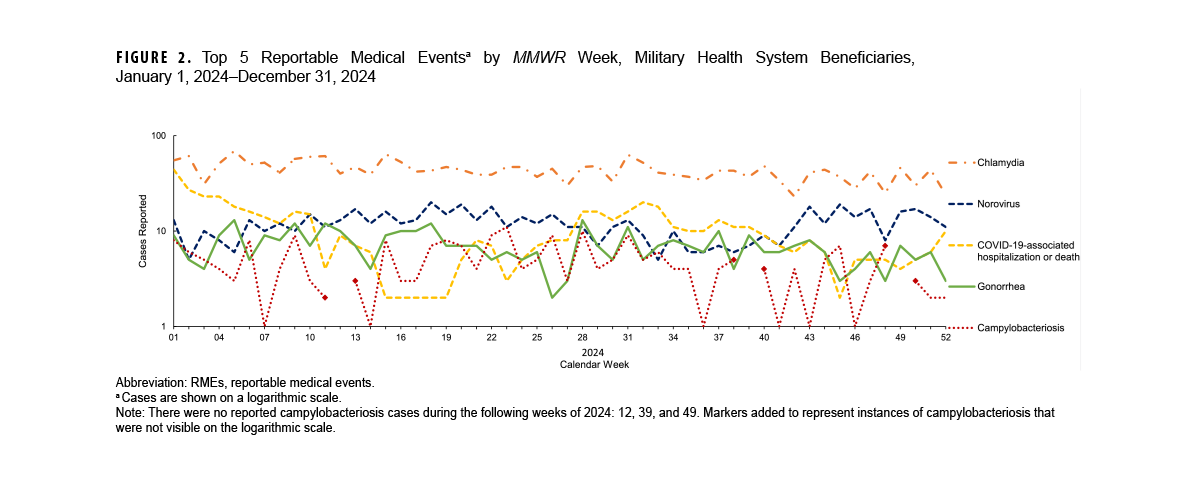
FIGURE 1. Top 5 Reportable Medical Events by MMWR Week Among Active Component U.S. Service Members, January 1, 2024–December 31, 2024. This graph comprises five lines on the horizontal, or x-, axis that depict case counts for the five most frequent reportable medical event conditions among active component service members during 2024. The horizontal, or x-, axis is divided into 52 units of measure, each representing an individual week during the year. The vertical, or y-, axis is presented on a logarithmic scale, in segments of 1 through 10, then 10 through 100, and 100, through 1,000. Chlamydia was the most common reportable medical condition, with counts consistently around 300 cases per week. Gonorrhea was generally the second most common reportable medical event, with cases averaging just below 100 per week, but heat illnesses surpassed gonorrhea for 11 weeks, from week 25 through 35, but then gradually fell again to the lowest position on the graph during the winter months. Norovirus and syphilis cases were generally the third and fourth most common conditions, with the exception of the summer weeks when heat illnesses rose in incidence, averaging around 10 cases per month each. Norovirus and syphilis diverged in the last weeks of the year, with norovirus cases rising in weeks 42 and 43, and remaining slightly elevated for the rest of the year, while syphilis cases declined noticeably in the last two weeks of the year.The top five RMEs reported to DRSi in 2024 are displayed on the following page, by week, for ACSMs and MHS beneficiaries. The top five RMEs reported for ACSMs were chlamydia, gonorrhea, norovirus, heat illness, and syphilis (Figure 1). Among MHS beneficiaries, the top five RMEs reported were chlamydia, norovirus, COVID-19-associated hospitalization or death, gonorrhea, and campylobacteriosis (Figure 2). FIGURE 2. Top 5 Reportable Medical Events by MMWR Week Among Military Health System Beneficiaries, January 1, 2024–December 31, 2024. This graph comprises five lines on the horizontal, or x-, axis that depict case counts for the five most frequent reportable medical event conditions among Military Health system beneficiaries during 2024. The horizontal, or x-, axis is divided into 52 units of measure, each representing an individual week during the year. The vertical, or y-, axis is presented on a logarithmic scale, in two segments, of one through 10, then 10 through 100. As in the active component population, chlamydia was the most common reportable medical condition, but with lower counts, just above 50 cases per week. Norovirus was generally the second most common condition, averaging around 10 cases per week. COVID-19-associated hospitalization or death showed the greatest variability, beginning the year as the second most common condition, with numbers slightly below those of chlamydia, but falling gradually to become the lowest position on the graph by week 15. COVID-19-associated hospitalization or death remained the lowest-charting condition for five weeks until rising again to regain the second highest position by week 28, where it remained until week 40, but at lower numbers than before, between 10 and 20 cases per week. During the last 10 weeks of the year COVID-19-associated hospitalization or death showed high variability but ended the year nearly tied with norovirus as the second highest condition. Gonorrhea case numbers were somewhat lower than those of norovirus, generally between five and 10 throughout the year. Campylobacteriosis was generally the lowest charting condition on the graph, fluctuating between zero and 10 cases throughout the year.
Ratios of RMEs for 2024 Compared to 2023 for ACSMs and MHS Beneficiaries

The current ratio data are based on incidence counts comparing year 2024 to 2023; low numbers for many conditions limit data interpretation and are not included in the figures. Conditions with less than 10 medical event reports per year, as well as COVID-19-associated hospitalizations and deaths, and syphilis, were excluded from the ratio comparisons. COVID-19-associated hospitalizations and deaths were excluded due to changes in the case definition in May 2023; syphilis cases were excluded due to changes in case validation processes implemented in January 2024. Ratios presented in Figures 3 and 4 include any RMEs that had, at minimum, a 30% increase or decrease in MERs in 2024 compared to MERs in 2023.
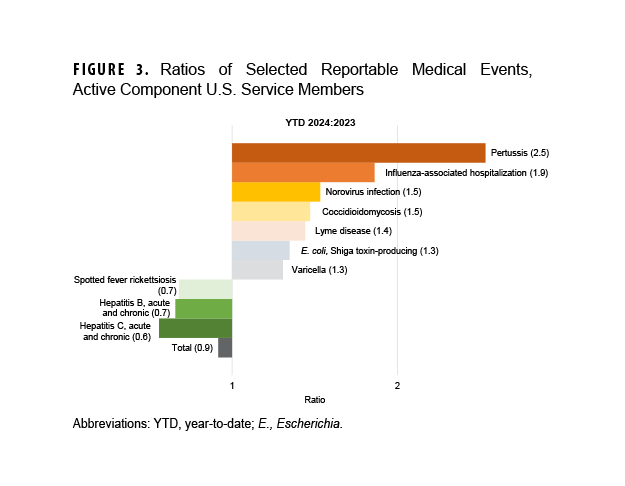
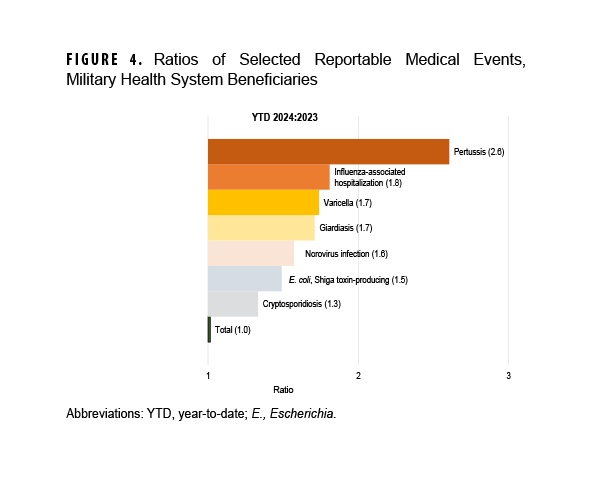
FIGURE 3. Ratios of Selected Reportable Medical Events, Active Component U.S. Service Members. This bar chart presents 11 horizontal bars, with the x axis demarcated by the numbers 1 and 2. The horizontal bars are stacked vertically, from greatest to least, to illustrate the ratios of reportable medical events to one another. Pertussis is the highest and longest bar, representing the greatest ratio to the other conditions, of 2.5. Influenza-associated hospitalization presents the next highest ratio, of 1.9. The next five bars—norovirus, coccidioidomycosis, Lyme disease, Shiga toxin-producing E. coli and varicella—constitute the middle range of ratios, between 1.5 and 1.3. Three bars—spotted fever rickettsiosis, acute and chronic hepatitis B, and acute and chronic hepatitis C—constitute the lower range of ratios, of 0.7 or 0.6. The total ratio is 0.9.FIGURE 4. Ratios of Selected Reportable Medical Events, Military Health System Beneficiaries. This bar chart presents eight horizontal bars, with the x axis demarcated by the numbers 1 and 2. The horizontal bars are stacked vertically, from greatest to least, to illustrate the ratios of reportable medical events to one another. As in the active component population graph, pertussis is the highest and longest bar, representing the greatest ratio to the other conditions, of 2.6. Influenza-associated hospitalization presents the next highest ratio, of 1.8, again comparable to its ratio among the active component population. The next bar, varicella, has a higher ratio, 1.7 than in the active component population, and is nearly tied with giardiasis, which does not appear on the active component graph. The following two bars, norovirus and Shiga toxin-producing E. coli, are again comparable to their ratios in the active component population. The final bar, representing cryptosporidiosis, with a ratio of 1.3, does not appear on the active component graph. The total ratio is 1.0.

For ACSMs, the total number of MERs submitted to DRSi in 2024 decreased by 8.4% compared to 2023. Cases of pertussis and influenza-associated hospitalizations had the most prominent increases in 2024 compared to 2023, with 153% and 86% increases, respectively. Increases of case counts in 2024 were also seen for norovirus infections (53%), coccidioidomycosis (47%), Lyme disease (44%), Shiga toxin-producing E. coli (35%), and varicella (31%) (Figure 3).

Three RMEs decreased among ACSMs in 2024 versus 2023: spotted fever rickettsiosis (-32%), acute and chronic hepatitis B (-34%), and acute and chronic hepatitis C (-44%). 

For MHS beneficiaries, the total number of MERs submitted to DRSi in 2024 increased by 1.6% compared to 2023. Like ACSMs, MHS beneficiaries also saw the most prominent increases for cases of pertussis and influenza-associated hospitalizations in 2024, with 161% and 81% increases, respectively. Increases were also seen for varicella (74%), giardiasis (71%), norovirus infections (57%), Shiga toxin-producing E. coli (49%), and cryptosporidiosis (33%) (Figure 4). There were no substantial decreases in specific RMEs in 2024 versus 2023 for MHS beneficiaries.

Like the DHA-PH, the Centers for Disease Control and Prevention have reported similar trends for increased incidence of pertussis, influenza-associated hospitalizations, and norovirus. According to preliminary CDC data, as of week 52 of 2024 over 6 times as many cases of pertussis had been reported compared to the same period in 2023.2 An increase in influenza-associated hospitalizations was reported during the 2023-2024 influenza season compared to the 2022-2023 influenza season.3 The CDC also noted an increase in norovirus outbreaks between August 1 and December 11, 2024, with 495 outbreaks versus 363 during the same period the preceding year.4

For questions about this report, please contact the Disease Epidemiology Branch at the Defense Centers for Public Health–Aberdeen. Email: dha.apg.pub-health-a.mbx.disease-epidemiologyprogram13@health.mil

Authors' Affiliation

Disease Epidemiology Branch, Defense Centers for Public Health–Aberdeen, MD: Ms. Aguirre, Mr. Allman, Mr. Marquez, Ms. Kotas, Dr. Ambrose

References

  1. Armed Forces Health Surveillance Division. Armed Forces Reportable Medical Events: Guidelines and Case Definitions. Defense Health Agency, U.S. Dept. of Defense. Accessed Feb. 28, 2024. https://health.mil/reference-center/publications/2022/11/01/armed-forces-reportable-medical-events-guidelines 
  2. Centers for Disease Control and Prevention. Pertussis Surveillance and Trends. U.S. Dept. of Health and Human Services. Accessed Jan. 21, 2025. https://www.cdc.gov/pertussis/php/surveillance/index.html 
  3. Centers for Disease Control and Prevention. About Estimated Flu Burden. U.S. Dept. of Health and Human Services. Accessed Jan. 21, 2025. https://www.cdc.gov/flu-burden/php/about/index.html 
  4. Centers for Disease Control and Prevention. NoroSTAT Data. U.S. Dept. of Health and Human Services. Accessed Jan. 21, 2025. https://www.cdc.gov/norovirus/php/reporting/norostat-data.html

You also may be interested in...

Report
Oct 1, 2022

MSMR Vol. 29 No. 10 - October 2022

.PDF | 1.41 MB

A monthly publication of the Armed Forces Health Surveillance Division. This issue of the peer-reviewed journal contains the following articles: Surveillance trends for SARS-CoV-2 and other respiratory pathogens among U.S. Military Health System Beneficiaries, Sept. 27, 2020 – Oct. 2,2021; Establishment of SARS-CoV-2 genomic surveillance within the ...

Article
Sep 1, 2022

Brief Report: Menstrual Suppression Among U.S. Female Service Members in the Millennium Cohort Study

U.S. Marine Corps Lance Cpl. Bobby Brodeur, a Gilford, New Hampshire, native and machine gunner with 3rd Battalion, 6th Marine Regiment, 2d Marine Division, conducts gun drills at Camp Lejeune, North Carolina, Oct. 13, 2022. Brodeur is currently serving as a machine gunner with 3/6 and is one of three female infantry Marines in Kilo Co. She has demonstrated an unwavering commitment to 3/6 through her high physical fitness scores and leading by example within the platoon. (U.S. Marine Corps photo by Lance Cpl. Megan Ozaki)

Menstrual suppression allows for the control or complete suppression of menstrual periods through hormonal contraceptive methods. In addition to preventing pregnancy, suppression can alleviate medical conditions and symptoms associated with menstruation such as iron deficiency anemia,1 eliminate logistical hygiene-related challenges, and improve ...

Article
Sep 1, 2022

Update: Routine Screening for Antibodies to Human Immunodeficiency Virus, U.S. Armed Forces, Active and Reserve Components, January 2017–June 2022

NAVAL MEDICAL CENTER CAMP LEJEUNE, North Carolina - As the leading petty officer for Naval Medical Center Camp Lejeune's Community Health Clinic, HM2 Kameron Jacobs is part of the first satellite team to treat service members living with HIV.

This report provides an update through June 2022 of routine screening results for antibodies to the human immunodeficiency virus (HIV) among members of the active and reserve components of the U.S. Armed Forces. During the full 5 and 1/2-year surveillance period, the HIV seropositivity rates for active component service members were 0.21 positives per ...

Article
Sep 1, 2022

Evaluation of the MSMR Surveillance Case Definition for Incident Cases of Hepatitis C

U.S. Marine Corps Lance Cpl. Angel Alvarado, a combat graphics specialist, donates blood for the Armed Services Blood Program (ASBP).

The validity of military hepatitis C virus (HCV) surveillance data is uncertain due to the potential for misclassification introduced when using administrative databases for surveillance purposes. The objectives of this study were to assess the validity of the surveillance case definition used by the Medical Surveillance Monthly Report (MSMR) for HCV ...

Report
Sep 1, 2022

MSMR Vol. 29 No. 09 - September 2022

.PDF | 2.12 MB

A monthly publication of the Armed Forces Health Surveillance Division. This issue of the peer-reviewed journal contains the following articles: Surveillance trends for SARS-CoV-2 and other respiratory pathogens among U.S. Military Health System Beneficiaries, Sept. 27, 2020 – Oct. 2,2021; Establishment of SARS-CoV-2 genomic surveillance within the ...

Article
Aug 1, 2022

Brief Report: Pain and Post-Traumatic Stress Disorder Screening Outcomes Among Military Personnel Injured During Combat Deployment.

U.S. Air Force Airman 1st Class Miranda Lugo, right, 18th Operational Medical Readiness Squadron mental health technician and Guardian Wingman trainer, and Maj. Joanna Ho, left, 18th OMRS director of psychological health, discuss the suicide prevention training program, Guardian Wingman, at Kadena Air Base, Japan, Aug. 20, 2021. Guardian Wingman aims to promote wingman culture and early help-seeking behavior. (U.S. Air Force photo by Airman 1st Class Anna Nolte)

The post-9/11 U.S. military conflicts in Iraq and Afghanistan lasted over a decade and yielded the most combat casualties since the Vietnam War. While patient survivability increased to the high­est level in history, a changing epidemiology of combat injuries emerged whereby focus shifted to addressing an array of long-term sequelae, including ...

Article
Aug 1, 2022

Musculoskeletal Injuries During U.S. Air Force Special Warfare Training Assessment and Selection, Fiscal Years 2019–2021.

U.S. Air Force Capt. Hopkins, 351st Special Warfare Training Squadron, Instructor Flight commander and Chief Combat Rescue Officer (CRO) instructor, conducts a military free fall equipment jump from a DHC-4 Caribou aircraft in Coolidge, Arizona, July 17, 2021. Hopkins is recognized as the 2020 USAF Special Warfare Instructor Company Grade Officer of the Year for his outstanding achievement from January 1 to December 31, 2020.

Musculoskeletal (MSK) injuries are costly and the leading cause of medical visits and disability in the U.S. military.1,2 Within training envi­ronments, MSK injuries may lead to a loss of training, deferment to a future class, or voluntary disenrollment from a training pipeline, all of which are impediments to maintaining full levels of manpower and ...

Report
Aug 1, 2022

MSMR Vol. 29 No. 08 - August 2022

.PDF | 822.83 KB

A monthly publication of the Armed Forces Health Surveillance Division. This issue of the peer-reviewed journal contains the following articles: Surveillance trends for SARS-CoV-2 and other respiratory pathogens among U.S. Military Health System Beneficiaries, Sept. 27, 2020 – Oct. 2,2021; Establishment of SARS-CoV-2 genomic surveillance within the ...

Article
Jul 1, 2022

Establishment of SARS-CoV-2 Genomic Surveillance Within the Military Health System During 1 March–31 December 2020.

Dr. Peter Larson loads an Oxford Nanopore MinION sequencer in support of COVID-19 sequencing assay development at the U.S. Army Medical Research Institute of Infectious Diseases, Fort Detrick, Maryland. (Photo by John Braun Jr., USAMRIID.)

This report describes SARS-CoV-2 genomic surveillance conducted by the Department of Defense (DOD) Global Emerging Infections Surveillance Branch and the Next-Generation Sequencing and Bioinformatics Consortium (NGSBC) in response to the COVID-19 pandemic. Samples and sequence data were from SARS-CoV-2 infections occurring among Military Health System ...

Article
Jul 1, 2022

Surveillance Trends for SARS-CoV-2 and Other Respiratory Pathogens Among U.S. Military Health System Beneficiaries, 27 September 2020–2 October 2021.

Staff Sgt. Misty Poitra and Senior Airman Chris Cornette, 119th Medical Group, collect throat swabs during voluntary COVID-19 rapid drive-thru testing for members of the community while North Dakota Army National Guard Soldiers gather test-subject data in the parking lot of the FargoDome in Fargo, N.D., May 3, 2020. The guardsmen partnered with the N.D. Department of Health and other civilian agencies in the mass-testing efforts of community volunteers. (U.S. Air National Guard photo by Chief Master Sgt. David H. Lipp)

Respiratory pathogens, such as influenza and adenovirus, have been the main focus of the Department of Defense Global Respiratory Pathogen Surveillance Program (DoDGRPSP) since 1976.1. However, DoDGRPSP also began focusing on SARS-CoV-2 when COVID-19 was declared a pandemic illness in early March 2020.2. Following this declaration, the DOD quickly ...

Article
Jul 1, 2022

Suicide Behavior Among Heterosexual, Lesbian/Gay, and Bisexual Active Component Service Members in the U.S. Armed Forces.

  The DOD’s theme for National Suicide Prevention Month is “Connect to Protect: Support is Within Reach.” Deployments, COVID-19 restrictions, and the upcoming winter season are all stressors and potential causes for depression that could lead to suicidal ideations. Options are available to individuals who are having thoughts of suicide and those around them (Photo by Kirk Frady, Regional Health Command Europe).

Lesbian, gay, and bisexual (LGB) individuals are at a particularly high risk for suicidal behavior in the general population of the United States. This study aims to determine if there are differences in the frequency of lifetime suicide ideation and suicide attempts between heterosexual, lesbian/gay, and bisexual service members in the active ...

Article
Jul 1, 2022

Brief Report: Phase I Results Using the Virtual Pooled Registry Cancer Linkage System (VPR-CLS) for Military Cancer Surveillance.

A patient at Naval Hospital Pensacola prepares to have a low-dose computed tomography test done to screen for lung cancer. Lung cancer is the leading cause of cancer-related deaths among men and women. Early detection can lower the risk of dying from this disease. (U.S. Navy photo by Jason Bortz)

The Armed Forces Health Surveillance Division, as part of its surveillance mission, periodically conducts studies of cancer incidence among U.S. military service members. However, service members are likely lost to follow-up from the Department of Defense cancer registry and Military Health System data sets after leaving service and during periods of ...

Refine your search