This Surveillance Snapshot provides an overview of the 2023-2024 mid-season analysis of influenza VE against influenza hospitalizations among ACSMs. Data from the DMSS and standardized laboratory data provided by DCPH–Portsmouth were utilized for this analysis.1 A cohort study design was implemented among the population of ACSMs in service at any time between September 1, 2023 and February 14, 2024.
The outcome was defined as a laboratory-confirmed influenza-positive result (rapid antigen, RT-PCR, or culture influenza assay) with an indication that the individual was hospitalized, or a hospitalization record with the first or second diagnostic International Classification of Diseases, 10th revision code for influenza (J09-J11). Person-time started at the beginning of the surveillance period or entry into active component service (whichever came last) and was censored at either the occurrence of the outcome, end of the surveillance period, or leaving active component or military service (whichever came first). Person-time and outcomes were stratified by vaccination status. Person-time and outcomes occurring prior to vaccination and up to 13 days post-vaccination were defined as unvaccinated. Person-time and outcomes occurring at least 14 days after vaccination were defined as vaccinated. Analyses were conducted for laboratory-confirmed influenza hospitalizations alone and then combined with hospitalization records for influenza. Incidence rates per 100,000 person-years (p-yrs) were calculated and a Poisson regression model was used to calculate adjusted incidence rate ratios (adjusted for sex, age category, prior vaccination [any influenza vaccine within previous five years], and month of diagnosis) and 95% CIs. VE was defined as (1 - OR) x 100.
There were 47 laboratory-confirmed influenza hospitalizations among ACSMs during the study period. An additional 17 influenza hospitalization records were identified using the encounter data. For both outcomes, the incidence rate of influenza hospitalization among unvaccinated ACSMs was twice the rate of vaccinated ACSMs (lab-confirmed only: 1.0 vs. 0.5 per 100,000 p-yrs; lab-confirmed and hospitalization records: 1.4 vs. 0.7 per 100,000 p-yrs) (Table). Likewise, the adjusted analysis resulted in VE estimates of 46% (95% CI: 2, 70) and 54% (95% CI: 12, 72) for the laboratory-confirmed only and laboratory-confirmed with hospitalization records, respectively.
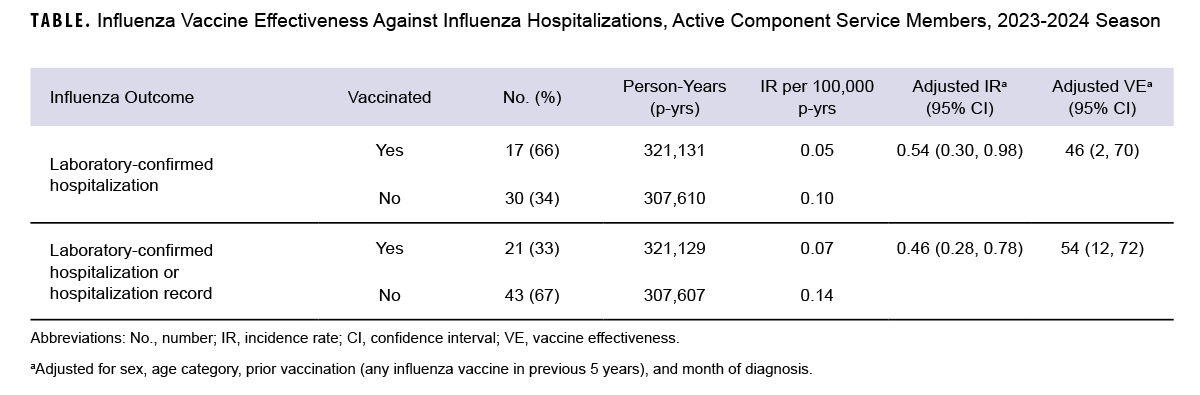
The results of this analysis show moderate protection against hospitalization for influenza among ACSMs from the 2023-2024 seasonal influenza vaccines. Although the number of outcomes are small, the analysis still reached statistical significance and provides data supporting the use of influenza vaccines among typically healthy ACSMs to prevent influenza hospitalizations.
Reference
- Rubertone MV, Brundage JF. The Defense Medical Surveillance System and the Department of Defense serum repository: glimpses of the future of public health surveillance. Am J Public Health. 2002;92(12):1900-1904. doi:10.2105/ajph.92.12.1900