2023-2024 Mid-Season Influenza Vaccine Effectiveness Against Laboratory-Confirmed Influenza Hospitalizations: U.S. Active Component Service Members

Image of 48088663. This report provides data supporting use of influenza vaccines among typically healthy service members to prevent influenza hospitalization.

This Surveillance Snapshot provides an overview of the 2023-2024 mid-season analysis of influenza VE against influenza hospitalizations among ACSMs. Data from the DMSS and standardized laboratory data provided by DCPH–Portsmouth were utilized for this analysis.1 A cohort study design was implemented among the population of ACSMs in service at any time between September 1, 2023 and February 14, 2024. 

The outcome was defined as a laboratory-confirmed influenza-positive result (rapid antigen, RT-PCR, or culture influenza assay) with an indication that the individual was hospitalized, or a hospitalization record with the first or second diagnostic International Classification of Diseases, 10th revision code for influenza (J09-J11). Person-time started at the beginning of the surveillance period or entry into active component service (whichever came last) and was censored at either the occurrence of the outcome, end of the surveillance period, or leaving active component or military service (whichever came first). Person-time and outcomes were stratified by vaccination status. Person-time and outcomes occurring prior to vaccination and up to 13 days post-vaccination were defined as unvaccinated. Person-time and outcomes occurring at least 14 days after vaccination were defined as vaccinated. Analyses were conducted for laboratory-confirmed influenza hospitalizations alone and then combined with hospitalization records for influenza. Incidence rates per 100,000 person-years (p-yrs) were calculated and a Poisson regression model was used to calculate adjusted incidence rate ratios (adjusted for sex, age category, prior vaccination [any influenza vaccine within previous five years], and month of diagnosis) and 95% CIs. VE was defined as (1 - OR) x 100. 

There were 47 laboratory-confirmed influenza hospitalizations among ACSMs during the study period. An additional 17 influenza hospitalization records were identified using the encounter data. For both outcomes, the incidence rate of influenza hospitalization among unvaccinated ACSMs was twice the rate of vaccinated ACSMs (lab-confirmed only: 1.0 vs. 0.5 per 100,000 p-yrs; lab-confirmed and hospitalization records: 1.4 vs. 0.7 per 100,000 p-yrs) (Table). Likewise, the adjusted analysis resulted in VE estimates of 46% (95% CI: 2, 70) and 54% (95% CI: 12, 72) for the laboratory-confirmed only and laboratory-confirmed with hospitalization records, respectively. 
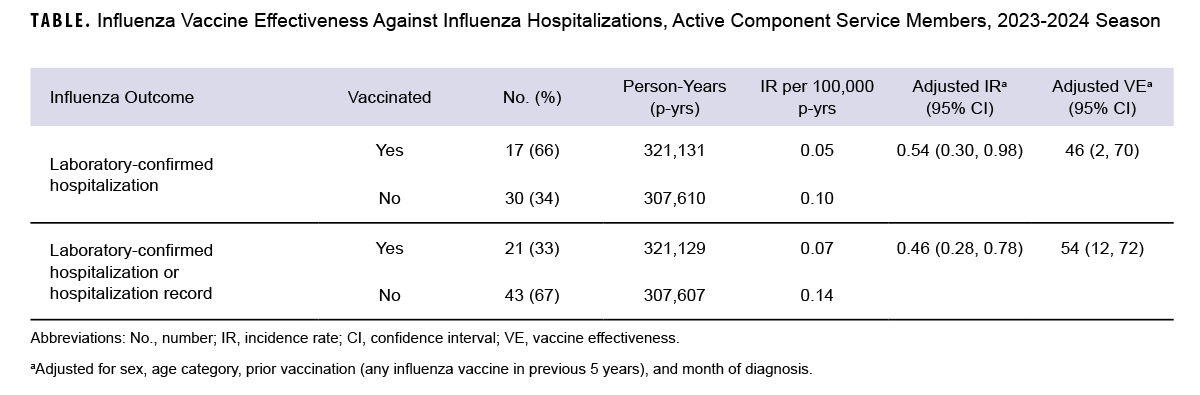
Click on the table to access a 508-compliant PDF version

The results of this analysis show moderate protection against hospitalization for influenza among ACSMs from the 2023-2024 seasonal influenza vaccines. Although the number of outcomes are small, the analysis still reached statistical significance and provides data supporting the use of influenza vaccines among typically healthy ACSMs to prevent influenza hospitalizations. 

Reference

  1. Rubertone MV, Brundage JF. The Defense Medical Surveillance System and the Department of Defense serum repository: glimpses of the future of public health surveillance. Am J Public Health. 2002;92(12):1900-1904. doi:10.2105/ajph.92.12.1900

You also may be interested in...

Article
Feb 1, 2025

Surveillance Snapshot: Non-Hodgkin Lymphoma Incidence in Active Component U.S. Service Members, 2017–2023

This analysis utilizes an updated case definition for non-Hodgkin lymphoma developed by the Armed Forces Health Surveillance Division, based on consultation with subject matter experts and previous literature, to establish non-Hodgkin lymphoma incidence within the U.S. Armed Forces active component, from 2017 through 2023.

Article
Feb 1, 2025

Development of a New Fleet Disease and Injury Surveillance Capability Using ESSENCE

This report details the steps taken to develop a timely, accurate, and comprehensive Navy fleet disease and injury surveillance capability, utilizing ESSENCE (Electronic Surveillance System for the Early Notification of Community-based Epidemics), including the successes and challenges that will guide further refinement and expansion of this tool.

Article
Feb 1, 2025

External Cause Coding of Injury Encounters in the Military Health System Among Active Component U.S. Service Members, 2016–2019

Knowledge of injury causes is essential for prevention. This article describes causes of injury for all U.S. service members, from 2016 through 2019, and identifies variations in injury cause coding over time, and by branch of military service, type of health care visit and facility, and diagnosis category.

Article
Jan 1, 2025

Use of Positive Predictive Value to Evaluate the Armed Forces Health Surveillance Division Brain Cancer Incidence Rules, Active Component Department of the Air Force Pediatric Dependent Population, January 1, 2010–December 31, 2020

This study applied the Armed Forces Health Surveillance Division (AFHSD) case definition for the identification of malignant brain tumors among U.S. active service members to the dependent pediatric population of the active component of the U.S. Air Force, to determine the positive predictive value of this case definition for a pediatric population.

Article
Dec 1, 2024

Syphilis Cases Among Pregnant Women and Newborns in the Military Health System, 2012–2022

This report presents the rates of maternal syphilis among pregnant women and congenital syphilis among newborns in the Military Health System beneficiary population from 2012 to 2022. Between 2012 and 2021, cases of congenial syphilis in the U.S. increased by 755%, and rates of maternal and congenital syphilis within the Military Health System ...

Article
Dec 1, 2024

Post-Acute Sequelae of SARS-CoV-2 and Kidney Events in U.S. Active Component Service Members, March 1, 2020–September 30, 2022

This study assessed the incidence and incidence rate ratio of selected kidney events among U.S. active component service members that occurred from 31 days to six months after a COVID-19 test. Early evidence suggests that COVID-19 is linked to kidney-related events in older and hospitalized patients but has not been examined among a younger, healthy ...

Refine your search