The Return of Reportable Medical Events Summaries to MSMR

Image of RMEs. Reportable Medical Events provide an important data resource, to guide efforts for controlling and preventing diseases with potential measurable impacts on public health and force readiness.

MSMR is pleased to announce the return of a recurring feature, a summary of reportable medical events (RMEs) affecting DOD service members and other MHS beneficiaries. Sentinel RME summaries were a regular feature of MSMR until 2010. The MSMR editors welcome reader comments on the format and content of these summaries as we seek to expand the usefulness of the journal.

RMEs are documented in the Disease Reporting System internet (DRSi) by health care providers and public health officials throughout the Military Health System (MHS). The DRSi collects reports on over 70 different RMEs, including infectious and non-infectious conditions, outbreak reports, STI risk surveys, and tuberculosis contact investigations. These reports are reviewed by each service’s public health surveillance hub, which serves as an active primary prevention component to identify other service members at risk, assess need for post-exposure screening and prophylaxis, or inform other actions to protect and assure public health. Primary prevention (reducing disease occurrence) is the most effective method for preserving the medical readiness of the force. 

Routine monitoring, evaluation, and publication of RMEs provide an important data resource for both policymakers and commanders, to guide their efforts for controlling and preventing diseases with potential measurable impacts on public health and force readiness—strategic, operational, and tactical. RMEs were chosen by consensus and recommendations from each service, which evaluated lists of nationally-notifiable diseases from the Centers for Disease Control and Prevention, position statements from the Council of State and Territorial Epidemiologists, and other events identified as significant military health threats meriting added surveillance. A complete list of RMEs is available in the 2022 Armed Forces Reportable Medical Events Guidelines and Case Definitions.1 

The data presented in the Table not only list the most recent case counts but reveal trends of incidence for the past 2 months, year-to-date, and throughout the preceding year. Data reported in the Table are considered provisional and do not represent conclusive evidence until case reports are fully validated.
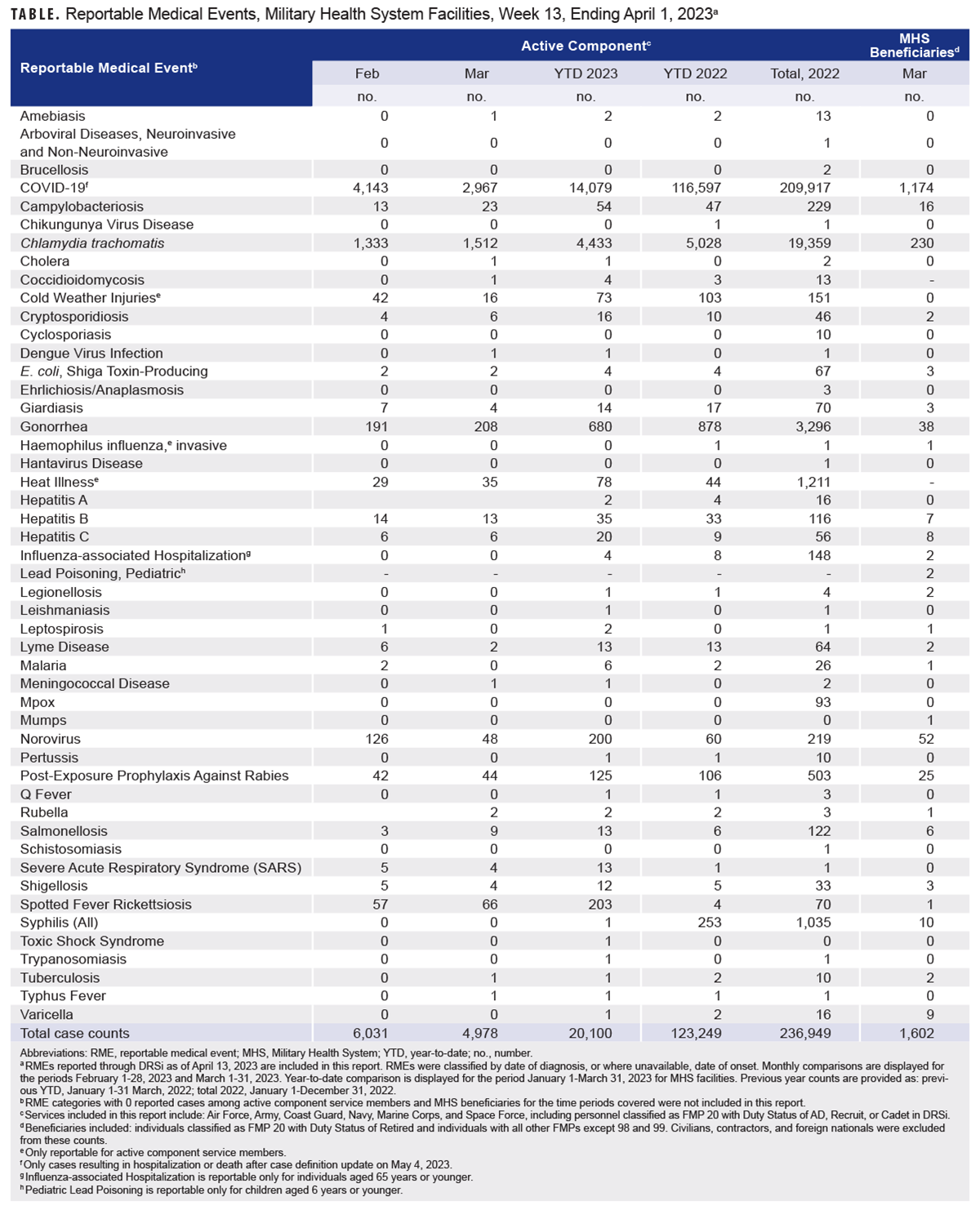
Click on the table to access a 508-compatible PDF version

The most recent data on the 5 most frequent RMEs among total active component cases, as reported per week during the preceding year, are depicted in the Top 5 RME Trends by Calendar Week graph. COVID-19 is excluded from the graph due to 2023 changes in reporting and case definitions.
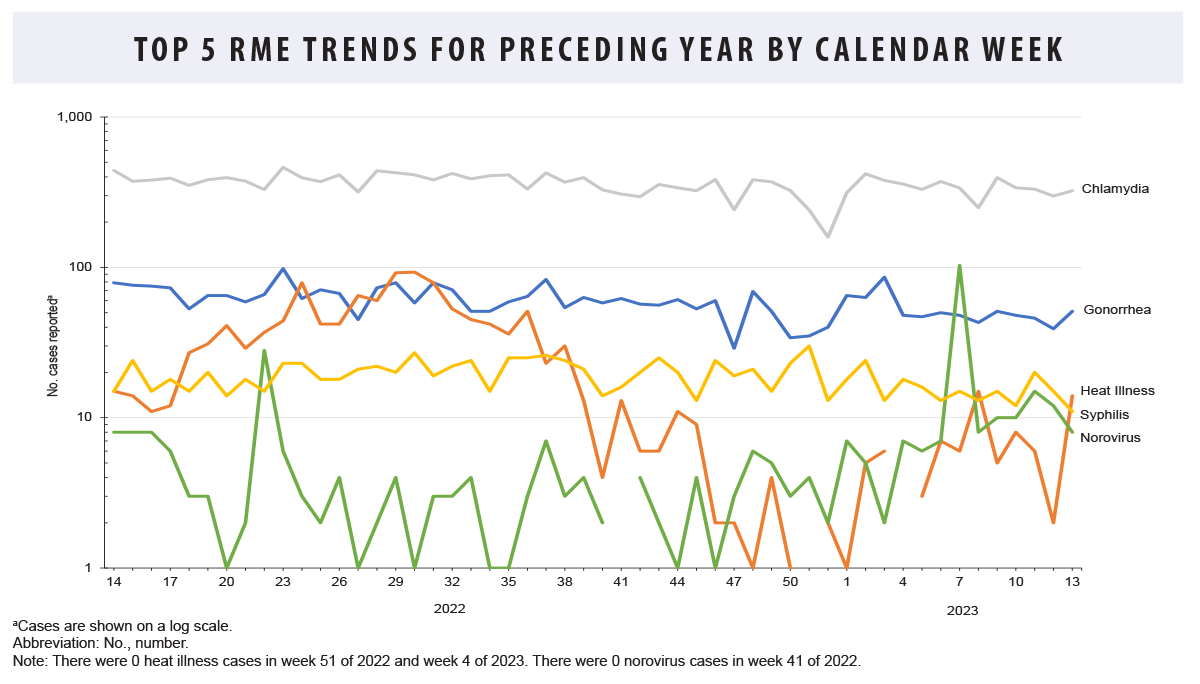
This horizontal line graph depicts by case count the 5 most frequent reportable medical conditions (or events) among active component service members over the past 52 weeks. Chlamydia was the most common reportable medical condition, with counts of approximately 300 cases per week. Gonorrhea was the second-most common reported disease, averaging approximately 80 cases per week. Gonorrhea was surpassed by heat illnesses in weeks 24, 27, 29, and 30 of 2022, and by norovirus in week 7 of 2023. Syphilis and heat illnesses alternated as the third and fourth most-common reported diseases, with case counts averaging approximately 20 per week. Norovirus rounded out the top 5, averaging between 1 and 8 cases per week.

Top 5 RME trends for preceding Year by Calendar Week. This line graph depicts the top 5 reportable medical conditions by case count among active component service members over the past 52 weeks. Chlamydia was the most common with counts of approximately 300 cases per week. Gonorrhea was the second-most common reported disease, averaging approximately 80 cases per week. Gonorrhea was surpassed by heat illnesses in weeks 24, 27, 29, and 30 of 2022, and by norovirus in week 7 of 2023. Syphilis and heat illnesses alternated as the third and fourth most-common reported diseases, with case counts averaging approximately 20 per week. Norovirus rounded out the top 5, averaging between 1 and 8 cases per week.

You also may be interested in...

Article
Dec 1, 2024

Post-Acute Sequelae of SARS-CoV-2 and Kidney Events in U.S. Active Component Service Members, March 1, 2020–September 30, 2022

This study assessed the incidence and incidence rate ratio of selected kidney events among U.S. active component service members that occurred from 31 days to six months after a COVID-19 test. Early evidence suggests that COVID-19 is linked to kidney-related events in older and hospitalized patients but has not been examined among a younger, healthy ...

Article
Nov 14, 2024

Global Emerging Infections Surveillance Capability Highlighted In Supplemental Issue of Emerging Infectious Disease Journal

The Defense Health Agency-Public Health Armed Forces Health Surveillance Division partnered with the Centers for Disease Control and Prevention on the release of a global emerging infectious disease supplement for the November 2024 issue of Emerging Infectious Diseases.

The Defense Health Agency-Public Health Armed Forces Health Surveillance Division’s Global Emerging Infections Surveillance program partnered with the Centers for Disease Control and Prevention on the release of a global emerging infectious disease supplement for the November 2024 issue of Emerging Infectious Diseases.

Article
Nov 1, 2024

Trends of Ischemic Heart Disease and Cerebrovascular Disease in Active Component Female Service Members, 2014–2023

Female-specific risk factors, including mental health, for ischemic heart and cerebrovascular diseases have only recently been recognized. This study summarizes trends from 2014 through 2023 in the incidence of ischemic heart disease and cerebrovascular heart disease among U.S. active component female service members and identifies potential military ...

Article
Nov 1, 2024

Cold Weather Injuries Among the Active and Reserve Components of the U.S. Armed Forces, July 2019–June 2024

Since 2004, MSMR has published annual updates on the incidence of cold weather injuries affecting U.S. Armed Force members for the five most recent cold seasons. Cold weather injuries are of significant military concern due to potential effects on service members (e.g., morbidity and potential disability) and the total force (e.g., adverse impacts on ...

Article
Oct 1, 2024

Update: Routine Screening for Antibodies to Human Immunodeficiency Virus in the U.S. Armed Forces, Active and Reserve Components, January 2019–June 2024

This annual report summarizes numbers and trends of newly identified HIV-antibody seropositivity, from January 1, 2019 through June 30, 2024, among military members of five services under the active and reserve components of the U.S. Armed Forces, in addition to the Army and Air Force National Guard.

Article
Oct 1, 2024

Guest Editorial: Health Policy Analysis: Improving HIV PrEP Implementation to Help End the HIV Epidemic in the U.S. Military

This guest editorial presents a policy analysis that suggests HIV PrEP coverage in the Military Health System remains suboptimal, and evaluates several available interventions could result in substantial increases in PrEP coverage that could further reduce new service member HIV infections and increase medical readiness.

Refine your search