The Return of Reportable Medical Events Summaries to MSMR

Image of RMEs. Reportable Medical Events provide an important data resource, to guide efforts for controlling and preventing diseases with potential measurable impacts on public health and force readiness.

MSMR is pleased to announce the return of a recurring feature, a summary of reportable medical events (RMEs) affecting DOD service members and other MHS beneficiaries. Sentinel RME summaries were a regular feature of MSMR until 2010. The MSMR editors welcome reader comments on the format and content of these summaries as we seek to expand the usefulness of the journal.

RMEs are documented in the Disease Reporting System internet (DRSi) by health care providers and public health officials throughout the Military Health System (MHS). The DRSi collects reports on over 70 different RMEs, including infectious and non-infectious conditions, outbreak reports, STI risk surveys, and tuberculosis contact investigations. These reports are reviewed by each service’s public health surveillance hub, which serves as an active primary prevention component to identify other service members at risk, assess need for post-exposure screening and prophylaxis, or inform other actions to protect and assure public health. Primary prevention (reducing disease occurrence) is the most effective method for preserving the medical readiness of the force. 

Routine monitoring, evaluation, and publication of RMEs provide an important data resource for both policymakers and commanders, to guide their efforts for controlling and preventing diseases with potential measurable impacts on public health and force readiness—strategic, operational, and tactical. RMEs were chosen by consensus and recommendations from each service, which evaluated lists of nationally-notifiable diseases from the Centers for Disease Control and Prevention, position statements from the Council of State and Territorial Epidemiologists, and other events identified as significant military health threats meriting added surveillance. A complete list of RMEs is available in the 2022 Armed Forces Reportable Medical Events Guidelines and Case Definitions.1 

The data presented in the Table not only list the most recent case counts but reveal trends of incidence for the past 2 months, year-to-date, and throughout the preceding year. Data reported in the Table are considered provisional and do not represent conclusive evidence until case reports are fully validated.
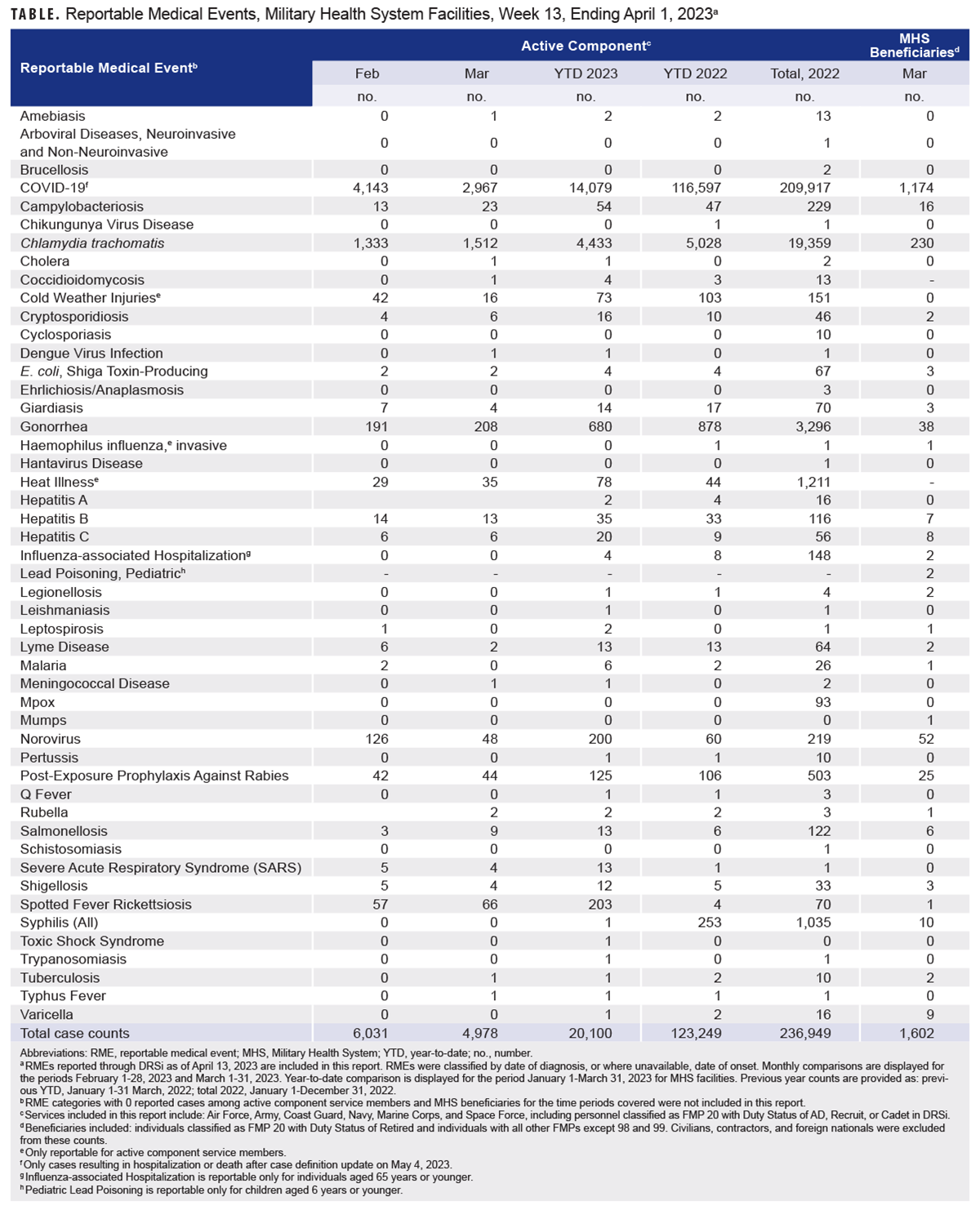
Click on the table to access a 508-compatible PDF version

The most recent data on the 5 most frequent RMEs among total active component cases, as reported per week during the preceding year, are depicted in the Top 5 RME Trends by Calendar Week graph. COVID-19 is excluded from the graph due to 2023 changes in reporting and case definitions.
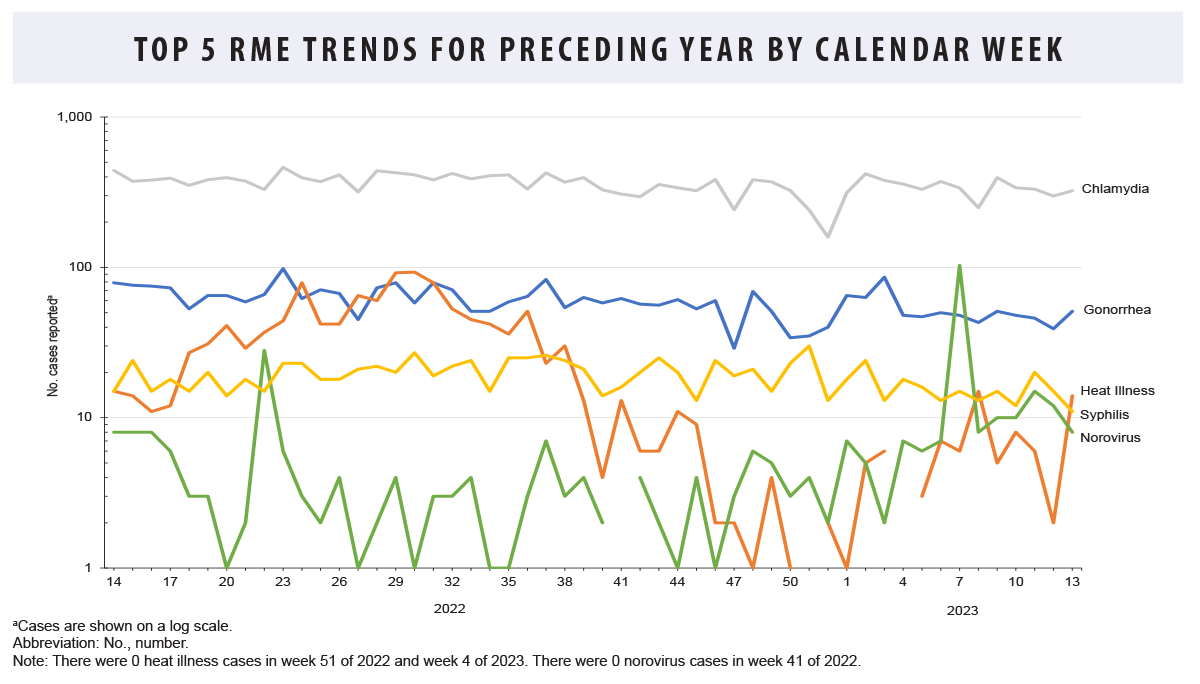
This horizontal line graph depicts by case count the 5 most frequent reportable medical conditions (or events) among active component service members over the past 52 weeks. Chlamydia was the most common reportable medical condition, with counts of approximately 300 cases per week. Gonorrhea was the second-most common reported disease, averaging approximately 80 cases per week. Gonorrhea was surpassed by heat illnesses in weeks 24, 27, 29, and 30 of 2022, and by norovirus in week 7 of 2023. Syphilis and heat illnesses alternated as the third and fourth most-common reported diseases, with case counts averaging approximately 20 per week. Norovirus rounded out the top 5, averaging between 1 and 8 cases per week.

Top 5 RME trends for preceding Year by Calendar Week. This line graph depicts the top 5 reportable medical conditions by case count among active component service members over the past 52 weeks. Chlamydia was the most common with counts of approximately 300 cases per week. Gonorrhea was the second-most common reported disease, averaging approximately 80 cases per week. Gonorrhea was surpassed by heat illnesses in weeks 24, 27, 29, and 30 of 2022, and by norovirus in week 7 of 2023. Syphilis and heat illnesses alternated as the third and fourth most-common reported diseases, with case counts averaging approximately 20 per week. Norovirus rounded out the top 5, averaging between 1 and 8 cases per week.

You also may be interested in...

Article
Feb 1, 2025

Surveillance Snapshot: Non-Hodgkin Lymphoma Incidence in Active Component U.S. Service Members, 2017–2023

This analysis utilizes an updated case definition for non-Hodgkin lymphoma developed by the Armed Forces Health Surveillance Division, based on consultation with subject matter experts and previous literature, to establish non-Hodgkin lymphoma incidence within the U.S. Armed Forces active component, from 2017 through 2023.

Article
Feb 1, 2025

Development of a New Fleet Disease and Injury Surveillance Capability Using ESSENCE

This report details the steps taken to develop a timely, accurate, and comprehensive Navy fleet disease and injury surveillance capability, utilizing ESSENCE (Electronic Surveillance System for the Early Notification of Community-based Epidemics), including the successes and challenges that will guide further refinement and expansion of this tool.

Article
Feb 1, 2025

External Cause Coding of Injury Encounters in the Military Health System Among Active Component U.S. Service Members, 2016–2019

Knowledge of injury causes is essential for prevention. This article describes causes of injury for all U.S. service members, from 2016 through 2019, and identifies variations in injury cause coding over time, and by branch of military service, type of health care visit and facility, and diagnosis category.

Article
Jan 1, 2025

Use of Positive Predictive Value to Evaluate the Armed Forces Health Surveillance Division Brain Cancer Incidence Rules, Active Component Department of the Air Force Pediatric Dependent Population, January 1, 2010–December 31, 2020

This study applied the Armed Forces Health Surveillance Division (AFHSD) case definition for the identification of malignant brain tumors among U.S. active service members to the dependent pediatric population of the active component of the U.S. Air Force, to determine the positive predictive value of this case definition for a pediatric population.

Topic
Mar 4, 2025

Integrated Biosurveillance

MHS Seal

AFHSD established the Integrated Biosurveillance division to serve as a central biosurveillance coordination unit to meet the needs of Department of Defense medical and public health components and leadership.

Article
Dec 1, 2024

Syphilis Cases Among Pregnant Women and Newborns in the Military Health System, 2012–2022

This report presents the rates of maternal syphilis among pregnant women and congenital syphilis among newborns in the Military Health System beneficiary population from 2012 to 2022. Between 2012 and 2021, cases of congenial syphilis in the U.S. increased by 755%, and rates of maternal and congenital syphilis within the Military Health System ...

Refine your search