January is National Radon Action Month: Learn to Manage Risk

Image of The U.S. Environmental Protection Agency has designated January as National Radon Action Month. The U.S. Environmental Protection Agency has designated January as National Radon Action Month, and the Centers for Disease Control and Prevention has chosen the last week of January as Radon Awareness Week. This is the perfect time to think about testing your home for radon. (Defense Health Agency-Public Health graphic illustration by Joyce Kopatch)

It’s January 2025, and a new year has begun. It’s a time of new beginnings and new resolutions. How about resolving to test your home for radon? The Environmental Protection Agency has designated January as National Radon Action Month, and the Centers for Disease Control and Prevention has chosen the last week of January as Radon Awareness Week. This is the perfect time to think about testing your home for radon.

Radon, a naturally occurring radioactive gas from the soils and rocks beneath your home, is in the air—usually in very small amounts. Radon is invisible, odorless, and tasteless, and it can build up in your home unnoticed and possibly put your family at risk.

The National Council on Radiation Protection and Measurements estimates that about one third of all radiation exposure to the U.S. population is from radon. The EPA estimates that high levels of radon are present in about one in 15 homes in the U.S. For most people, where they spend their time indoors is the primary factor that determines the extent of their radon exposure. Many people spend most of their time indoors at home, and that’s where they are most exposed to radon.

The EPA estimates that radon is the number one cause of lung cancer among people who don’t smoke, and it is the second leading cause of cancer for people who do. Smokers, with a lung cancer risk 10 times greater than for nonsmokers, are especially vulnerable to radon. However, not everyone who is exposed to radon, or smokes, will develop lung cancer. For those who do, there is no way to tell if radon, smoking, or something else was the cause. To find out if you have a radon problem in your home, it needs to be tested. The U.S. Surgeon General and the CDC recommend that all homes get tested for radon. Home radon tests are simple and inexpensive—and can help save lives.

So, you’ve resolved to test your home for radon: What’s next? You can test your home with a simple kit. Radon test kits are available from many retailers; hardware stores usually sell them. Alternatively, you can hire a radon professional to perform the tests and evaluate the results. Your state may be able to provide you with information on getting a test kit from a radon measurement professional. The National Radon Program Services also offers information on radon and how to get a test kit (1-800-SOS-RADON (1-800-767-7236).

Okay, after having read, understood, and followed the testing instructions, you’ve tested your home and have the results. If high levels of radon are present in your home, take action. You can manage your risks, and radon problems in your home can be fixed. If you smoke—stop.


The amount of radon or activity of radon is reported in units of picocuries, otherwise known as pCi, per volume (in liters) of air. This table provides the U.S. Army Corps of Engineers recommendations on how soon action should be taken for various levels of radon concentration. (Source: U.S. Army Corps of Engineers Public Works Technical Bulletin 200-1-144: Oct. 30, 2014)
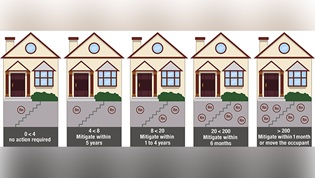
Photo of houses in a row

A qualified radon professional can help you understand the results; here are a few things to keep in mind. The amount of radon in the air is typically measured in picocuries per liter, otherwise known as pCi/L. In the U.S., the average indoor radon level is about 1.3 pCi/L, and the average outdoor level is about 0.4 pCi/L. The EPA recommends taking action to reduce radon in a building when levels are at or above four pCi/L and urges people to consider taking action to reduce radon in a building when levels are between two and four pCi/L. If the test results are between four and eight pCi/L, actions to reduce the radon levels should be taken within five years. The higher the level, the sooner action should be taken. However, immediate action most likely won’t be needed. The U.S. Army Corps of Engineers provides the following recommendations on how soon action should be taken.

The Department of Defense has adopted the EPA guidelines for remediation of radon in living quarters. If you live in military housing, please contact your housing office for more information on local radon testing and remediation efforts.

Systems to reduce the level of radon in your home can decrease radon levels by about 99%. Preventing radon from entering your home, or controlling the air flow in your home with good ventilation, will reduce your exposure. The EPA recommends methods that prevent radon from entering your home. Qualified radon professionals can advise you and fix your radon problem. Read the EPA’s Consumer’s Guide to Radon Reduction for an overview of radon reduction methods.

January is the month to learn about the risks of radon, what to do if you have a problem, and importantly, to encourage your family, friends, and neighbors to test their homes. Finally, it’s a good idea to retest your home every two years to verify that the levels are acceptable.

For more information about National Radon Action Month, visit:

To learn more about radon, visit:


The Defense Health Agency supports our Nation by improving health and building readiness–making extraordinary experiences ordinary and exceptional outcomes routine.

The mention of any non-federal entity and/or its products is for informational purposes only, and is not to be construed or interpreted, in any manner, as federal endorsement of that non-federal entity or its products.

You also may be interested in...

Article
Sep 29, 2023

Real Life Falls Are Not a Laughing Matter: Protect your Body, Ego

Each year thousands of military personnel injure themselves because of falls from vehicles and equipment, tripping over objects, and slipping on hazardous surfaces like ice, snow, or water. Injuries include lacerations requiring stitches, concussions or head injury, sprained ankles, wrists or hands, and broken bones. These often require ER visits and can result in temporary disability and lost duty time for many days or even months. (Defense Centers for Public Health-Aberdeen graphic illustration by Joyce Kopatch)

Cartoons typically portray slips or falls as comical accidents. But falls are no laughing matter. Falls often cause injuries that require emergency room visits for injuries such as lacerations requiring stitches, concussions or head injury, sprained ankles, wrists or hands, or broken bones. Learn how to prevent fall-related injuries.

Article
Sep 28, 2023

Nebraska Air National Guard State Surgeon’s Path Leads Him to Professional Boxing’s Highest Pinnacle

Nebraska Air National Guard Col. (Dr.) Mark Shirley takes in a practice at Mick Doyle’s Kickboxing and Fitness Center in Omaha, Nebraska, on Oct. 10, 2022. A member of the Nebraska Air National Guard where he serves as the state surgeon, Shirley is also a doctor of osteopathic medicine and a member of the emergency department staff of the Memorial Community Hospital and Health System in Blair, Nebraska. (Photo: U.S. Air Force National Guard Lt. Col. Kevin Hynes)

Dressed in surgical scrubs, Nebraska Air National Guard Col. Mark Shirley looks like any other medical doctor pulling a 24-hour emergency department shift. Shirley serves as the state air surgeon where he oversees the medical support required to keep the Nebraska Air Guard’s approximately 1,000 airmen ready to support any and every federal or state ...

Article
Aug 2, 2023

55th Dental Squadron Participates in Operation Healthy Delta

U.S. Air Force Capt. Bethanie Swanson, a dentist, and U.S. Air Force Tech. Sgt. Omalee Vega, the noncommissioned officer in charge, both assigned to the 55th Medical Group in Offutt Air Force Base, Nebraska, conduct a dental examination during Operation Healthy Delta Innovative Readiness training program in Anna, Illinois, on June 11, 2023.  (Photo: U.S. Air National Guard Airman 1st Class Danielle Dawson)

More than 270 service members from the U.S. Air Force, U.S. Space Force, U.S. Army and U.S. Air National Guard, Army and Air Force Reserve, U.S. Marine Corps Reserve, U.S. Navy Reserve, and the U.S Public Health Service collaborated to provide no-cost health services to underserved communities in Illinois and Missouri.

Article
Aug 1, 2023

Case Report: Complicated Urinary Tract Infection Due to an Extensively Resistant Escherichia coli in a Returning Traveler

This article presents the medical case report of a 76-year-old man who returned to the U.S. following overseas travel and was admitted at Hawai'i's Tri­pler Army Medical Center with a complicated urinary tract infection due to an extensively resistant strain of E. coli.

Article
Aug 1, 2023

Active Surveillance for Acute Respiratory Disease Detected No Outbreaks at Four U.S. Army Basic Training Installations in 2022

This article presents the 2022 results of the active surveillance program for acute respiratory disease and Group A Beta-Hemolytic Streptococcus conducted by the Defense Centers for Public Health-Aberdeen at the four Army installations responsible for basic combat training or one-station unit training. This ARD surveillance program rapidly monitors, ...

Article
Jul 25, 2023

Defense Public Health Experts Investigate If Minority Group Service Members are More Likely to Experience Behavioral Health Problems

A recent Department of Defense study found American Indian and Alaska Native U.S. Army Soldiers had higher rates of suicidal ideation than white soldiers. The DOD is investigating behavioral health disparities among minority groups in the military to see how they might mirror similar disparities in the civilian population. (Graphic illustration: Steven Basso, Defense Centers for Public Health-Aberdeen)

U.S. public health agencies such as the National Institute of Mental Health have recognized that certain minority groups appear to experience greater risk for certain behavioral health disorders. The higher rates of adverse health problems in minority groups are often referred to as “disparities.”

Article
Jun 28, 2023

88th Operational Medical Readiness Squadron Focused on ‘Fit to Fight’ Force

Brenda Couch watches over U.S. Air Force Tech. Sgt. Ron Sparkman, a student at the 155th medical group with the Nebraska National Guard, as he checks vitals on an airman during training at Wright-Patterson Medical Center on June 13. Operational Medical Readiness Squadron was this month’s pick for “Dominate the Dirty Work,” a series of stories offering an in depth look at the hard working and dedicated individuals that often go unseen. (Photo: Kenneth J. Stiles, U.S. Air Force)

The 88th Operational Medical Readiness Squadron provides direct support to U.S. Air Force operations by promoting and sustaining force health, preventing injury and illness, restoring health, and elevating human performance. Its top priority is ensuring airmen and military members are medically ready to execute their missions at home-base and deployed ...

Refine your search