Earlier in 2024, the Department of Defense completed full deployment of the federal electronic health record when it went live at the joint DOD/Department of Veterans Affairs Captain James A. Lovell Federal Health Care Center on March 9, in North Chicago, Illinois.
Known as MHS GENESIS within the DOD, the federal electronic health record provides a single EHR for service members, veterans, and other beneficiaries, allowing patients to securely schedule appointments, keep track of their medications and medical images, ask for refills electronically, and improve the quality of appointments inside and outside the Military Health System. MHS GENESIS provides access to complete health records that are portable and follow a beneficiary’s health from the time they enter the MHS to the end of their care as veterans. The Department of Veterans Affairs, Department of Homeland Security’s U.S. Coast Guard, and Department of Commerce’s National Oceanic and Atmospheric Administration are deploying the same federal EHR as DOD.
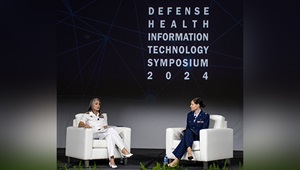 USPHS Rear Adm. Tracy Farrill and USAF Col. Tara Conner discuss MHS GENESIS at the DHITS 2024. (photo by Robert Hammer, DHA Communications)
In February 2017, limited fielding for the initial operational capability of MHS GENESIS began at four sites in the Pacific Northwest. Since then, MHS GENESIS has undergone multiple upgrades, stabilization and adoption changes, and thousands of configuration changes. In September 2019, incremental deployment began and continued rolling out at hospitals and clinics during the COVID-19 pandemic.
The Defense Health Agency, the Program Executive Office, Defense Healthcare Management Systems, the military services, and military hospitals and clinics completed stateside deployment of the system on June 3, 2023, and followed up in September 2023 by deploying to all overseas hospitals and clinics.
What’s Next
Since its first “go-live” in 2019, MHS GENESIS “has received multiple enhancements in response to end-user feedback,” said Bill Tinston, director of the Federal Electronic Heath Record Modernization Office.
“As DOD and VA plan more partnerships to effectively share resources, including facilities and clinicians, Lovell FHCC is a critical blueprint on how this can be achieved,” Tinston explained. “DOD and VA can now make decisions on how and where to work together without information technology being a barrier.”
Lovell FHCC is the only fully integrated, jointly run VA and DOD health care system in the nation. Lessons learned from Lovell FHCC “will inform future joint sharing sites and is just the beginning of delivering the federal EHR as we build on our success and focus on joint operations at other sites,” said Tinston.
At the recent Defense Health Information Technology Symposium, U.S. Public Health Service Rear Adm. Tracy Farrill, the DHA MHS GENESIS functional champion, and U.S. Air Force Col. Tara Conner, chief health informatics officer at the DHA, touched on these improvements in their plenary session on optimization and modernization of MHS GENESIS.
DHA plans include:
- Exploring new technologies to reduce administrative burden and improve patient engagement
- Standardizing and automating processes and developing targeted user resources
- Improving stakeholder engagement through an ongoing collaboration with key stakeholders to prioritize solutions as outlined in the MHS Strategy, fiscal years 2024–2029, released in 2023
- Enhancing feedback channels between DHA headquarters, the Defense Health Networks, and military hospitals and clinics to communicate progress updates, verify issue resolution, and promote best practices
- Rolling out the models and lessons learned by the five venture sites for the My Military Health pilot initiative by working with partners to identify available and upcoming capabilities and technologies
- Consolidating legacy systems data, and streamlining and standardizing policy, data sources, and metrics to enable better reporting and dashboarding of actionable information to military health leaders
How MHS GENESIS Affects Patients, Providers, the Enterprise
For DOD patients, MHS GENESIS provides a number of benefits, according to what feedback has shown, Tinston said. These include:
- Reduces time spent repeating health histories, undergoing duplicative tests, and managing printed health records
- Supports patients with secure communications with their care team
- Tracks medications, vaccines, allergies, and lab results in a single health care record
- Increases virtual access to health care professionals through modern telehealth patient portals
- Provides easier access to military treatment information to support service-connected disability claims when transitioning from active duty to veteran status
For providers, MHS GENESIS improves the continuum of care by simplifying access to patients’ medical records across different health care systems, both public and private.
This means:
- Increased efficiencies in sharing relevant medical information between multiple health care professionals and medical facilities
- Improved access to reliable patient data with advanced support tools for improved clinical decisions
- Aligned workflows that follow best practices using fewer systems
- Reduced retraining when moving to different facilities because of a common user experience across facilities
At the DOD enterprise level, MHS GENESIS provides:
- Real-time analytics to enhance health care operations and drive innovation
- Agile system improvements, reducing the time needed to respond to public health emergencies
- High-reliability principles and behavior-based practices incorporated into the processes and systems used by health care professionals
- Fewer duplicate testing and procedures and configuration complexity
- New standards for cybersecurity with an enterprise approach to protecting patient data
Outperforming Legacy Health Records
The legacy systems required the need to “specify and custom-build new functions to meet evolving regulatory, accreditation and standard-of-care requirements,” said U.S. Air Force Col. Christina Sheets, program manager for the Department of Defense Healthcare Management System Modernization office, which is managed under the Program Executive Office, Defense Healthcare Management Systems.
The new, common federal EHR “offers a unified inpatient and outpatient medication list with integrated medication reconciliation for care transition points, replacing separate inpatient and outpatient lists,” Sheets said, adding, “These changes extend the electronic safety net around our beneficiaries, improving patient safety.”
Beneficiary Interactions Via the Patient Portal
The federal EHR allows easier interactions between beneficiaries and their care teams.
For example, MHS GENESIS users can refill medication prescription requests to a preferred pharmacy via a mobile device or their desktop computer. There have been 1 million prescription refill requests with the new capability since March 1, 2024, averaging more than 134,000 a month, Sheets said.
Other convenient and accurate patient portal features include the ability to:
- Review your health record
- Send secure messages and documents to your health care provider
- Schedule appointments
- Complete basic medical forms prior to appointments
- Access educational content
End-user Feedback is Key to Enhancements
The FEHRM’s current focus remains listening to feedback and optimizing data.
End-user satisfaction surveys from patients and providers are part of a larger framework of feedback the FEHRM receives on the federal EHR. The fourth annual virtual Federal EHR Annual Summit, will also provide an interactive and comprehensive way to hear feedback from end users, scheduled for Oct. 22–24, 2024.
What MHS GENESIS Has Improved Already
Dr. Paul Cordts, DHA’s chief medical officer and deputy assistant director of medical affairs, discussed major initiatives that have come out of the MHS GENESIS deployment at the Society of Federal Health Professionals (AMSUS) annual conference in February 2024. These include:
- Advanced patient safety through barcoding medication administration
- Interest in expanding graduate medical education to strengthen digital health
- Expansion of patient portal champions to improve the patient experience at each facility
“We are at a point where we are lifting our eyes beyond the federal EHR and broadening our perspective on how we work together to create success,” Tinston said, adding, “There are other elements of health care delivery that we can set our eyes on to improve across the enterprise.”