Pregnancy and the hormonal life cycle can have significant impacts on women’s cardiovascular health and life expectancy. However, the research behind how women are negatively affected is incomplete and largely limited.
Women are also less likely to receive guideline-recommended drug therapy and invasive management of heart disease compared to men, according to U.S. Air Force Col. (Dr.) Travis Batts, chief of cardiology at Wilford Hall Ambulatory Surgical Center, Lackland Air Force Base in San Antonio, Texas.
“The impact of pregnancy on heart health cannot be overstated,” Batts said. “As the average age of first-time mothers in the United States increases, so does the likelihood of cardiovascular risk factors.”
According to Batts, this trend forces an elevated focus on pre-pregnancy cardiovascular assessments to lower risks.
“The connection of maternal age with cardiovascular health highlights a broader trend of increasing heart disease, specifically heart attack rates among younger women ages 30 to 50,” Batts said. “This shift emphasizes the importance of recognizing and treating heart attack symptoms promptly and appropriately, regardless of age or perceived health status.”
“Our growing understanding of heart attack symptoms in women and the impact of the hormonal life cycle highlight the critical need for personalized medical care,” Batts said. “The goal is to reduce differences in care and improve outcomes for all individuals at risk of heart disease, with a particular focus on young and middle-aged women who may be at risk of underdiagnosis and undertreatment.”
Heart disease remains the leading cause of death globally for both women and men. However, heart attack symptoms and the response to those symptoms can significantly differ between genders “with recent studies highlighting the particular vulnerability and treatment differences faced by women,” Batts said. “This discrepancy contributes to increased death rates among women and underscores the urgent need for gender-specific approaches in the diagnosis, treatment, and management of heart disease.”
Women’s Heart Attack Symptoms May Go Unrecognized
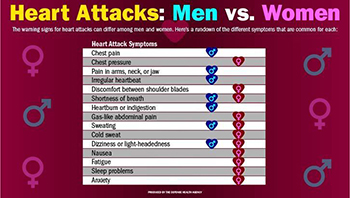 Heart attack symptoms differ between men and women, so be aware of how you as a woman may experience heart attack. (Graphics Credit: Kim Farcot, Defense Health Agency)
When you are having a heart attack, minutes matter. Fast action can save lives. Women often experience symptoms other than the crushing chest pain and left arm pain that typically afflict men having heart attacks.
For example, women are more likely to experience pain between the shoulder blades, abdominal pain, and nausea. In some situations, a failure to identify the unique symptoms women experience can lead to delays in seeking treatment.
If you're a woman, here are the most common heart attack symptoms:
- Chest pain or discomfort
- Pain in the arm(s), back, neck, or jaw
- Stomach pain
- Shortness of breath, nausea, or lightheadedness
- Cold sweats
- Fatigue
How Long Can a Woman Have Symptoms Before a Heart Attack?
Many people expect a heart attack to come on suddenly. But research suggests that women experience symptoms for several weeks before a heart attack. Doctors say it's important to encourage women to seek medical care when they have symptoms. You can have heart problems—even a heart attack—without chest pain. That's particularly common among women.
"Despite women having more symptomatic chest pain than men, they are less likely to have timely and appropriate care," Batts said. “A May 2022 study in the Journal of the American Heart Association “revealed that on average women have an 11-minute longer wait time when seeking emergency care for heart attack. We know this delay has a direct impact on heart attack outcomes.”
Should I Take Aspirin During a Heart Attack?
Medical advice on taking aspirin has changed over the years when it comes to treating an initial heart attack or preventing a subsequent heart attack.
- Don't do anything before calling 911. Specifically, don't take an aspirin then wait for it to relieve your pain. Aspirin alone won't treat your heart attack.
- The emergency operator can advise you whether to take aspirin and how much to take.
- If the operator does not suggest aspirin, you may receive the drug in the ambulance or emergency department.
Heart Attacks Can Happen Even if You're Young and in Good Shape
Younger women are having more heart attacks, according to a National Heart, Lung, and Blood Institute study in 2019.
Researchers were surprised to find that while the heart attack rate has decreased among older adults, it's risen among those ages 35-54, especially women. A November 2019 study in the journal Circulation reviewed more than 28,000 hospitalizations for heart attacks in four cities.
One condition, spontaneous coronary artery dissection, or SCAD, causes a small percentage of heart attacks overall, but is responsible for 40% of heart attacks in women younger than age 50, according to an August 2020 article in the Journal of the American College of Cardiology The average SCAD patient is just 42 years old and is likely healthy and active with no signs of heart disease.
“SCAD's prevalence underscores the need for increased awareness and specialized research to understand and combat this condition effectively,” Batts said.
Finally, other conditions such as myocardial infarction with non-obstructive arteries reveal a group of diseases that can cause heart attack without the usual risk factors and heart test findings, Batts said.
The Bottom Line
“As our approach to the diagnosis and management of chest pain syndromes continues to evolve, we must highlight the impact of racial and ethnic differences on the evaluation of patients with chest pain," Batts said. "There are disparities in chest pain management in diverse populations that lead to worse outcomes, increased heart attacks, and higher death rates.”
Call 911 immediately if you experience heart attack warning signs. Calling 911 is almost always the fastest way to get life-saving treatment and preserve your heart muscle and tissues.
An emergency medical services team can begin treatment when they arrive—up to an hour sooner than if you get to the hospital by car. EMS staff are also trained to revive someone whose heart has stopped. Patients with chest pain who arrive by ambulance usually receive faster treatment at the hospital, too.
Batts shared his bottom line recommendations, saying, “For both women and men alike, the keys to improving your heart health are simple: Take all symptoms seriously, ask questions about your heart health, and get screened yearly for heart disease risk factors.”