Reportable medical events at Military Health System facilities through week 31, ending August 2, 2025

Image of Photo6_RMEs_Graph. Reportable Medical Events are documented to monitor, control, and prevent the occurrence and spread of diseases.

Reportable Medical Events (RMEs) are documented in the Disease Reporting System internet (DRSi) by health care providers and public health officials throughout the Military Health System (MHS) for monitoring, controlling, and preventing the occurrence and spread of diseases of public health interest or readiness importance. These reports are reviewed by each service’s public health surveillance hub. The DRSi collects reports on over 70 different RMEs, including infectious and non-infectious conditions, outbreak reports, STI risk surveys, and tuberculosis contact investigation reports. A complete list of RMEs is available in the 2022 Armed Forces Reportable Medical Events Guidelines and Case Definitions.1 Data reported in these tables are considered provisional and do not represent conclusive evidence until case reports are fully validated.
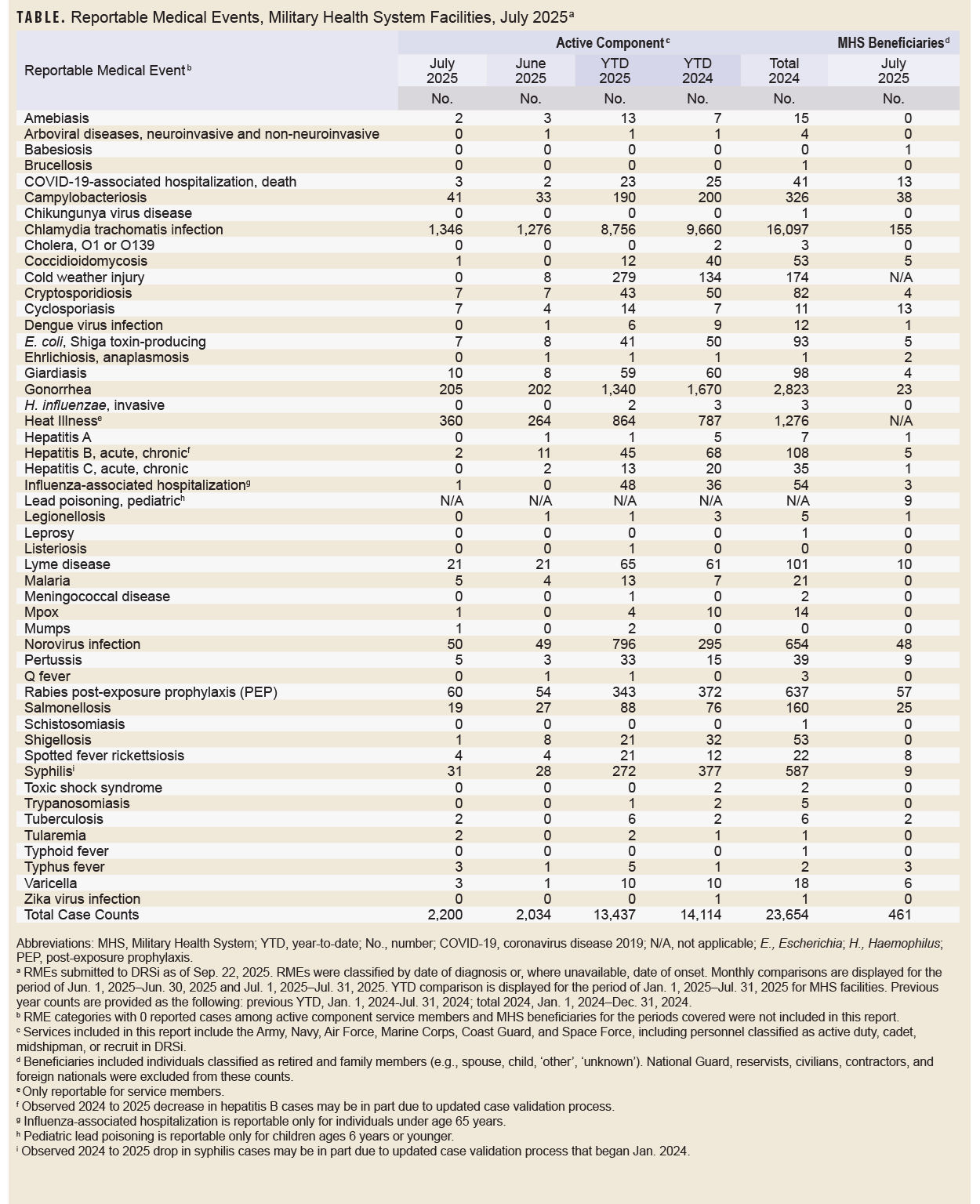
Click on the table to access a Section 508-compliant PDF of the table

Total active component cases reported per week are displayed for the top 5 RMEs for the previous year. Each month, the graph is updated with the top 5 RMEs, and is presented with the current month’s (July 2025) top 5 RMEs, which may differ from previous months. COVID-19 is excluded from these graphs due to changes in reporting and case definition updates in 2023.
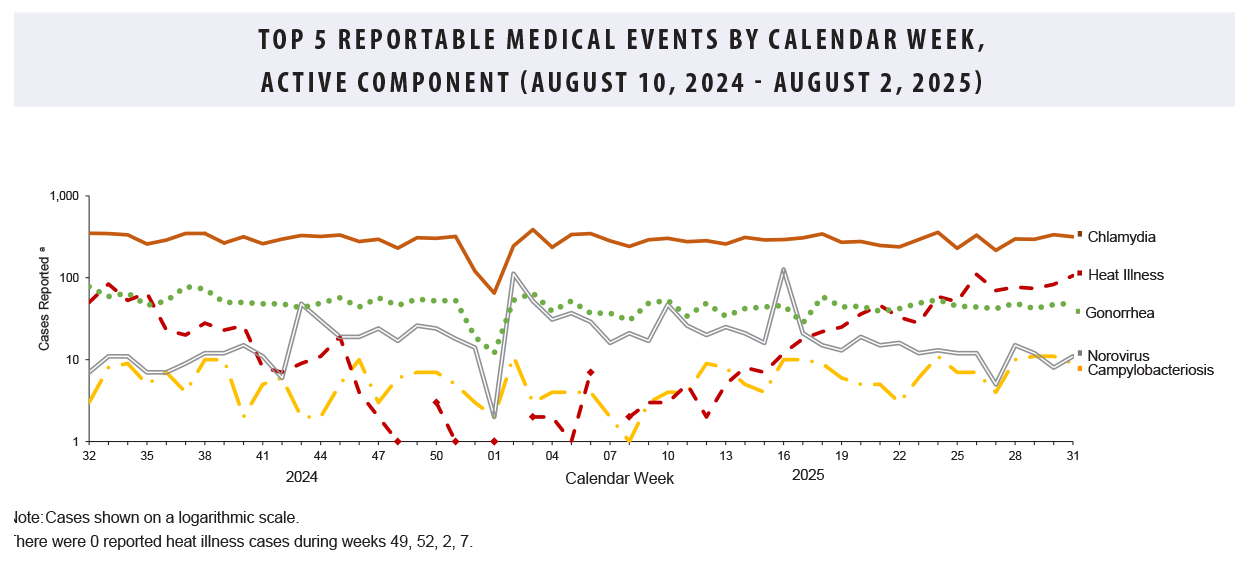
FIGURE. Top Five Reportable Medical Events by Calendar Week, Active Component (August 10, 2024–August 2, 2025): This figure comprises five lines on the horizontal, or x-, axis that depict case counts for the five most frequent reportable medical event conditions among active component service members during the past 52 weeks. Chlamydia remained the most common reportable medical condition, with counts consistently around 300 cases per week. Heat illnesses rose throughout the month, exceeding 100 cases by month’s end, continuing to outnumber gonorrhea, which was the third most common condition. Cases of both norovirus and campylobacteriosis were again the fourth- and fifth most common reportable medical events in July, with approximately 10 cases per condition each week.

For questions about this report, please contact the Disease Epidemiology Branch at the Defense Centers for Public Health–Aberdeen. Email: dha.apg.pub-health-a.mbx.disease-epidemiologyprogram13@health.mil

Authors’ Affiliation

Defense Health Agency, Disease Epidemiology Branch, Defense Centers for Public Health–Aberdeen

References

  1. Armed Forces Health Surveillance Division. Armed Forces Reportable Medical Events. Accessed Feb. 28, 2024. https://health.mil/reference-center/publications/2022/11/01/armed-forces-reportable-medical-events-guidelines 
  2. Defense Manpower Data Center. Department of Defense Active Duty Military Personnel by Rank/Grade of Service. Accessed Feb. 28, 2024. https://dwp.dmdc.osd.mil/dwp/app/dod-data-reports/workforce-reports 
  3. Defense Manpower Data Center. Armed Forces Strength Figures for January 31, 2023. Accessed Feb. 28, 2024. https://dwp.dmdc.osd.mil/dwp/app/dod-data-reports/workforce-reports 
  4. Navy Medicine. Surveillance and Reporting Tools–DRSI: Disease Reporting System Internet. Accessed Feb. 28, 2024. https://www.med.navy.mil/navy-marine-corps-public-health-center/preventive-medicine/program-and-policy-support/disease-surveillance/drsi

You also may be interested in...

Report
Feb 1, 2023

MSMR Vol. 30 No. 2 - February 2023

.PDF | 965.54 KB

This issue of the peer-reviewed monthly journal published by the Armed Forces Health Surveillance Division (AFHSD) features the articles: Changing of the Guard: MSMR’s Second Editor-in-Chief Retires; Brief Report: Hospitalizations Among Active Duty Members of the U.S. Coast Guard, Fiscal Year 2021; Historical Perspective: The Critical Role of Disease ...

Report
Jan 1, 2023

MSMR Vol. 30 No. 1 - January 2023

.PDF | 1.22 MB

A monthly publication of the Armed Forces Health Surveillance Division. This issue of the peer-reviewed journal contains the following articles: Incidence and management of chronic insomnia, active component, U.S. Armed Forces, 2012 to 2021; Changes in the prevalence of overweight and obesity and in the incidence of prediabetes and type 2 diabetes ...

Report
Dec 1, 2022

MSMR Vol. 29 No. 12 - December 2022

.PDF | 2.22 MB

A monthly publication of the Armed Forces Health Surveillance Division. This issue of the peer-reviewed journal contains the following articles: Surveillance trends for SARS-CoV-2 and other respiratory pathogens among U.S. Military Health System Beneficiaries, Sept. 27, 2020 – Oct. 2,2021; Establishment of SARS-CoV-2 genomic surveillance within the ...

Report
Nov 1, 2022

MSMR Vol. 29 No. 11 - November 2022

.PDF | 1.30 MB

A monthly publication of the Armed Forces Health Surveillance Division. This issue of the peer-reviewed journal contains the following articles: Surveillance trends for SARS-CoV-2 and other respiratory pathogens among U.S. Military Health System Beneficiaries, Sept. 27, 2020 – Oct. 2,2021; Establishment of SARS-CoV-2 genomic surveillance within the ...

Report
Oct 1, 2022

MSMR Vol. 29 No. 10 - October 2022

.PDF | 1.41 MB

A monthly publication of the Armed Forces Health Surveillance Division. This issue of the peer-reviewed journal contains the following articles: Surveillance trends for SARS-CoV-2 and other respiratory pathogens among U.S. Military Health System Beneficiaries, Sept. 27, 2020 – Oct. 2,2021; Establishment of SARS-CoV-2 genomic surveillance within the ...

Article
Sep 1, 2022

Update: Routine Screening for Antibodies to Human Immunodeficiency Virus, U.S. Armed Forces, Active and Reserve Components, January 2017–June 2022

NAVAL MEDICAL CENTER CAMP LEJEUNE, North Carolina - As the leading petty officer for Naval Medical Center Camp Lejeune's Community Health Clinic, HM2 Kameron Jacobs is part of the first satellite team to treat service members living with HIV.

This report provides an update through June 2022 of routine screening results for antibodies to the human immunodeficiency virus (HIV) among members of the active and reserve components of the U.S. Armed Forces. During the full 5 and 1/2-year surveillance period, the HIV seropositivity rates for active component service members were 0.21 positives per ...

Refine your search