Surveillance snapshot: Telehealth services among active component members of the U.S. Armed Forces, 2020–2024

Image of 98903189. The U.S. Department of Defense uses telehealth for primary care, medication management, and other services including outpatient care.

Telehealth in the Military Health System has long been an important tool for providing care in deployed and non-deployed settings.1 The U.S. Department of Defense uses telehealth for primary care, medication management,2 and other services including outpatient care. Certain types of care provided at fixed military hospitals and clinics, as well as health care encounters outside the military medical system that are billed to TRICARE, are also provided through telehealth.3

This Surveillance Snapshot presents trends in telehealth service use and identifies the 10 most frequent diagnoses addressed via telehealth among U.S. active component service members using Defense Medical Surveillance System outpatient and demographic records from January 2020 through December 2024.
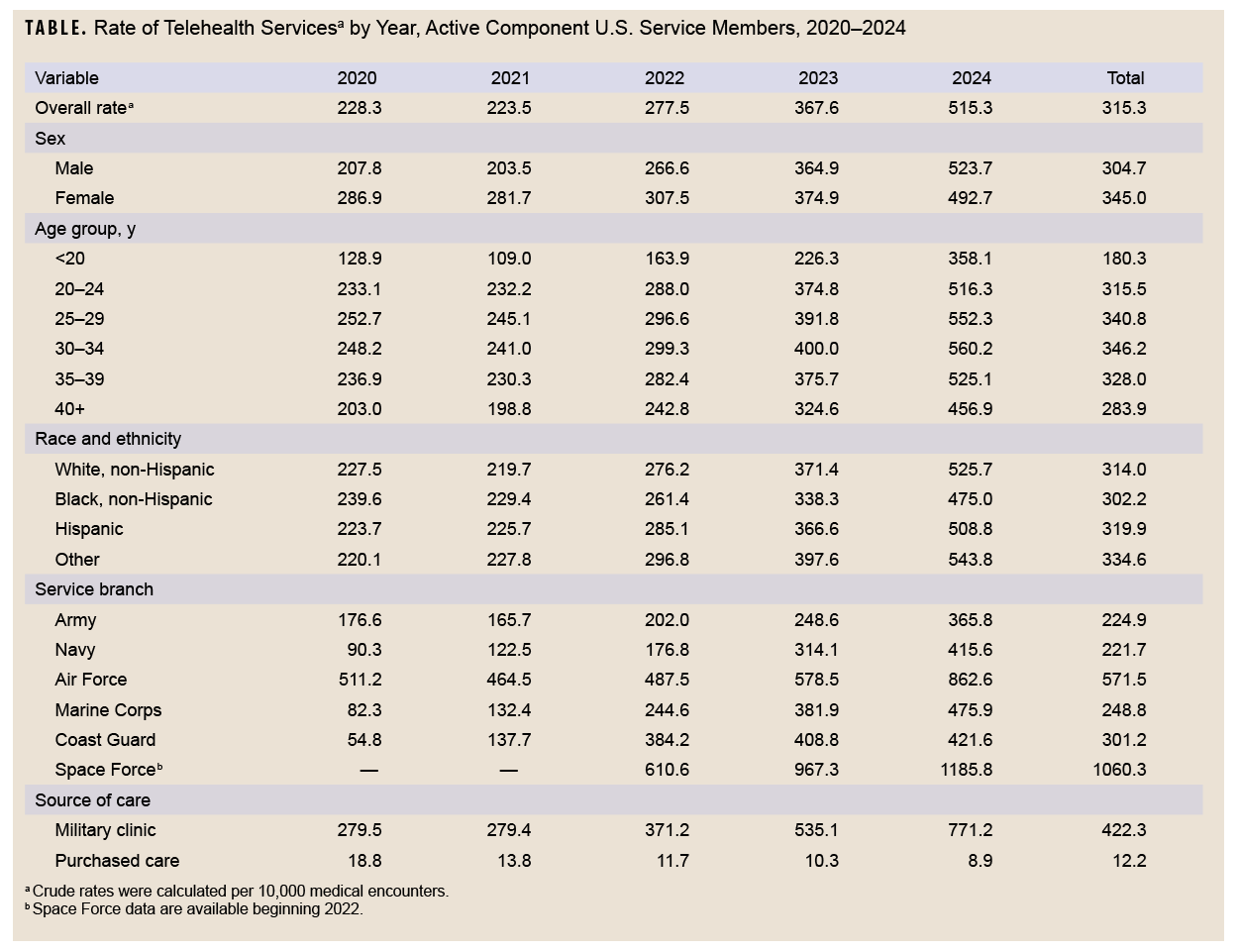
Telehealth services were identified by having a virtual appointment type or by using the Common Procedural Terminology code modifiers 98966–98969, 99374–99380, 99339–99444, 99421–99423, 98000–98007, G0320–G0321, G0425–G0427, G0459, G0508–G0509, D9995, G2061–G2063, C7900–C7902, T1014. The use of telehealth was defined as having at least 1 telehealth encounter per patient per day; if a patient had multiple telehealth encounters per day, the first record was retained as the qualifying encounter. Reasons for telehealth encounters among ACSMs were determined using International Classification of Diseases, 10th Revision codes associated with each telehealth visit. The rate of telehealth encounters was calculated per 10,000 encounter records and stratified by year, patient demographics, and type of care (military clinics or purchased care).

A total of 2,924,428 telehealth encounters were provided to over 1,007,453 ACSMs during the study period. The overall crude rate of telehealth per 10,000 encounters demonstrates an upward trajectory from 2020 to 2024, rising from 228.3 to 515.3 (Table). Over the 5-year study period, women used telehealth at a higher rate than men (345.0 vs. 304.7 per 10,000 encounters, respectively). Direct care from military hospitals and clinics accounted for most telehealth encounters from 2020 through 2024.

The leading 10 reasons for telehealth encounters from 2020 through 2024 were other general symptoms and signs, encounter for other administrative examinations, encounter for immunization, occupational Health Periodic Health Assessment examination, obstructive sleep apnea, low back pain, other specified counseling, pain in right knee, adjustment disorder with mixed anxiety and depressed mood, and pain in left knee (data not shown).

The highest rates observed in 2024 were among male ACSMs (523.7 per 10,000 encounters), those aged 30-34 years (560.2 per 10,000 encounters), Space Force ACSMs (1,185.8 per 10,000 encounters), those treated in a military clinic (771.2 per 10,000 encounters), and ACSMs of other races or ethnicities (543.8) (Table).

The steady increase of telehealth encounter rates from 2020 through 2024 indicates a growing role for virtual care among ACSMs.

Authors’ Affiliation

Defense Health Agency, Epidemiology and Analysis Branch, Armed Forces Health Surveillance Division, Public Health Directorate, Defense Health Agency, Silver Spring, MD: Mr. Adegboye, Dr. Mabila

References

  1. Madsen C, Banaag A, Koehlmoos TP. Analysis of telehealth usage and trends in the Military Health System, 2006-2018. Telemed J E Health. 2021;27(12):1346-1354. doi:10.1089/tmj.2020.0474 
  2. Vaudreuil R, Langston DG, Magee WL, Betts D, Kass S, Levy C. Implementing music therapy through telehealth: considerations for military populations. Disabil Rehabil Assist Technol. 2022;17(2):201-210. doi:10.1080/17483107.2020.1775312 
  3. Gilder T, Banaag A, Madsen C, Koehlmoos TP. Trends in telehealth care during the COVID-19 pandemic for the Military Health System. Telemed Rep. 2023;4(1):147-155. doi:10.1089/tmr.2022.0042

You also may be interested in...

Report
Jul 1, 2022

MSMR Vol. 29 No. 07 - July 2022

.PDF | 1.67 MB

A monthly publication of the Armed Forces Health Surveillance Division. This issue of the peer-reviewed journal contains the following articles: Surveillance trends for SARS-CoV-2 and other respiratory pathogens among U.S. Military Health System Beneficiaries, Sept. 27, 2020 – Oct. 2,2021; Establishment of SARS-CoV-2 genomic surveillance within the ...

Article
Jun 1, 2022

Morbidity Burdens Attributable to Various Illnesses and Injuries, Deployed Active and Reserve Component Service Members, U.S. Armed Forces, 2021

As in previous years, among service members deployed during 2021, injury/poisoning, musculoskeletal diseases and signs/symptoms accounted for more than half of the total health care burden during deployment. Compared to garrison disease burden, deployed service members had relatively higher proportions of encounters for respiratory infections, skin ...

Article
Jun 1, 2022

Absolute and Relative Morbidity Burdens Attributable to Various Illnesses and Injuries, Non-service Member Beneficiaries of the Military Health System, 2021

In 2021, mental health disorders accounted for the largest proportions of the morbidity and health care burdens that affected the pediatric and younger adult beneficiary age groups. Among adults aged 45–64 and those aged 65 or older, musculoskeletal diseases accounted for the most morbidity and health care burdens. As in previous years, this report ...

Article
Jun 1, 2022

Absolute and Relative Morbidity Burdens Attributable to Various Illnesses and Injuries, Active Component, U.S. Armed Forces, 2021

In 2021, as in prior years, the medical conditions associated with the most medical encounters, the largest number of affected service members, and the greatest number of hospital days were in the major categories of injuries, musculoskeletal disorders, and mental health disorders. Despite the pandemic, COVID-19 accounted for less than 2% of total ...

Article
Jun 1, 2022

Hospitalizations, Active Component, U.S. Armed Forces, 2021

The hospitalization rate in 2021 was 48.0 per 1,000 person-years (p-yrs), the second lowest rate of the most recent 10 years. For hospitalizations limited to military facilities, the rate in 2021 was the lowest for the entire period. As in prior years, the majority (71.2%) of hospitalizations were associated with diagnoses in the categories of mental ...

Article
Jun 1, 2022

Ambulatory Visits, Active Component, U.S. Armed Forces, 2021

In 2021, the overall numbers and rates of active component service member ambulatory care visits were the highest of any of the last 10 years. Most categories of illness and injury showed modest increases in numbers and rates. The proportions of ambulatory care visits that were accomplished via telehealth encounters fell to under 15% in 2021, compared ...

Article
Jun 1, 2022

Medical Evacuations out of the U.S. Central and U.S. Africa Commands, Active and Reserve Components, U.S. Armed Forces, 2021

The proportions of evacuations out of USCENTCOM that were due to battle injuries declined substantially in 2021. For USCENTCOM, evacuations for mental health disorders were the most common, followed by non-battle injury and poisoning, and signs, symptoms, and ill-defined conditions. For USAFRICOM, evacuations for non-battle injury and poisoning were ...

Article
May 1, 2022

Update: Sexually Transmitted Infections, Active Component, U.S. Armed Forces, 2013–2021

This illustration depicts a 3D computer-generated image of a number of drug-resistant Neisseria gonorrhoeae bacteria. CDC/James Archer

This report summarizes incidence rates of the 5 most common sexually transmitted infections (STIs) among active component service members of the U.S. Armed Forces during 2013–2021. In general, compared to their respective counterparts, younger service members, non-Hispanic Black service members, those who were single and other/unknown marital status, ...

Article
May 1, 2022

The Association Between Two Bogus Items, Demographics, and Military Characteristics in a 2019 Cross-sectional Survey of U.S. Army Soldiers

NIANTIC, CT, UNITED STATES 06.16.2022 U.S. Army Staff Sgt. John Young, an information technology specialist assigned to Joint Forces Headquarters, Connecticut Army National Guard, works on a computer at Camp Nett, Niantic, Connecticut, June 16, 2022. Young provided threat intelligence to cyber analysts that were part of his "Blue Team" during Cyber Yankee, a cyber training exercise meant to simulate a real world environment to train mission essential tasks for cyber professionals. (U.S. Army photo by Sgt. Matthew Lucibello)

Data from surveys may be used to make public health decisions at both the installation and the Department of the Army level. This study demonstrates that a vast majority of soldiers were likely sufficiently engaged and answered both bogus items correctly. Future surveys should continue to investigate careless responding to ensure data quality in ...

Refine your search