Surveillance snapshot: Telehealth services among active component members of the U.S. Armed Forces, 2020–2024

Image of 98903189. The U.S. Department of Defense uses telehealth for primary care, medication management, and other services including outpatient care.

Telehealth in the Military Health System has long been an important tool for providing care in deployed and non-deployed settings.1 The U.S. Department of Defense uses telehealth for primary care, medication management,2 and other services including outpatient care. Certain types of care provided at fixed military hospitals and clinics, as well as health care encounters outside the military medical system that are billed to TRICARE, are also provided through telehealth.3

This Surveillance Snapshot presents trends in telehealth service use and identifies the 10 most frequent diagnoses addressed via telehealth among U.S. active component service members using Defense Medical Surveillance System outpatient and demographic records from January 2020 through December 2024.
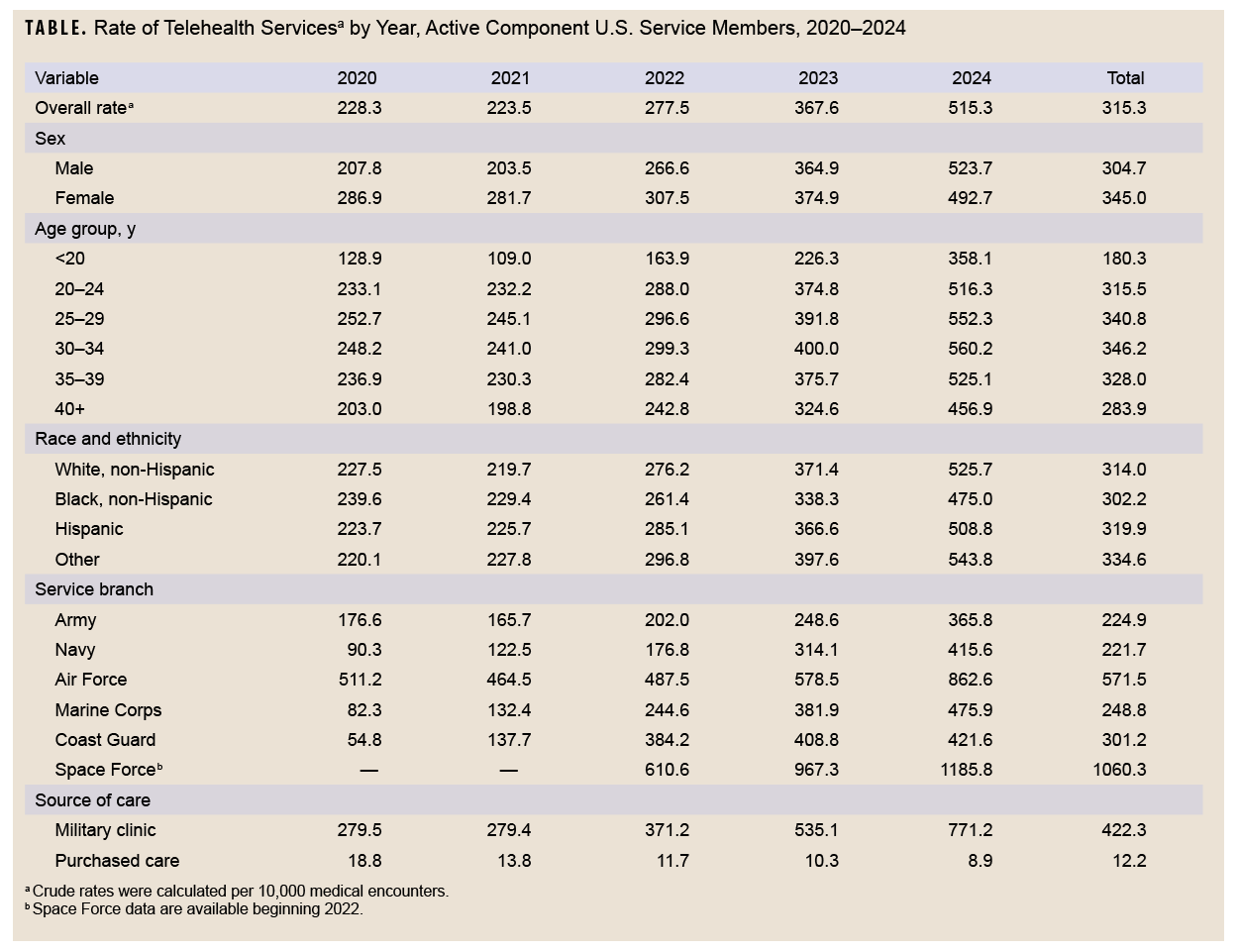
Telehealth services were identified by having a virtual appointment type or by using the Common Procedural Terminology code modifiers 98966–98969, 99374–99380, 99339–99444, 99421–99423, 98000–98007, G0320–G0321, G0425–G0427, G0459, G0508–G0509, D9995, G2061–G2063, C7900–C7902, T1014. The use of telehealth was defined as having at least 1 telehealth encounter per patient per day; if a patient had multiple telehealth encounters per day, the first record was retained as the qualifying encounter. Reasons for telehealth encounters among ACSMs were determined using International Classification of Diseases, 10th Revision codes associated with each telehealth visit. The rate of telehealth encounters was calculated per 10,000 encounter records and stratified by year, patient demographics, and type of care (military clinics or purchased care).

A total of 2,924,428 telehealth encounters were provided to over 1,007,453 ACSMs during the study period. The overall crude rate of telehealth per 10,000 encounters demonstrates an upward trajectory from 2020 to 2024, rising from 228.3 to 515.3 (Table). Over the 5-year study period, women used telehealth at a higher rate than men (345.0 vs. 304.7 per 10,000 encounters, respectively). Direct care from military hospitals and clinics accounted for most telehealth encounters from 2020 through 2024.

The leading 10 reasons for telehealth encounters from 2020 through 2024 were other general symptoms and signs, encounter for other administrative examinations, encounter for immunization, occupational Health Periodic Health Assessment examination, obstructive sleep apnea, low back pain, other specified counseling, pain in right knee, adjustment disorder with mixed anxiety and depressed mood, and pain in left knee (data not shown).

The highest rates observed in 2024 were among male ACSMs (523.7 per 10,000 encounters), those aged 30-34 years (560.2 per 10,000 encounters), Space Force ACSMs (1,185.8 per 10,000 encounters), those treated in a military clinic (771.2 per 10,000 encounters), and ACSMs of other races or ethnicities (543.8) (Table).

The steady increase of telehealth encounter rates from 2020 through 2024 indicates a growing role for virtual care among ACSMs.

Authors’ Affiliation

Defense Health Agency, Epidemiology and Analysis Branch, Armed Forces Health Surveillance Division, Public Health Directorate, Defense Health Agency, Silver Spring, MD: Mr. Adegboye, Dr. Mabila

References

  1. Madsen C, Banaag A, Koehlmoos TP. Analysis of telehealth usage and trends in the Military Health System, 2006-2018. Telemed J E Health. 2021;27(12):1346-1354. doi:10.1089/tmj.2020.0474 
  2. Vaudreuil R, Langston DG, Magee WL, Betts D, Kass S, Levy C. Implementing music therapy through telehealth: considerations for military populations. Disabil Rehabil Assist Technol. 2022;17(2):201-210. doi:10.1080/17483107.2020.1775312 
  3. Gilder T, Banaag A, Madsen C, Koehlmoos TP. Trends in telehealth care during the COVID-19 pandemic for the Military Health System. Telemed Rep. 2023;4(1):147-155. doi:10.1089/tmr.2022.0042

You also may be interested in...

Article
Jul 1, 2023

Absolute and Relative Morbidity Burdens Attributable to Various Illnesses and Injuries Among Non-Service Member Beneficiaries of the Military Health System, 2022

This report represents an updated summary of care provided to non-service members in the MHS during calendar year 2022. MHS beneficiaries are diverse and heterogeneous, including active component service members, activated National Guard and Reserve service members, active component immediate family, retirees, and their family members, with differing ...

Article
Jun 1, 2023

Absolute and Relative Morbidity Burdens Attributable to Various Illnesses and Injuries Among Active Component Members, U.S. Coast Guard, 2022

This report employs the same disease classification system and health care burden measures as employed in the MSMR burden analysis of the U.S. Armed Forces active component to quantify the impacts of various illnesses and injuries among members of the active component of the U.S. Coast Guard in 2022.

Article
Jun 1, 2023

Absolute and Relative Morbidity Burdens Attributable to Various Illnesses and Injuries Among Active Component Members, U.S. Armed Forces, 2022

This annual summary uses several health care burden measures to quantify the impacts of various illnesses and injuries in 2022 among members of the active component of the U.S. Armed Forces. Health care burden metrics include the total number of medical encounters, individuals affected, and hospital bed days.

Report
Jun 1, 2023

MSMR Vol. 30 No. 6 - June 2023

.PDF | 1.55 MB

This annual issue quantifies the impacts of various illnesses and injuries in 2022 among members of the active component of the U.S. Armed Forces as well as the U.S. Coast Guard; health care burden metrics include the total number of medical encounters, including hospitalizations and ambulatory services, as well as numbers and types of individuals ...

Report
May 1, 2023

MSMR Vol. 30 No. 5 - May 2023

.PDF | 1023.59 KB

The May 2023 MSMR reintroduces a monthly reportable medical event (RME) summary for the active component and MHS beneficiaries; then features a review of enhanced mpox outbreak case detection among MHS beneficiaries through ESSENCE (Electronic Surveillance System for the Early Notification of Community-based Epidemics); followed by a report on ...

Article
May 1, 2023

Enhanced Mpox Outbreak Case Detection Among MHS Beneficiaries Through Use of ESSENCE (Electronic Surveillance System for the Early Notification of Community-based Epidemics)

A colorized scanning electron microscopic image of the mpox virus on the surface of infected VERO E6 cells

This report describes how ESSENCE, which collects near real-time biosurveillance data globally on U.S. military personnel, monitored the mpox outbreak in 2002 and assesses its detection of confirmed/probable cases among MHS beneficiaries. ESSENCE systematically queries millions of health encounters to detect records of potential public health ...

Article
May 1, 2023

Increasing Incidence Rates of Eosinophilic Esophagitis in Active Component Service Members, U.S. Armed Forces, 2009–2021

A respiratory therapist visualizes the vocal chords of a patient using an endoscopy tool

This study examines the incidence of eosinophilic esophagitis among the active component of the U.S. Armed Forces from 2009 to 2021. Reported prevalence has been increasing worldwide, with a recent meta-analysis estimating 34.2 cases per 100,000 persons.

Article
May 1, 2023

Portable RT-PCR and MinION Nanopore Sequencing as a Proof-of-Concept SARS-CoV-2 Biosurveillance in Wastewater

Wastewater treatment facility

This study reports on the efficacy of 2 different portable nucleic acid detection technologies, RT-PCR and MinION Mk1C nanopore sequencing, which identified SARS-CoV-2 variants in wastewater collected at Tyndall AFB during a 2-month surveillance. This highly multiplexed approach circumvented signal dropout associated with the detection of newly ...

Refine your search