Reportable Medical Events at Military Health System Facilities Through Week 22, Ending May 31, 2025

Image of Cover 5. Reportable Medical Events are documented in the Disease Reporting System internet throughout the Military Health System.

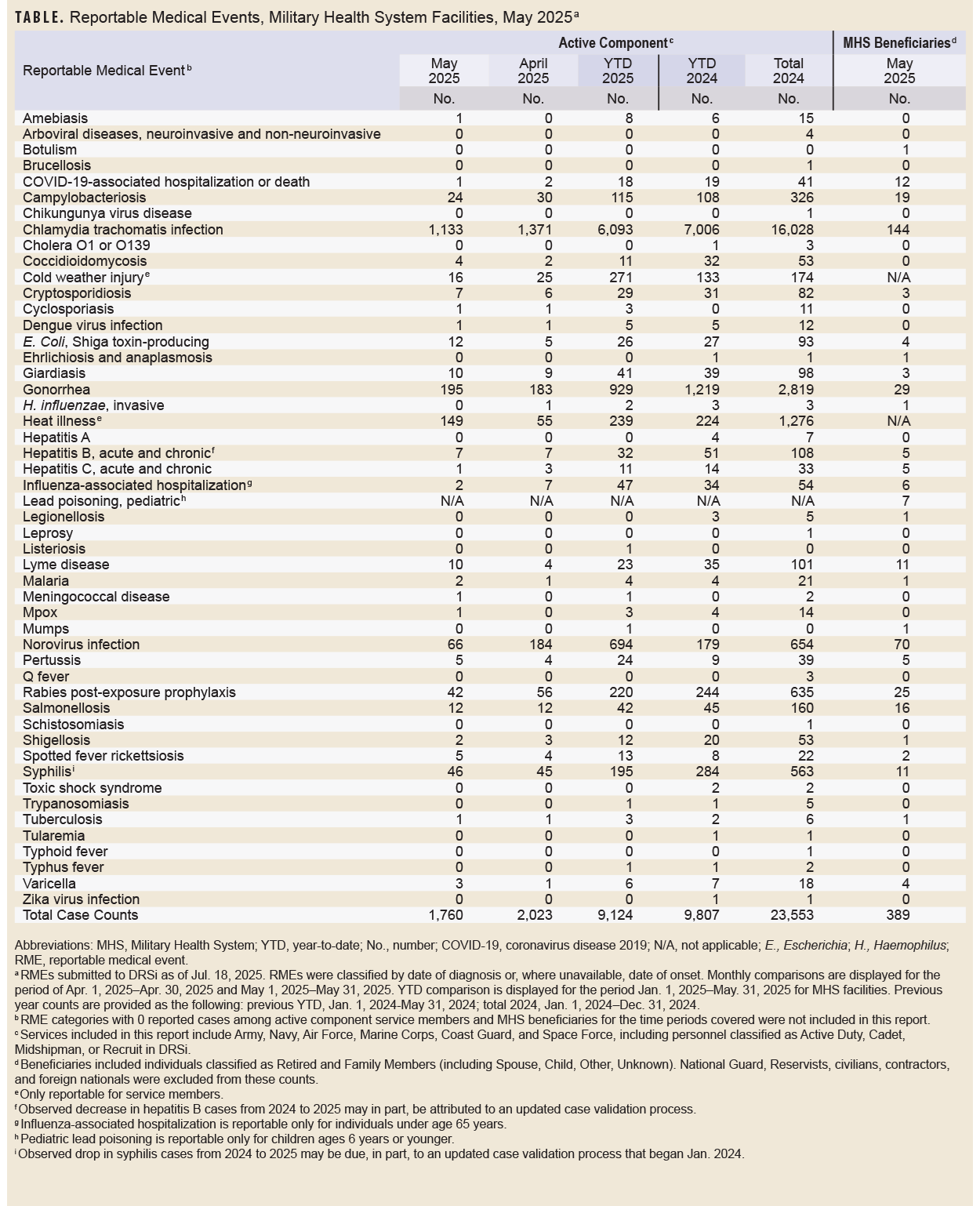
Reportable Medical Events are documented in the Disease Reporting System internet by health care providers and public health officials throughout the Military Health System for monitoring, controlling, and preventing the occurrence and spread of diseases of public health interest or readiness importance. These reports are reviewed by each service’s public health surveillance hub. The DRSi collects reports on over 70 different RMEs, including infectious and non-infectious conditions, outbreak reports, STI risk surveys, and tuberculosis contact investigation reports. A complete list of RMEs is available in the 2022 Armed Forces Reportable Medical Events Guidelines and Case Definitions.1 Data reported in these tables are considered provisional and do not represent conclusive evidence until case reports are fully validated.
Total active component cases reported per week are displayed for the top five RMEs for the previous year. Each month, the graph is updated with the top five RMEs, and is presented with the current month’s (May 2025) top five RMEs, which may differ from previous months. COVID-19 is excluded from these graphs due to changes in reporting and case definition updates in 2023.
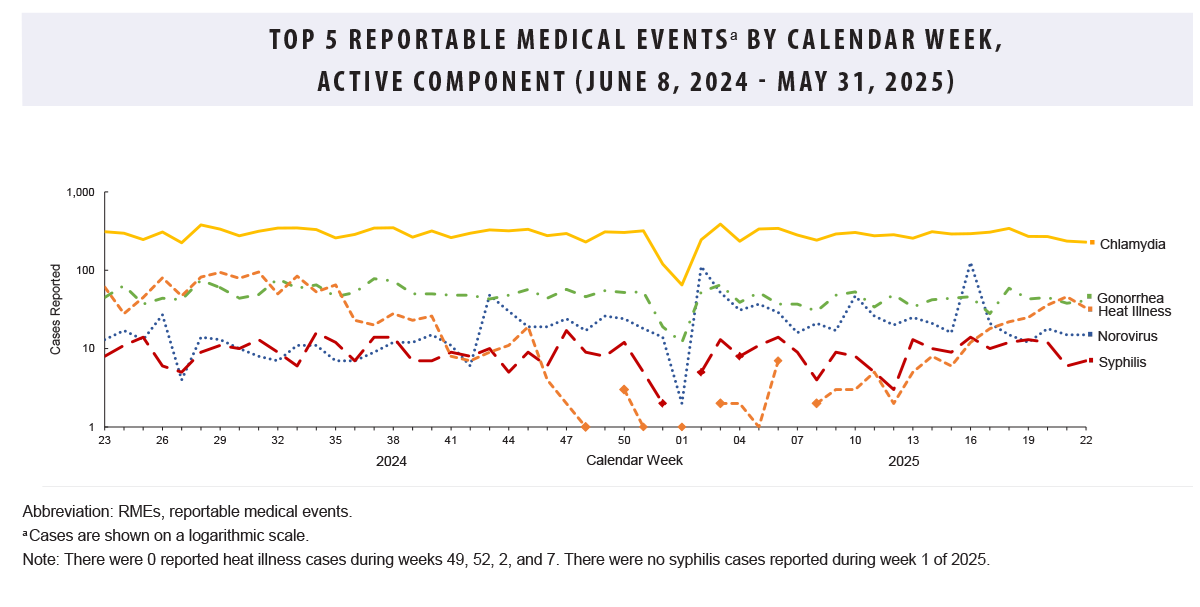
FIGURE. Top 5 Reportable Medical Events by Calendar Week, Active Component (June 8, 2024–May 31, 2025). This figure comprises five lines on the horizontal, or x-, axis that depict case counts for the five most frequent reportable medical event conditions among active component service members during the past 52 weeks. Chlamydia remains the most common reportable medical condition, with counts consistently around 300 cases per week. Gonorrhea was the second-most common reported condition, averaging just under 49 cases per week, and was surpassed by heat illnesses for one week, in week 21. Heat illnesses rose steadily throughout May, with an average of 37 cases per week for the month. Norovirus was consistently the fourth most frequent condition in May, averaging just over 16 cases per week. Syphilis averaged just over 11 cases per week.

For questions about this report, please contact the Disease Epidemiology Branch at the Defense Centers for Public Health–Aberdeen. Email: dha.apg.pub-health-a.mbx.disease-epidemiologyprogram13@health.mil

Authors' Affiliation

Defense Health Agency, Disease Epidemiology Branch, Defense Centers for Public Health–Aberdeen

References

  1. Armed Forces Health Surveillance Division. Armed Forces Reportable Medical Events. Accessed Feb. 28, 2024. https://health.mil/reference-center/publications/2022/11/01/armed-forces-reportable-medical-events-guidelines 
  2. Defense Manpower Data Center. Department of Defense Active Duty Military Personnel by Rank/Grade of Service. Accessed Feb. 28, 2024. https://dwp.dmdc.osd.mil/dwp/app/dod-data-reports/workforce-reports 
  3. Defense Manpower Data Center. Armed Forces Strength Figures for January 31, 2023. Accessed Feb. 28, 2024. https://dwp.dmdc.osd.mil/dwp/app/dod-data-reports/workforce-reports 
  4. Navy Medicine. Surveillance and Reporting Tools–DRSI: Disease Reporting System Internet. Accessed Feb. 28, 2024. https://www.med.navy.mil/navy-marine-corps-public-health-center/preventive-medicine/program-and-policy-support/disease-surveillance/drsi

You also may be interested in...

Report
Sep 1, 2023

MSMR Vol. 30 No. 9 - September 2023

.PDF | 1.30 MB

The September 2023 MSMR provides the annual update of routine screening for antibodies to HIV among the active and reserve components of the U.S. Armed Forces; followed by a serological survey of Ross River virus (RRV) infection among U.S. Marine expeditionary forces who train in Australia; followed by a Surveillance Snapshot of the 10 leading ...

Article
Sep 1, 2023

Update: Routine Screening for Antibodies to Human Immunodeficiency Virus, U.S. Armed Forces, Active and Reserve Components, January 2018–June 2023

This report provides an update through June 2023 of routine screening results for antibodies to HIV among members of the U.S. military. From January 2018 through June 2023, approximately 7 million U.S. military service members (active component, reserve component, and national guard) were tested for HIV antibodies; 1,502 were identified as HIV ...

Report
Aug 1, 2023

MSMR Vol. 30 No. 8 - August 2023

.PDF | 1.02 MB

The August 2023 MSMR provides the most recent data from the active surveillance program for acute respiratory disease and Group A Beta-Hemolytic Streptococcus among U.S. Army basic trainees; then summarizes the case report of an extensively resistant E. coli in a returning traveler at Hawai'i's Tripler Army Medical Center; followed by a Surveillance ...

Article
Aug 1, 2023

Case Report: Complicated Urinary Tract Infection Due to an Extensively Resistant Escherichia coli in a Returning Traveler

This article presents the medical case report of a 76-year-old man who returned to the U.S. following overseas travel and was admitted at Hawai'i's Tri­pler Army Medical Center with a complicated urinary tract infection due to an extensively resistant strain of E. coli.

Article
Aug 1, 2023

Active Surveillance for Acute Respiratory Disease Detected No Outbreaks at Four U.S. Army Basic Training Installations in 2022

This article presents the 2022 results of the active surveillance program for acute respiratory disease and Group A Beta-Hemolytic Streptococcus conducted by the Defense Centers for Public Health-Aberdeen at the four Army installations responsible for basic combat training or one-station unit training. This ARD surveillance program rapidly monitors, ...

Report
Jul 1, 2023

MSMR Vol. 30 No. 7 - July 2023

.PDF | 1.30 MB

This continuation of the June issue, which published the annual quantification of health care provided by the Military Health System, continues with the impacts of various illnesses and injuries in 2022 among deployed service members; medical evacuations out of theaters of military operation; health care provision to non-service member MHS ...

Article
Jul 1, 2023

Medical Evacuations out of U.S. Central and U.S. Africa Command Among Active and Reserve Components, U.S. Armed Forces, 2022

This report summarizes the nature, numbers, and trends of conditions for which military members were medically evacuated from the U.S. Central Command (CENTCOM) or Africa Central Command (AFRICOM) operations during 2022, with historical comparisons to the previous four years.

Article
Jul 1, 2023

Morbidity Burdens Attributable to Various Illnesses and Injuries Among Deployed Active and Reserve Component Service Members, U.S. Armed Forces, 2022

This annual estimate of illness- and injury-related morbidity and health care burdens on the U.S. Armed Forces and MHS updates previous analyses of these burden distributions among active and reserve component service members in deployed settings. This report focuses on the health encounters of service members during deployment to U.S. Central Command ...

Refine your search