The expansion of service women’s occupational roles in the U.S. military has heightened focus on women’s health, with the Department of Defense recently committing to “spending half a billion dollars each year on women’s health research.”1 These efforts could benefit from a comprehensive understanding of readiness among service women. Medical readiness may be broadly considered as the capability to achieve military mission and job success.2 Given that readiness is multi-factorial and requires physical and mental fitness, measurable markers such as body mass index and lost work days, while not exhaustive measures, are important to consider.
Body composition standards have been in place in the military for many decades3 to ensure personnel readiness.4 BMI is indirectly associated with retention in the military, as those who fail to meet weight standards are often separated from service. Although BMI cannot distinguish between fat and fat-free mass, a meta-analysis showed that BMI had a sensitivity of 51% and a specificity of 95% in women, suggesting that BMI performs well in correctly identifying those without obesity.5 While those data also suggest that BMI is less accurate at identifying those with obesity, it may still offer utility as an initial screening for readiness, given its fast and non-invasive characteristics. Lost work days can also serve as an indicator of readiness, due to the rigors of military service, including deployments, posing frequent risks for injury, illness, or hospitalization,6 leaving service members unable to perform their duties. Excessive lost work days may challenge mission completion and readiness.
Behavioral factors that may impede readiness include unhealthy sleep7 and substance use; but screening for these factors may be cumbersome in fast-paced military environments. Measuring health-related quality of life—or how mental, emotional, and physical capabilities affect daily functioning8—could provide a brief, non-intrusive screening tool for health-related factors associated with readiness. While HRQOL has been evaluated as a predictor of health outcomes in service member and military spouse populations,9,10 to our knowledge no studies have focused on U.S. service women. The aim of this analysis was to understand if HRQOL is significantly associated with subsequent readiness outcomes among active duty service women.
Methods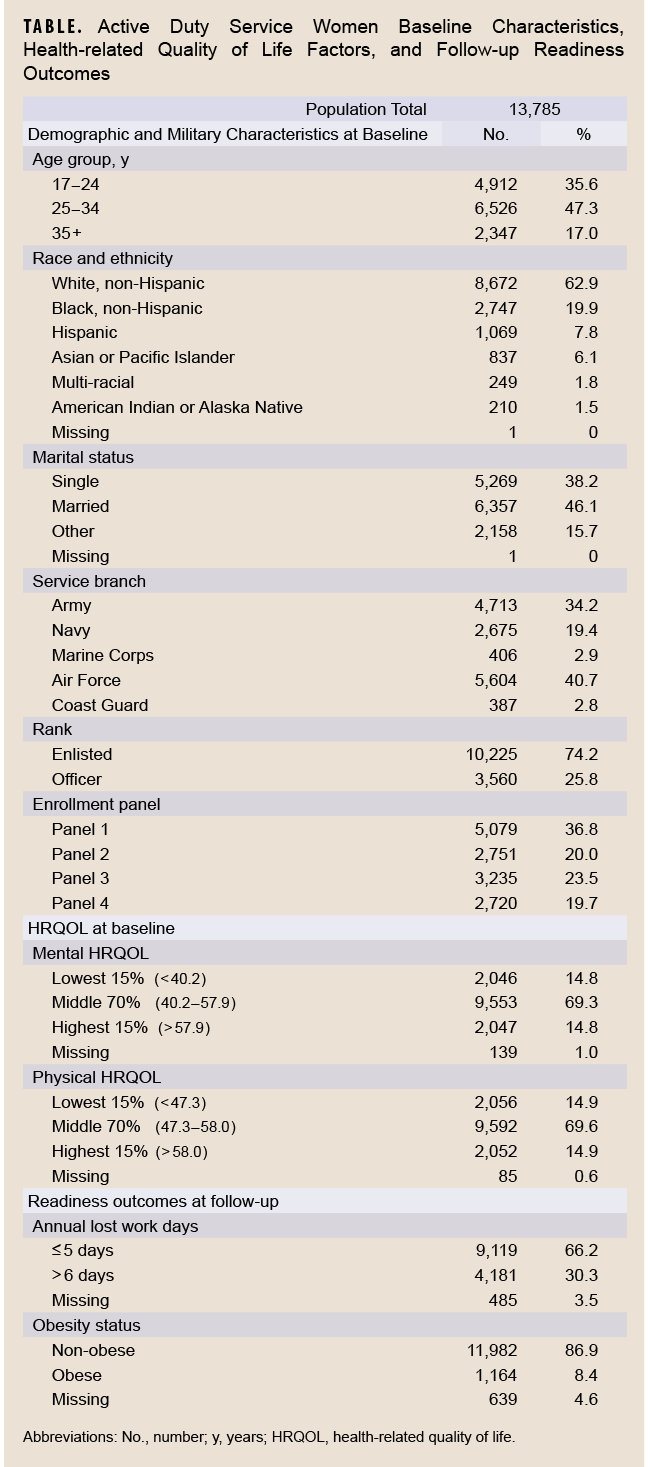
Data were from active duty service women enrolled in the U.S. Millennium Cohort Study, the largest and longest-running study of military personnel and veterans.11 Participants from all branches of service and components were enrolled in five panels: in 2001, 2004, 2007, 2011, and 2020. Among 260,228 enrolled participants, 79,872 were service women.11
For this evaluation of baseline HRQOL and subsequent readiness outcomes, eligibility criteria included: enrollment in the first four panels (n=18,078 excluded from panel five, as no follow-up survey was available for those participants at the time of this study); completion of the first follow-up survey (n=24,569 excluded who did not complete a follow-up survey); and serving on active duty at baseline and follow-up (n=16,426 excluded who were not on active duty at baseline; n=7,014 excluded who were not on active duty at follow-up). After application of all eligibility criteria, a total of 13,785 active duty service women were included in the study. HRQOL and covariates were reported at baseline, 2001-2011; readiness outcomes were assessed at first follow-up, 2004-2014.
Baseline HRQOL was coded from Veterans RAND 12 Item Short Form Survey (VR-12) summary scores using a validated scoring algorithm8 to capture effects of somatic (PCS, or physical component summary) and emotional (MCS, or mental component summary) health problems on basic daily functioning, with higher scores indicating better HRQOL, and lower scores indicating worse HRQOL. The Veterans RAND 12 Item Health Survey was developed from the Veterans RAND 36 Item Health Survey, which was developed and modified from the original RAND version of the 36-item Health Survey version 1.0 (also known as MOS SF-36).12
MCS and PCS scores have normative values, with a mean of 50 and standard deviation of 10, to compare with other U.S. populations.13 Scores were categorized into three groups, using the 15th and 85th centiles to demarcate the low and high scoring groups, which roughly approximated one standard deviation from the mean.10 Readiness-related outcomes included self-reported BMI and lost work days due to illness or injury (excluding time for pregnancy and childbirth).
The BMI readiness-related outcome was calculated from self-reported height and weight, dichotomized as women with a BMI under 30 kg/m2 (i.e., more likely to be ready), versus those with a BMI of 30 kg/m2 or greater (i.e., having obesity, less likely to be ready). The missed work days readiness-related outcome was calculated using the self-reported number of days that women were unable to work or perform usual activities within the past three years due to illness or injury; they were asked to exclude work days lost for pregnancy and childbirth. This outcome was dichotomized as those who missed five or fewer work days during the follow-up period (i.e., more likely to be ready) versus those who missed six or more days (i.e., less likely to be ready).
Socio-demographic and military covariates included age, marital status, race and ethnicity, pay grade, service branch, and enrollment panel. No collinearity was found when assessed among MCS and PCS scores and covariates, based on a variance inflation factor threshold of four or greater. Poisson regression models with robust error variance estimated prevalence ratios to assess the association between HRQOL and readiness outcomes, with adjustment for baseline covariates. All statistical analyses were conducted using SAS software version 9.4 (SAS Institute, Inc., Cary, NC). The study was approved by the Naval Health Research Center Institutional Review Board (NHRC.2000.0007).
Results
Most service women in this sample were younger than age 35 years at baseline, non-Hispanic White race or ethnicity, and enlisted, while a plurality were married, in the Air Force, and enrolled in panel 1 (in 2001). Women with MCS scores less than 40.2 and PCS scores less than 47.3 were in the lowest 15th centile; those scoring greater than 57.9 and 58.0, respectively, were in the top 15th centile. Most women reported not having obesity (86.9%) and missing five or fewer workdays (66.2%) due to illness or injury (Table).
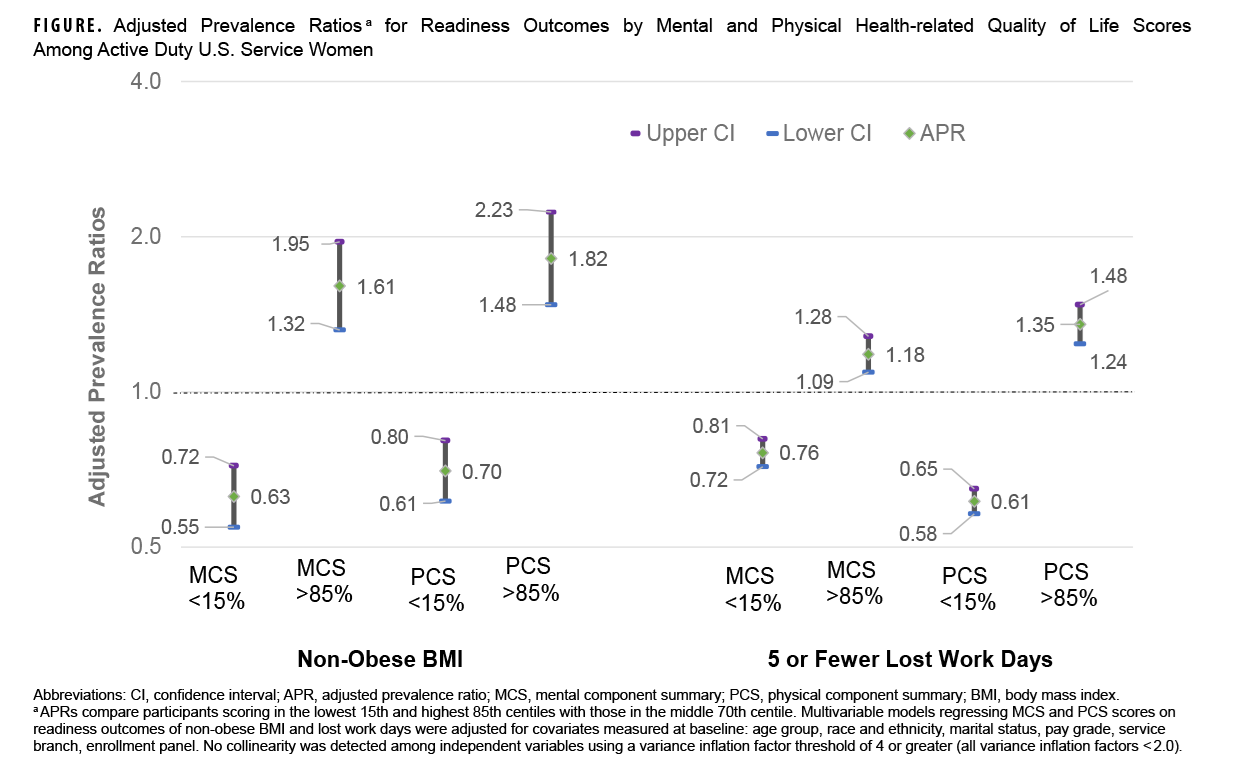
Adjusted multivariable models suggest that higher MCS and PCS scores were significantly associated with a higher likelihood for readiness, as defined by lack of obesity and fewer missed workdays (Figure). Women scoring in the top 15th centile for PCS demonstrated higher adjusted prevalences of non-obese BMI (APR 1.8, 95% CI 1.5, 2.2) and five or fewer lost workdays (APR 1.4, 95% CI 1.2, 1.5) compared to women scoring in the middle 70th centile. Results were similar for MCS scores, but measures of association were slightly lower.
Results show a strong and consistent relationship between MCS and PCS scores in the lowest 15th centile and readiness outcomes. Women scoring in the lowest 15th centile for MCS demonstrated a lower adjusted prevalence of non-obese BMI (APR 0.6, 95% CI 0.6, 0.7) and 5 or fewer lost workdays (APR 0.8, 95% CI 0.7, 0.8). compared to women scoring in the middle 70th centile. These relationships were similar in magnitude and significance for women scoring in the lowest 15th centile for PCS.
Discussion
Our findings suggest the VR-12 HRQOL instrument may be an efficient screening tool for health factors associated with readiness among service women. Low MCS and PCS scores were consistently associated with decreased likelihood of readiness (i.e., obese BMI and more lost work days). These relationships between HRQOL and readiness persisted after covariate adjustment, suggesting that HRQOL could stand alone as a brief screener for health-related readiness factors. Although these readiness-related outcomes could also be associated with subsequent HRQOL, this study’s longitudinal design allowed a temporal assessment of HRQOL with each outcome, supporting a consistent relationship between these more global measures of health (MCS and PCS) and future readiness-related metrics.
The greatest magnitude of association for MCS and PCS was with BMI readiness outcome. As meeting weight standards in the military is tied to retention, this finding is critical to understanding service women’s readiness. Research indicates that military service women who become pregnant may need additional support to sustain fitness during and after pregnancy. Recent research found that nearly 40% of active duty service women with a normal pregnancy (i.e., non-eclamptic) did not return to their baseline BMI after pregnancy.14 The Marine Corps Artemis program, launched in 2021 at Camp Pendleton,14,15 is designed to support women during and after pregnancy, but the program is limited to one service branch.
Additionally, the finding that both MCS and PCS scores are associated with BMI corroborates the proposition that there are mental and emotional components to weight control beyond simple caloric intake versus output.16 Recent research utilizing Millennium Cohort Study data found that service members who screened positive for mental disorders such as post-traumatic stress disorder or depression were at higher risk for subsequent binge eating disorder.16 Another study demonstrated that participants who screened positive for PTSD were more likely to experience subsequent weight gain.17 A study of female veterans reported that military experiences including challenging food environments, sexual trauma, and pregnancy during service negatively affected eating behaviors.18 Programs designed specifically with a holistic approach to women’s weight management could be beneficial in helping them cope with military life stress.19
Limitations of this study include the narrow definition of readiness, which may not fully capture all elements of readiness; however, BMI and missed work days are reasonable and objective proxies of duty fitness. MCS and PCS scores may have changed during the follow-up period due to unmeasured factors such as severe illness or injury. Although severe event prevalence is expected to be small, such factors may have biased results towards the null. Nonetheless, MCS and PCS provide global measures of physical and mental health. In fact, recent research on injury status and HRQOL observed MCS and PCS as stable over time, with baseline scores the strongest and most significant predictors of follow-up scores.20
This report highlights the need for additional research to better understand female service member readiness, especially with renewed service focus on force lethality and deployability, and potential reviews of fitness and body composition standards.21 Women-focused research on the unique needs of service women would fulfill a commitment to military women’s health and, ultimately, result in a more ready female force.
Author Affiliations
Deployment Health Research Department, Naval Health Research Center, San Diego, CA: Ms. Jacobson, Dr. Castañeda, Ms. Zhu, Dr. Lewis, Dr. Carey; Leidos, Inc., San Diego: Ms. Jacobson, Ms. Zhu, Dr. Lewis
Acknowledgments
In addition to the authors, the team of the Millennium Cohort Study includes Anna Bacetti, Satbir K. Boparai, Nathan C. Carnes, Rebecca A. Consigli, Toni Rose Geronimo-Hara, Yohannes Haile, Judith Harbertson, Lauren Jackson, Claire K. Kolaja, Cynthia A. LeardMann, Erin L. Richard, Anna C. Rivera, Scott Roesch, Rudolph P. Rull, Neika Sharifian, Beverly D. Sheppard, Karen Tannenbaum, Daniel W. Trone, Xin Tu, Javier Villalobos, Jr., Jennifer L. Walstrom, and Kerris J. Woods. The authors also appreciate the contributions from the Deployment Health Research Department and Leidos, Inc., and especially thank the Millennium Cohort Study participants.
Disclaimer
Dr. Castañeda and Dr. Carey are employees of the U.S. Government. This work was prepared as part of official duties. Title 17, U.S. Code Section 105 provides that copyright protection is not available for any U.S. Government work, which Title 17, U.S. Code Section 101 defines as work prepared by a military service member or employee of the U.S. Government as part of official duties. Report 25-03 was supported by the Defense Health Agency, Defense Health Program, and Department of Veterans Affairs under work unit 60002. The views expressed in this article are those of the authors and do not reflect official policy nor position of the U.S. Government, Department of Defense, Department of the Navy, or Department of Veterans Affairs. The study protocol was approved by the Naval Health Research Center Institutional Review Board in compliance with all applicable federal regulations governing the protection of human participants. Research data were derived from approved Naval Health Research Center Institutional Review Board protocol NHRC.2000.0007.
The authors have no conflicts of interest to disclose. The Millennium Cohort Study is funded through the Defense Health Agency, Defense Health Program, and Department of Veterans Affairs. Funders had no role in study design, data collection, analysis, manuscript preparation, or the decision to publish.
References
- U.S. Department of Defense. DoD Commits $500 Million for Women’s Health Research, Supports Better Care for All Women. 2024. Accessed Dec. 16, 2024. https://www.defense.gov/news/releases/release/article/3913913/dod-commits-500-million-for-womens-health-research-supports-better-care-for-all
- Herrera GJ, Congressional Research Service. The Fundamentals of Military Readiness. 2020. U.S. Congress. Accessed Dec. 16, 2024. https://www.congress.gov/crs-product/r46559
- Harty PS, Friedl KE, Nindl BC, et al. Military body composition standards and physical performance: historical perspectives and future directions. J Strength Cond Res. 2022;36(12):3551-3561. doi:10.1519/jsc.0000000000004142
- Friedl KE. Can you be large and not obese? The distinction between body weight, body fat, and abdominal fat in occupational standards. Diabetes Technol Ther. 2004;6(5):732-749. doi:10.1089/dia.2004.6.732
- Sommer I, Teufer B, Szelag M, et al. The performance of anthropometric tools to determine obesity: a systematic review and meta-analysis. Sci Rep. 2020;10(1):12699. doi:10.1038/s41598-020-69498-7
- Smith TC, LeardMann CA, Smith B, et al. Post deployment hospitalizations among service members deployed in support of the operations in Iraq and Afghanistan. Ann Epidemiol. 2009;19(9):603-612. doi:10.1016/j.annepidem.2009.05.002
- Seelig AD, Jacobson IG, Donoho CJ, et al. Sleep and health resilience metrics in a large military cohort. Sleep. 2016;39(5):1111-1120. doi:10.5665/sleep.5766
- Ware JE, Keller SD, Kosinski M. SF-12: How to Score the SF-12 Physical and Mental Health Summary Scales. 2nd ed. New England Medical Center;1995. Accessed Jun. 17, 2025. https://www.researchgate.net/profile/john-ware-6/publication/291994160_how_to_score_sf-12_items/links/58dfc42f92851c369548e04e/how-to-score-sf-12-items.pdf
- Corry NH, Radakrishnan S, Williams CS, et al. Longitudinal association of health behaviors and health-related quality of life with military spouse readiness. BMC Public Health. 2024;24(1):1341. doi:10.1186/s12889-024-18786-2
- LeardMann CA, Smith TC, Smith B, et al, Millennium Cohort Study. Baseline self-reported functional health and vulnerability to post-traumatic stress disorder after combat deployment: prospective US military cohort study. BMJ. 2009;338:b1273. doi:10.1136/bmj.b1273
- Castañeda SF, Belding JN, Kolaja CA, et al. Cohort profile update: the US Millennium Cohort Study–evaluating the impact of military experiences on service members and veteran health. Int J Epidemiol. 2023;52(4):e222-e231. doi:10.1093/ije/dyad088
- Kazis LE, Selim A, Rogers W, et al. Dissemination of methods and results from the Veterans Health Study: final comments and implications for future monitoring strategies within and outside the Veterans Healthcare System. J Ambul Care Manage. 2006;29(4):310-319. doi:10.1097/00004479-200610000-00007
- Selim AJ, Rogers W, Fleishman JA, et al. Updated US population standard for the Veterans RAND 12-Item Health Survey (VR-12). Qual Life Res. 2009;18:43-52. doi:10.1007/s11136-008-9418-2
- Johnson D, Madsen C, Banaag A, et al. Pregnancy weight gain and postpartum weight retention in active duty military women: implications for readiness. Mil Med. 2021;188(5-6):e1076-e1083. doi:10.1093/milmed/usab429
- Hansen J. USMC Artemis Program: A Quantitative Analysis of Pregnancy and Postpartum Fitness and Recovery. Dissertation. Acquisition Research Program;2024. Accessed Dec. 16, 2024. https://dair.nps.edu/bitstream/123456789/5291/1/NPSPM-25-236.pdf
- Sharifian N, Ray TN, Jacobson IG, et al. Bidirectional associations between probable eating disorders and mental health conditions among military service members and veterans. Am J Epidemiol. 2024;194(6):1621-1630. doi:10.1093/aje/kwae205
- Mitchell KS, Porter B, Boyko EJ, et al. Longitudinal associations among posttraumatic stress disorder, disordered eating, and weight gain in military men and women. Am J Epidemiol. 2016;184(1):33-47. doi:10.1093/aje/kwv291
- Breland JY, Donalson R, Nevedal A, et al. Military experience can influence women’s eating habits. Appetite. 2017;118:161-167. doi:10.1016/j.appet.2017.08.009
- Jaycox LH, Morral AR, Street A, et al. Gender differences in health among US service members: unwanted gender-based experiences as an explanatory factor. Rand Health Q. 2023;10(2):8. Accessed Jun. 17, 2025. https://apps.dtic.mil/sti/pdfs/AD1165841.pdfhttps://apps.dtic.mil/sti/pdfs/AD1165841.pdf
- Kolaja C, Castañeda SF, Woodruff SI, et al, Millennium Cohort Study. The relative impact of injury and deployment on mental and physical quality of life among military service members. PLoS One. 2022;17(9):e0274973. doi:10.1371/journal.pone.0274973
- Secretary of Defense. Memorandum for Senior Pentagon Leadership: Rapid Force-Wide Review of Military Standards. U.S. Dept. of Defense. Mar. 12, 2025. Accessed May 9, 2025. https://www.defense.gov/news/releases/release/article/4118161/rapid-force-wide-review-of-military-standards