Staphylococcus schleiferi is an opportunistic pathogen primarily associated with veterinary infections, such as otitis externa and pyoderma, in both dogs and cats.1 In humans, S. schleiferi is a relatively rare cause of nosocomial infections such as bacteremia, endocarditis, wound and surgical site infections, and infections related to medical devices.2-4 Studies have suggested that humans may acquire this organism through contact with dogs,1,5,6 but thus far, there is no molecular evidence to confirm this.
Recent comparative genomic analysis taxonomically separated S. schleiferi subspecies—S. schleiferi subsp. schleiferi and S. schleiferi subsp. coagulans—into 2 species—S. schleiferi and S. coagulans—with genome phylogeny distinguishing them into two monophyletic clusters.6 Staphylococcus schleiferi isolates mostly originate from humans, while S. coagulans isolates are found in both animals and humans. Additionally, the subspecies can be distinguished by unique features. The sialidase B gene (nanB), has been shown to be a unique marker for S. schleiferi, whereas the chrA gene is exclusive to S. coagulans.6
This case study presents a unique instance of S. coagulans infection in a 63-year-old female with a history of breast cancer and implant reconstruction for almost two decades, who presented with a S. coagulans infection of the breast implant. This infection was suspected to have originated from her pet dog, but could not be molecularly proven, nor was there an obvious route of infection. This case highlights the clinical challenges and management strategies involved with the treatment of this S. coagulans infection.
Case Presentation
A 63-year-old female with a history of right breast cancer, post-bilateral mastectomies with implant reconstruction 19 years earlier, presented to the emergency department with worsening right breast infection. She had completed a 10-day course of trimethoprim/sulfamethoxazole (bactrim) but continued to report small amount of purulent drainage and redness. She denied experiencing fever, chills, night sweats, nausea, vomiting, abdominal pain, or other complaints. Her vital signs were stable, and laboratory results showed white blood cell count, platelets, and neutrophil levels within normal ranges.
A physical examination revealed a small amount of pericapsular fluid near the right breast implant. The patient was referred to plastic surgery, and the right implant was surgically removed by a covering surgeon the following day. Intra-operatively, the patient was noted by report to have extremely thin skin with some compromise, raising concerns about potential skin flap necrosis if capsulectomy were performed, so it was left in place and the incision closed over a drain. A swab specimen was sent to the microbiology laboratory for analysis.
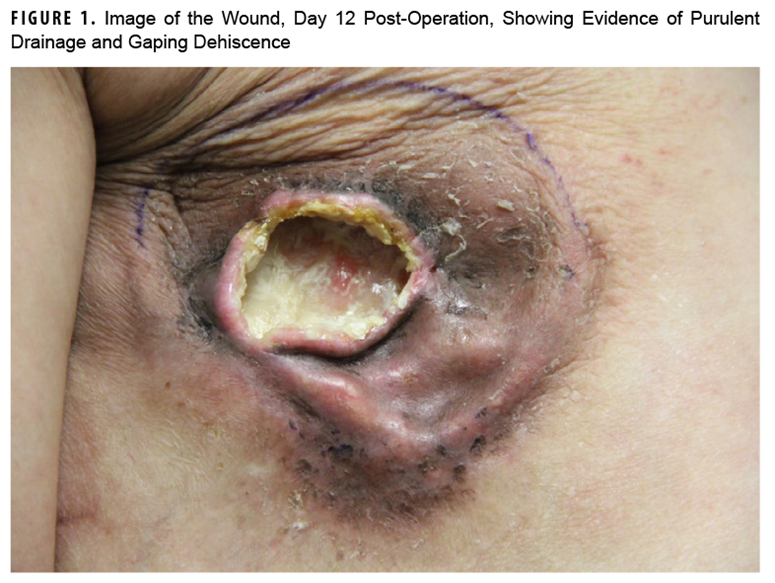 Patient care was transferred from the covering surgeon and was seen on post-operative day 12, when she exhibited purulent drainage and wound dehiscence, prompting the wound to be fully opened for adequate drainage in the clinic, as she refused admission and surgical washout (Figure 1). Fluid was sent to the microbiology laboratory for analysis. Surgical debridement and coverage with a latissimus dorsi flap were recommended, but the patient continued to refuse recommended treatment, so local wound care was continued.
On post-operative day 40, the patient finally agreed to limited surgery and underwent right breast capsulectomy, wound debridement, application of a bilayer wound matrix, and placement of negative pressure wound therapy device. A tissue sample was sent to the microbiology laboratory for further analysis.
The microbiology laboratory identified all isolates from the patient as S. schleiferi based on MALDI-TOF (matrix-assisted laser desorption/ionization time-of-flight) analysis, and all isolates were susceptible to all antibiotics tested. The patient was treated with multiple antibiotics, including trimethoprim/sulfamethoxazole, ciprofloxacin, clindamycin, and levofloxacin. She underwent split-thickness skin grafting to achieve wound coverage and at last follow-up six weeks later was doing well.
For additional analysis, the isolates from the patient were whole genome sequenced on an Illumina MiSeq or NextSeq benchtop sequencer (Illumina, Inc., San Diego, CA), as previously described,7 and sequence analysis was performed using CLC Genomics Workbench (QIAGEN, Germantown, MD). The patient was also asked to swab her pet dog, and bacterial isolates from the dog identified as S. schleiferi by MALDITOF were also sequenced.
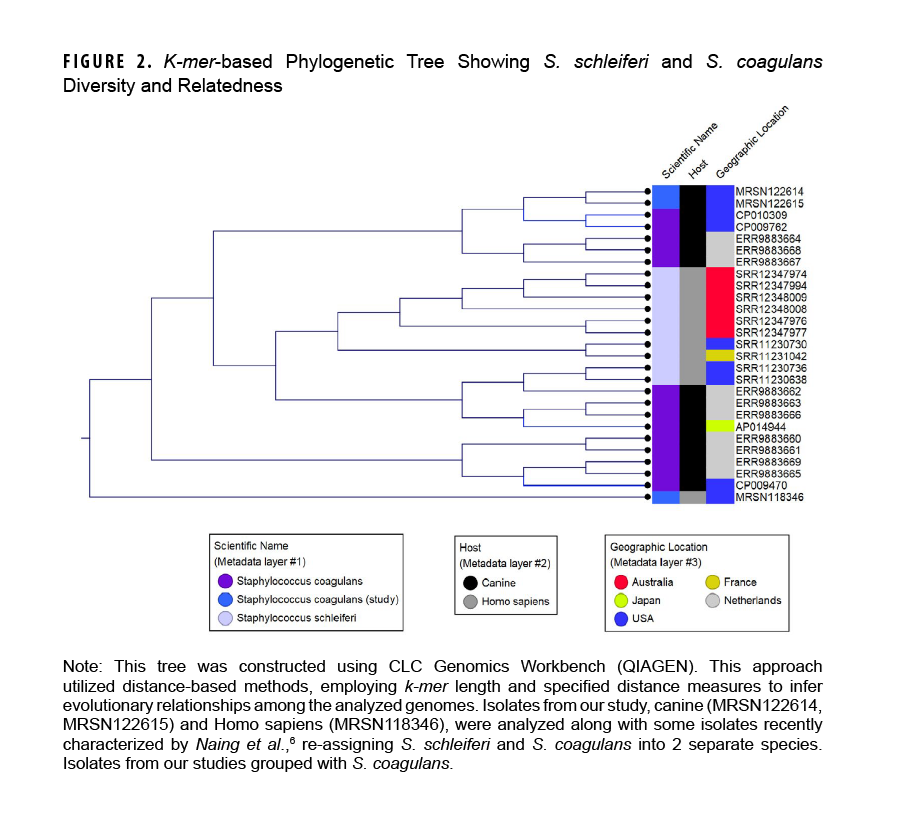
Based on the initial k-mer analysis, the isolates from both the patient and dog closely matched the reference genome CP009762 (https://www.ncbi.nlm.nih.gov/nuccore/CP009762), a canine clinical isolate published in 2015. The patient isolate shared an average nucleotide identity of 98.87% with CP009762, while the dog isolates demonstrated an ANI of 99.98%. Phylogenetic analysis of previously published WGS of S. schleiferi from humans and S. coagulans from canines, along with the isolates from this study, revealed two distinct S. coagulans clusters. The isolates from the patient’s dog grouped within one cluster, whereas the patient’s isolate formed a separate S. coagulans cluster (Figure 2). All three isolates from this study carried the chrA gene, a marker exclusive to S. coagulans. SNP analysis indicated that the dog isolates were closely related, with only 12 SNP differences, while the patient isolate exhibited 16,038 SNP differences, suggesting no genetic relation.
Discussion
To our knowledge, this is the first report of a breast implant infection caused by S. coagulans. When the patient first presented with cellulitis, she was administered multiple antibiotics with no symptom resolution. Interestingly, the bacteria causing the infection were susceptible to the antibiotics with which the patient was treated.
Initially, when asked if she had a pet dog, the patient denied having one. At a later date, after admitting that indeed she had a pet dog, she denied close contact with the animal, nor could she recall experiencing a skin break that may have led to the infection. It is important to note that S. coagulans can colonize human skin, especially those in close contact with dogs.8 Although we could not molecularly confirm that the patient’s infection originated from the dog, it is plausible that the patient was first colonized with the bacteria or was directly infected by the dog, but several months may have passed since the bacterial inoculation occurred. Additionally, the patient collected the specimen from the dog’s mouth instead of the ears, as initially requested, and the polymicrobial nature of the dog’s oral flora may have lowered the chance of obtaining a strain more molecularly related to that found in the patient.
It appeared that this may have been an endogenous infection of the breast implant, which became evident following its surgical removal. For infections related to implants, cure is mostly achieved by device removal, regardless of whether the isolates are susceptible to anti-staphylococcal agents. It has been shown that in surgical infections it can take up to 12 months for a S. schleiferi infection to appear.2 It is plausible that our patient had the infection for some time, forming biofilms that protected the bacteria from her immune system and antibiotics, leading to persistent infections despite susceptibility to the antibiotics of her treatment.9 This may explain why the patient’s vital signs were stable and laboratory markers, including WBC, were within normal range.
A recent study that performed molecular characterization and taxonomic reassignments of the two separate species of S. schleiferi and S. coagulans re-assigned several publicly available reference genomes to the correct species, including CP009762, which is now S. coagulans.6 It is important to clinically differentiate the two species due to differences in host preference, pathogenic potentials, antibiotic resistance profiles, and virulence factors.6,10
S. schleiferi is an important human pathogen, whereas S. coagulans predominantly causes infections in animals, and exhibits greater resistance to antibiotics. Current diagnostic methods routinely used in clinical microbiology laboratories, including MALDI-TOF mass spectrometry, cannot reliably differentiate the two species. In our case study, it would have been clinically relevant to immediately provide accurate identification of S. coagulans versus S. schleiferi. Accurate identification could have significantly influenced initial empirical treatment, given the differences in the drug susceptibility profiles of the organisms. Additionally, precise identification could have provided additional information about the possible source of infection, including pet exposure.
Although MALDI-TOF mass spectrometry can be combined with biochemical property tests for routine identification of S. coagulans,11 development of a molecular test, such as PCR, to facilitate routine differentiation of S. coagulans and S. schleiferi, is urgently needed. Sasaki et al. developed a multiplex PCR method for identifying coagulase-positive Staphylococcus species, which could distinguish several species including S. schleiferi.12 It remains unclear, however, whether that test can differentiate S. coagulans and S. schleiferi, potentially requiring further redevelopment. Such advancements would enhance clinical outcomes by enabling targeted treatment strategies and improving infection control measures.
This case study illustrates the clinical challenges and pathogenicity of S. coagulans in patients with medical devices. The successful management of this infection required a multi-disciplinary approach, including surgical intervention, proper identification of the organism, and targeted antibiotic therapy. The development of a method for discriminating between the two species is required for routine testing.
Author Affiliations
Tripler Army Medical Center, Honolulu, HI: LTC Kamau, MAJ O’Neal, Mr. Tatdanai, MAJ MacArthur, CPT Dombach, LTC Carlson; Medical Technology Department, University of Hawai’i, Mānoa: Dr. Nxedhlana; Multidrug Resistant Organism Repository and Surveillance Network (MRSN), Walter Reed Army Institute of Research, Silver Spring, MD: Dr. Harless
Acknowledgments
The authors would like to acknowledge the support of MRSN and Microbiology Laboratory, Department of Pathology and Area Laboratory Services, whose dedicated professionalism and attention to detail keep our patients safe.
Disclaimer
The views expressed in this case study are those of the authors and do not reflect official policy nor position of the Defense Health Agency, Department of Defense, or the U.S. Government. This work was prepared as part of official duties. Title 17, U.S. Code Section 105 provides that copyright protection is not available for any U.S. Government work, which Title 17, Section 101 defines as a work prepared by a military service member or employee of the U.S. Government as part of official duties. The Human Research Protection Office and Public Affairs Office at Tripler Army Medical Center and the Defense Health Agency reviewed and approved this case study for release.
References
- Davis MF, Cain CL, Brazil AM, Rankin SC. Two coagulase-negative staphylococci emerging as potential zoonotic pathogens: wolves in sheep’s clothing? Front Microbiol. 2013;4:123. doi:10.3389/fmicb.2013.00123
- Célard M, Vandenesch F, Darbas H, et al. Pacemaker infection caused by Staphylococcus schleiferi, a member of the human preaxillary flora: four case reports. Clin Infect Dis. 1997;24(5):1014-1015. doi:10.1093/clinids/24.5.1014
- Kobayashi T, Ikeda M, Ohama Y, et al. First human case of catheter-related blood stream infection caused by Staphylococcus schleiferi subspecies coagulans: a case report and literature review. Ann Clin Microbiol Antimicrob. 2021;20(1):68. doi:10.1186/s12941-021-00474-3
- Hernández JL, Calvo J, Sota R, et al. Clinical and microbiological characteristics of 28 patients with Staphylococcus schleiferi infection. Eur J Clin Microbiol Infect Dis. 2001;20(3):153-158. doi:10.1007/pl00011251
- Jindal A, Shivpuri D, Sood S. Staphylococcus schleiferi meningitis in a child. Pediatr Infect Dis J. 2015;34(3):329. doi:10.1097/inf.0000000000000561
- Naing SY, Duim B, Broens EM, et al. Molecular characterization and clinical relevance of taxonomic reassignment of Staphylococcus schleiferi subspecies into two separate species, Staphylococcus schleiferi and Staphylococcus coagulans. Microbiol Spectr. 2023;11(2):e0467022. doi:10.1128/spectrum.04670-22
- Kamau E, McGann P, Lebreton F, et al. Case report: complicated urinary tract infection due to an extensively resistant Escherichia coli in a returning traveler. MSMR. 2023;30(8):6-9. Accessed Jun. 20, 2025. https://www.health.mil/news/articles/2023/08/01/e-coli-case-report
- Chanchaithong P, Perreten V, Schwendener S, et al. Strain typing and antimicrobial susceptibility of methicillin-resistant coagulase-positive Staphylococcal species in dogs and people associated with dogs in Thailand. J Appl Microbiol. 2014;117(2):572-586. doi:10.1111/jam.12545
- Speziale P, Geoghegan JA. Biofilm formation by Staphylococci and Streptococci: structural, functional, and regulatory aspects and implications for pathogenesis. Front Cell Infect Microbiol. 2015;5:31. doi:10.3389/fcimb.2015.00031
- Sewid AH, Kania SA. Distinguishing characteristics of Staphylococcus schleiferi and Staphylococcus coagulans of human and canine origin. PLoS One. 2024;19(2):e0296850. doi:10.1371/journal.pone.0296850
- Kobayashi T, Ikeda M, Ohama Y, et al. First human case of catheter-related blood stream infection caused by Staphylococcus schleiferi subspecies coagulans: a case report and literature review. Ann Clin Microbiol Antimicrob. 2021;20(1):68. doi:10.1186/s12941-021-00474-3
- Sasaki T, Tsubakishita S, Tanaka Y, et al. Multiplex-PCR method for species identification of coagulase-positive Staphylococci. J Clin Microbiol. 2010;48(3):765-769. doi:10.1128/jcm.01232-09