Recurring headache, a broad term that includes chronic migraine as well as other headache diagnoses, is a major cause of lost duty time among U.S. military women.1 Migraine, in particular, is as much as three times more prevalent among women and is the headache type most affected by changes in estrogen levels that may result from biological processes (e.g., menopause, pregnancy) or use of exogenous hormones (e.g., hormonal contraceptives).2
Although prior studies have compared recurring headache among male and female service members,3-5 few have focused on the association of recurring headache with women’s health issues.6 Furthermore, the availability of treatments for certain headache diagnoses, such as use of contraceptives to treat migraine without aura, suggests that studies of recurring headache and women’s health issues could inform targeted health care strategies.7
This cross-sectional study of self-reported “recurring headaches/migraines,” referred to in this report as “recurring headache,” focused on 2 specific aims: 1) examining univariate associations of recurring headache with demographics and women’s health characteristics and 2) examining age-specific associations of recurring headache with menstrual-related issues.
Methods
Data for this cross-sectional study were drawn from the 2021 Periodic Health Assessment.8 The PHA is a standardized, annual health assessment for all military services that assesses individuals’ medical readiness. The PHA is comprehensive and collects data on survey items related to chronic medical conditions such as recurring headache and women’s health issues.
The PHA Data Sharing Agreement restricted analyses to U.S. Navy and Marine Corps personnel through 2021. Because a new version of the PHA questionnaire was introduced mid-2021, assessments in this study included those completed from August through December 2021. The main outcome was recorded as a closed question prompt on the PHA that asks for self-reported experience of “recurring headaches/migraines” within the prior year. The PHA asks survey participants, “Since your last PHA, have you experienced any of the following health conditions that either required medical care or impacted your duty performance (or both) and if so, what is your status?”
To examine recurring headache status (regardless of medical care or performance), we dichotomized answers to ‘yes’ or ‘no’. Women’s health variables of interest were hypothesized determinants (or surrogates for determinants) of recurring headache, reflecting putative relevance to estrogen-associated migraine: pregnancy history, contraceptive methods, history of total hysterectomy (as a surrogate for oophorectomy), post-menopausal status, and menstrual-related issues.2 Women’s health questions and possible answers from the PHA are displayed in Table 1. Demographics included age (in years), pay grade (% enlisted), number of deployments (%≥1), service branch (% Marine Corps or Navy), service component (% active duty or reserve), and “temporary profile or temporary limited duty” (LIMDU/TLD) status (% ‘yes’).
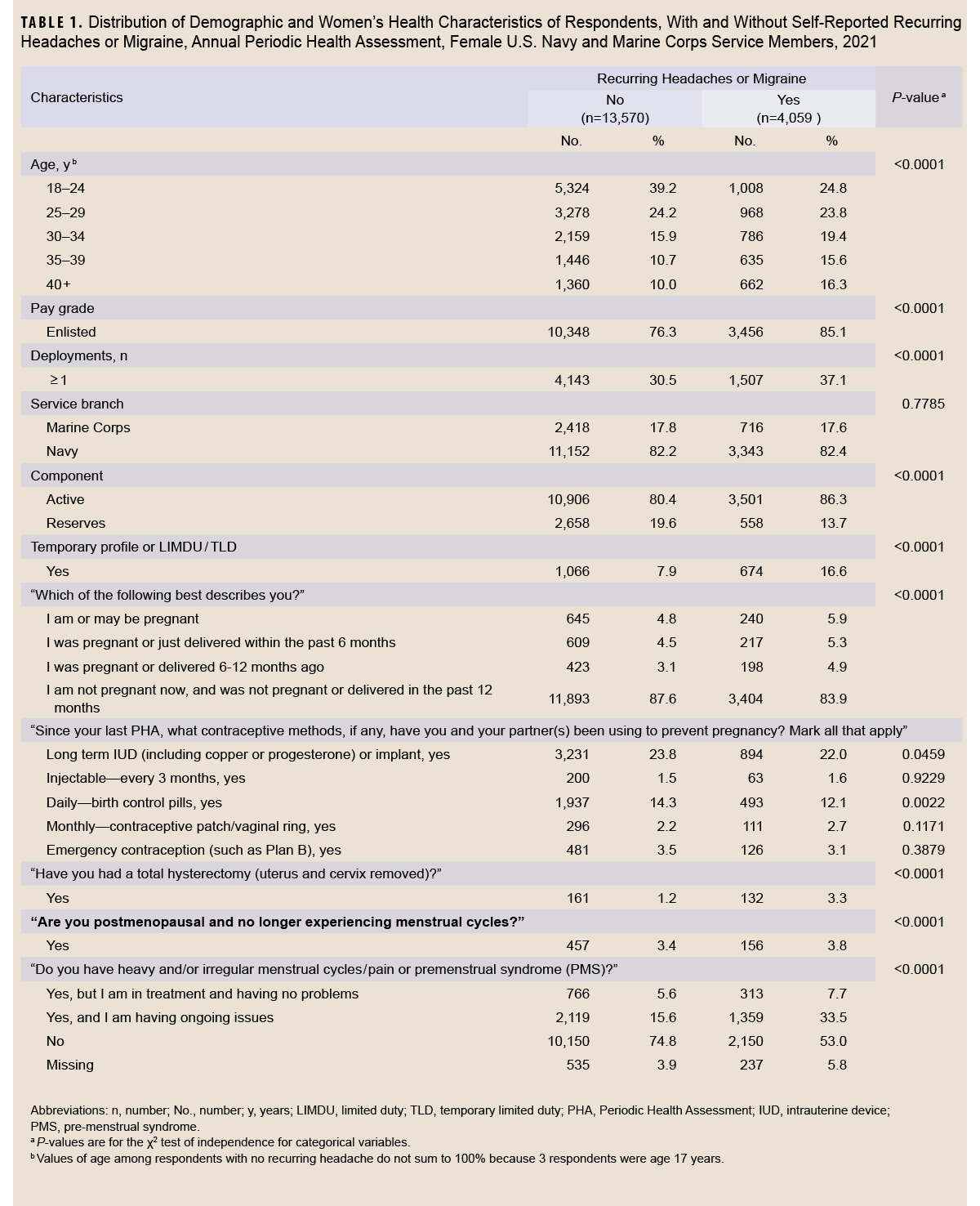
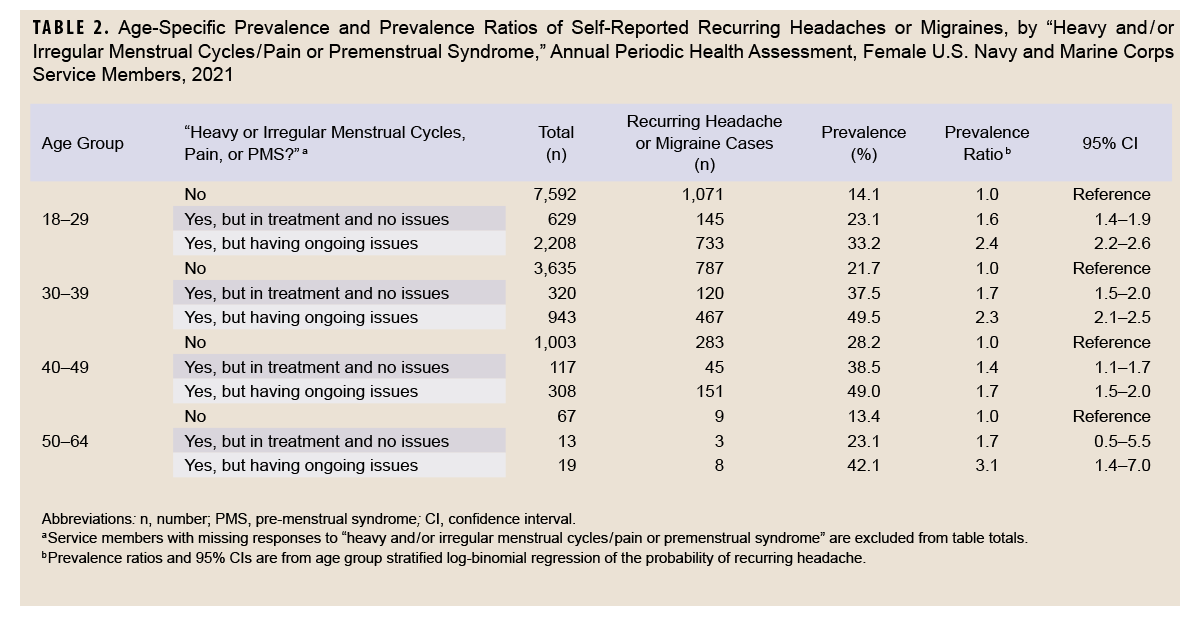
To examine distributions of demographics for women’s health characteristics—Aim 1—we displayed percentages among women with or without self-reported recurring headache. P-values were computed from t-tests or Chi-square tests. For Aim 2, to examine age-specific associations of recurring headache with menstrual-related issues (i.e., responding ‘yes’, or endorsing heavy and/or irregular menstrual cycles/pain or pre-menstrual syndrome), we used log-binomial regression to test interaction terms for statistical significance, defined as p<0.05. Estimates were stratified into 4 age groups: 18–29, 30–39, 40–49, and 50–64 years. Age-specific prevalence ratios and 95% percent confidence intervals were estimated from log-binomial regression of the probability of recurring headache.
Results
Overall, 17,629 women who completed the 2021 PHA were included in this study. The prevalence of self-reported recurring headache was 23.0%. Table 1 demographics show that women with self-reported recurring headache were more likely than women without self-reported recurring headache to be older, enlisted, deployed at least once, active duty, or on LIMDU/TLD. Associations with women’s health variables suggest that those with recurring headache, compared to those without, were more likely to endorse “[are] or may be pregnant,” history of total hysterectomy, or post-menopausal status. The occurrence of menstrual-related issues was strongly associated with recurring headache, particularly among those who endorsed ongoing issues. Notably, univariate associations showed that women with recurring headache were less likely to report using a long-term intrauterine device (22.0% vs. 23.8%, p=0.0459) or daily birth control pills (12.1% vs. 14.3%, p=0.0022).
As shown in Table 2, age-specific associations of recurring headache with menstrual-related issues were stronger among women in the younger age groups, particularly those who endorsed having ongoing issues. P-values for each interaction term of age (as a continuous covariate) and menstrual-related issues (“Yes, but in treatment and no issues” or “Yes, but having ongoing issues”) were p=0.6313 and p=0.0711, respectively. PRs and 95% CIs of recurring headache among women with ongoing menstrual-related issues (compared with no issues) were 2.4 (2.2, 2.6); 2.3 (2.1, 2.5); 1.7 (1.5, 2.0); and 3.1 (1.4, 7.0)—among women ages 18–29, 30–39, 40–49, and 50–64 years, respectively. Among women 50–64 years of age, wider CIs likely reflected a smaller sample in this age group.
Discussion
This study indicated a high prevalence of self-reported recurring headache (23.0%) during a 5-month period in 2021 among U.S. Navy and Marine Corps women. This study’s numbers approximate 2011 findings from the Millennium Cohort Study, which included female U.S. active duty, reserve, and Guard members (n=12,409), and reported provider-diagnosed migraine or recurrent severe headache occurrence within the past year among 20.9% or 22.3% of military women, respectively.9 These estimates are higher than the female general population’s annual prevalence (17%)10 but lower than lifetime migraine prevalence (30.1%) among female veterans.3
Although the present study could not differentiate between specific headache diagnoses, noted associations with estrogen-related health characteristics suggest that a substantial proportion of women may be at risk for estrogen-associated migraines upon clinical evaluation.2 This cross-sectional study could not establish temporal relationships between variables of interest, and our findings have limited ability to support causal inference. Nevertheless, the lower prevalence of recurring headache among women in treatment for menstrual-related issues warrants consideration of whether individuals reporting ongoing menstrual-related issues could benefit from hormonal contraception or other hormone-related treatments of estrogen-associated headache,11 which is consistent with the literature.2,12
This work adds to the literature on recurring headache among women in the U.S. Navy and Marine Corps. Limitations of this preliminary study include an inability to differentiate between diagnostic subtypes of headache, absence of covariates of interest not recorded by the PHA, and cross-sectional analysis that precludes causal inference. Strengths of this work include its large sample size and estimation of age-specific prevalences. Additional work is needed to understand patterns of headache and migraine among U.S. military women, but this study highlights the importance and relevance of women’s health issues in female service members with recurring headache.
Author Affiliations
Naval Health Research Center, San Diego, CA: Dr. Romine, Ms. Dougherty, Dr. Hessert, Dr. MacGregor; Leidos, Inc., San Diego: Dr. Romine, Ms. Dougherty
Disclaimer
The authors are military service members or employees of the U.S. Government. This work was prepared as part of official duties. Title 17, U.S.C. §105 provides that copyright protection is not available for any work of the U.S. Government. Title 17, U.S.C. §101 defines a U.S. Government work as work prepared by a military service member or employee of the U.S. Government as part of official duties. This report was supported by the U.S. Navy Bureau of Medicine and Surgery under work unit 60808. The views expressed in this article are those of the authors and do not necessarily reflect official policy nor position of the Department of the Navy, Department of Defense, or the U.S. Government. The study protocol was approved by the Naval Health Research Center Institutional Review Board in compliance with all applicable Federal regulations governing the protection of human subjects. Research data were derived from an approved Naval Health Research Center Institutional Review Board protocol, NHRC.2003.0025.
References
- Martin CB. Migraines and other headaches, active components, US Armed Forces, 2001-2007. MSMR. 2008;15(4):6-10. Accessed Apr. 17, 2025. https://www.health.mil/reference-center/reports/2008/01/01/medical-surveillance-monthly-report-volume-15-number-4
- O’Neal MA. Estrogen-associated migraine headache, including menstrual migraine. In: Barbieri RL, ed. UpToDate. Updated May 23, 2023. Accessed Apr. 17, 2025. https://www.uptodate.com/contents/estrogen-associated-migraine-headache-including-menstrual-migraine
- Gasperi M, Schuster NM, Franklin B, et al. Migraine prevalence, environmental risk, and comorbidities in men and women veterans. JAMA Netw Open. 2024;7(3):e242299. doi:10.1001/jamanetworkopen.2024.2299
- Sico JJ, Seng EK, Wang K, et al. Characteristics and gender differences of headache in the Veterans Health Administration: a national cohort study, fiscal year 2008-2019. Neurology. 2022;99(18):e1993-e2005. doi:10.1212/wnl.0000000000200905
- Taubman SB. Risk factors for migraine after OEF/OIF deployment, active component, US Armed Forces. MSMR. 2009;16(12):10-13. Accessed Apr. 17, 2025. https://www.health.mil/reference-center/reports/2009/01/01/medical-surveillance-monthly-report-volume-16-number-12
- McDermott MC, Musilli MG, Brown JE, et al. Female-specific health care of military female-designated service members and veterans: a systematic overview of reviews. Mil Med. 2024;189(9-10):221-223. doi:10.1093/milmed/usae101
- Trego LL, Middleton MCA, Centi S, et al. The Military Women’s Health Delphi Study: a research agenda for the next decade. Mil Med. 2023;188(suppl 4):32-40. doi:10.1093/milmed/usac271
- Office of the Under Secretary of Defense for Personnel and Readiness. DoD Instruction 6200.06: Periodic Health Assessment (PHA) Program. U.S. Dept. of Defense. Updated Apr. 18, 2025. Accessed Apr. 30, 2025. https://www.esd.whs.mil/portals/54/documents/dd/issuances/dodi/620006p.pdf
- Jankosky CJ, Hooper TI, Granado NS, et al. Headache disorders in the millennium cohort: epidemiology and relations with combat deployment. Headache. 2011;51(7):1098-1111. doi:10.1111/j.1526-4610.2011.01914.x
- Cutrer FM. Pathophysiology, clinical manifestations, and diagnosis of migraine in adults. In: Swanson JW, ed. UpToDate. Wolters Kluwer. Updated Nov. 6, 2024. Accessed Apr. 17, 2025. https://www.uptodate.com/contents/pathophysiology-clinical-manifestations-and-diagnosis-of-migraine-in-adults
- Ricker EA, Goforth CW, Barrett AS, Deuster PA, de la Motte SJ. Female military officers report a desire for menstrual suppression during military training. Mil Med. 2021;186(suppl 1):775-783. doi:10.1093/milmed/usaa339
- Edelman A. Continuous or extended cycle vs. cyclic use of combined hormonal contraceptives for contraception. Cochrane Database Syst Rev. 2014;(7):cd004695. doi:10.1002/14651858.cd004695.pub3