Long-acting reversible contraception includes forms of birth control that offer strong combinations of efficacy, safety, and convenience, such as subdermal implants and intrauterine devices.1 In the U.S., LARC use is estimated to be twice as prevalent among active duty service members compared with the general population (23.0% vs. 10.4%).2,3 The number of active duty LARC users increased by 19.0% between 2016 and 2019, from 50,365 to 59,942.2
While unintended pregnancy following LARC placement is rare (<1.0%),1,4 there is a paucity of research among ADSMs, a population in which unintended pregnancy has major implications for military readiness.5 This descriptive study examined demographic, military, and medical characteristics of unintended pregnancies diagnosed after LARC placement in U.S. ADSMs, including pregnancies due to LARC failure as well as pregnancies undetected at time of LARC placement.
Methods 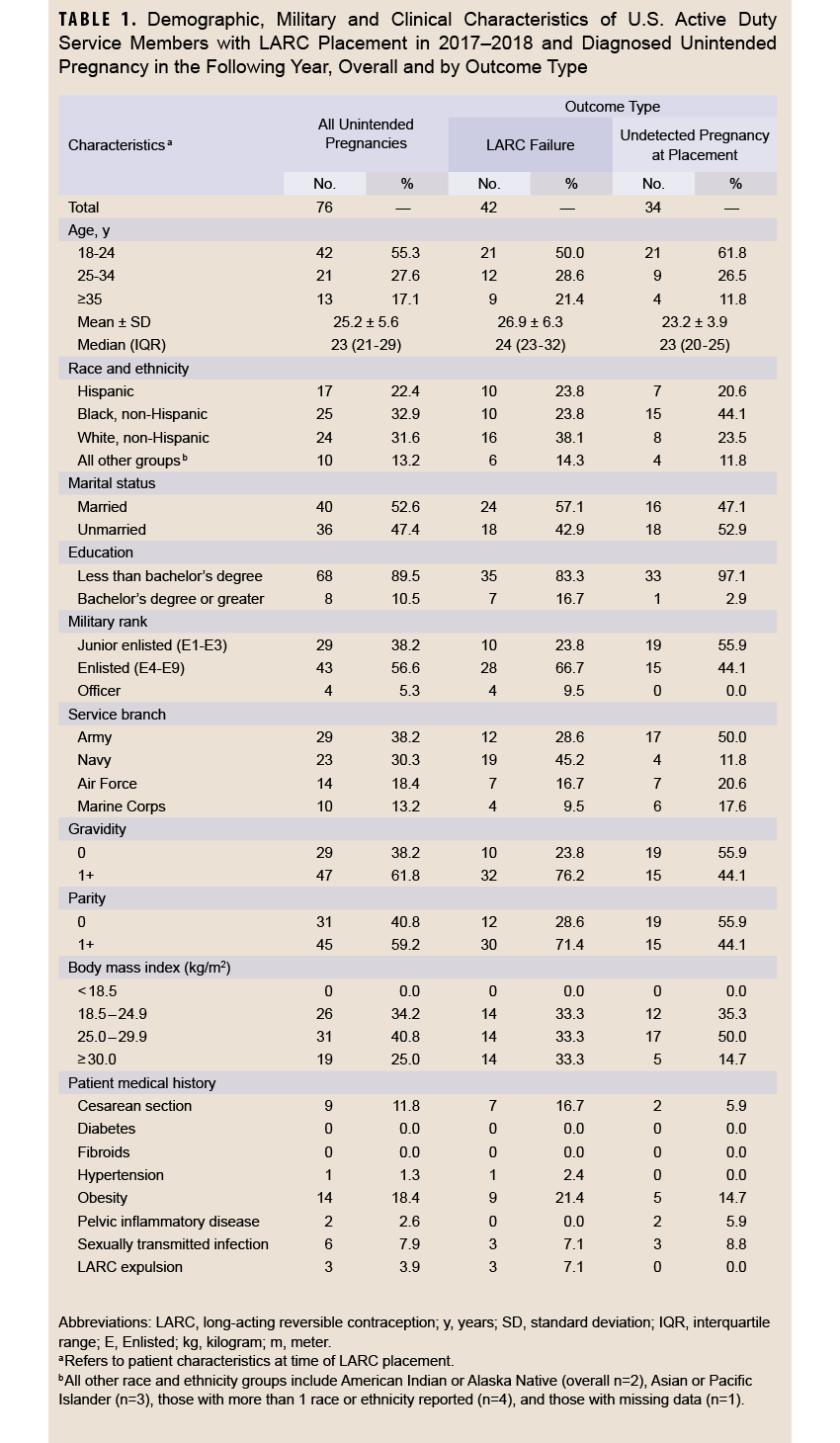
This study utilized medical encounter data from the Military Health System Data Repository, military personnel data from Defense Manpower Data Center, as well as data abstracted from patient electronic health records. Medical encounter data included care received at either military or civilian facilities coded with International Classification of Diseases and Current Procedural Terminology codes. Data were linked using the unique Electronic Data Interchange Personal Identifier assigned to each ADSM.
The study population included confirmed cases of unintended pregnancy diagnosed after LARC placement. Suspected cases were first screened from medical encounter data; this group included ADSMs who had LARC placement at a military clinic in 2017 or 2018 (ICD-10 diagnosis code Z30.430; ICD-10 procedure codes 0UH[9,C]xHZ; CPT codes 11981, 58300), indication of pregnancy within 12 months after placement (ICD-10 diagnosis codes Z32.01, Z[33,34,36].x, O[03,09,20].x, O26.3), and no indication of LARC removal or re-insertion prior to pregnancy (ICD-10 diagnosis codes Z30.43[2,3]; ICD-10 procedure codes 0UPDxHZ; CPT codes 11976, 11982-83, 58301). Suspected cases were confirmed using information abstracted from patient EHRs; all cases had no records of LARC removal prior to pregnancy diagnosis and were described as unintended pregnancies.
Cases were categorized into 2 types, based on estimated timing of conception relative to placement: LARC failure or undetected pregnancy at placement. Date of conception was calculated by adding 2 weeks to the date of last menstrual period, as obtained from patient self-reporting or pregnancy ultrasound records.6 Estimated dates of conception occurring more than one week after LARC placement were considered LARC failures, while all others were estimated to be already pregnant at LARC placement.
All variables were abstracted from patient EHRs except for race and ethnicity, marital status, education, rank, and service branch, which were derived from DMDC files from the month of LARC placement. Characteristics were assessed overall and by outcome type (LARC failure or undetected pregnancy at placement) using descriptive and summary statistics. Statistical analysis was completed using SAS Enterprise Guide, version 8.3.
Institutional Review Board approval for this study was obtained from the Naval Health Research Center (protocol NHRC.1999.0003) and informed consent was waived per 32 Code of Federal Regulations §219.116(d).
Results
Initial screening identified 466 ADSMs with suspected pregnancy within 1 year following LARC placement that occurred in 2017 or 2018. After EHR review, 76 (16.3%) cases were confirmed as unintended pregnancies, of which 42 (55.3%) occurred in ADSMs who experienced LARC failure and 34 (44.7%) were among those with undetected pregnancy at LARC placement. Most cases had determined LMP from patient self-reporting at time of LARC placement versus ultrasound dating (72.4 vs. 27.6%; data not shown).
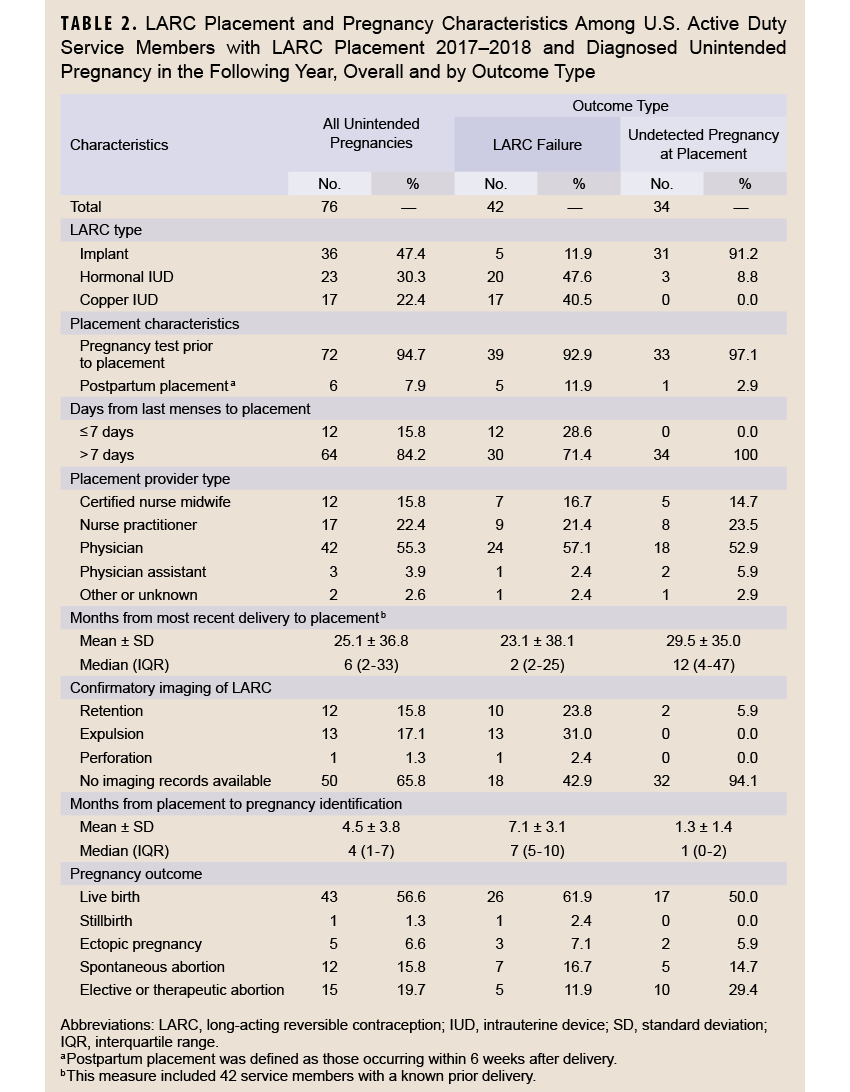
Most cases occurred among ADSMs aged 18-24 years at LARC placement (55.3%), married (52.6%), and of enlisted military rank (94.7%) (Table 1). Compared with patients who experienced LARC failure, those with undetected pregnancy at placement were younger and more likely of non-Hispanic Black race or ethnicity, junior enlisted rank, in the Army, and never previously pregnant. Most LARC failures occurred among patients with an IUD (88.1%), while nearly all patients already pregnant at placement received a subdermal implant (91.2%) (Table 2). Overall, almost all cases (94.7%) had completed a pregnancy test prior to LARC placement. Almost half of cases (43.4%) ended in a non-live birth outcome.
Discussion
In this study of unintended pregnancies diagnosed after LARC placement, the majority of cases occurred among young, enlisted ADSMs; about half of cases were unmarried, and one-third were never previously pregnant. These characteristics generally suggest a patient population with reduced social support and limited independence from the military, which providers should be aware of when offering LARC-related care.
The American College of Obstetricians and Gynecologists guidelines state that implants and IUDs can be placed any time during the menstrual cycle if there is reasonable certainty a patient is not pregnant.1 This study found only 34 instances in which providers were unable to detect or reasonably rule out pregnancy at contraceptive initiation, suggesting some variation in recommended practice guidelines,1,7 or incomplete or inaccurate dating of patients’ recent sexual histories or LMPs, albeit rare.
To be reasonably certain a patient is not pregnant at LARC placement, providers should follow the pregnancy checklist recommended by the Centers for Disease Control and Prevention, as these criteria are highly accurate in ruling out pregnancy (i.e., negative predictive value of 99-100%).7 Editing checks within EHRs (e.g., re-entering dates to facilitate patient recall and avoid entry errors) and improved patient-provider communication (e.g., through shared decision-making vs. traditional provider-driven model8,9) can also help promote optimal LARC selection and timing of placement.
While calculation of a formal LARC failure rate was outside the scope of this study, only 42 failures were identified over the 2-year period, most of which were among patients with IUDs. This number is small and consistent with existing evidence that shows extremely high effectiveness (i.e., failure rates <1.0%) of LARC methods.1,4
Study limitations include potential misclassification of outcome type (LARC failure or undetected pregnancy at placement), as date of LMP was most often derived from patient self-reporting at time of LARC placement rather than ultrasound dating. Available EHRs lacked information on how a provider ruled out pregnancy at LARC placement (other than performing a pregnancy test) or determined or corrected LMP from ultrasound records, further hindering LMP estimate reliability. Among the 466 ADSMs screened for unintended pregnancy following LARC placement, only 16.3% were confirmed cases, demonstrating the value of EHR use to identify true unintended pregnancies. Remaining cases were not confirmed due to various circumstances (e.g., no pregnancy, LARC removal before pregnancy). Limited resources did not allow for abstraction of LARC placements with no pregnancy; therefore, this study could not determine whether certain characteristics were associated with an increased risk for unintended pregnancy or LARC failure.
The consequences of unintended pregnancy can be significant for ADSMs, their support systems, and service units (e.g., extended non-deployability). If unintended pregnancy occurs while in a military theater of operation, increased costs incur due to medical evacuation and personnel replacement. Independent of deployment status, unintended pregnancy also results in quality of life adjustments for ADSMs as well as their unit personnel, with potential effects on ADSM retention, mission readiness, and unit cohesion.5 Active duty status may also influence a service member’s decision to maintain a pregnancy. Ongoing efforts to improve contraceptive access, use, and reliability are critical for preserving operational readiness and career advancement opportunities among this population, while also decreasing health care expenditures.
Author Affiliations
Deployment Health Research Department, Naval Health Research Center, San Diego, CA: Dr. Hall, Ms. Burrell, Dr. Khodr, Ms. Romano, Ms. Gumbs, Dr. Conlin; Leidos, Inc., San Diego: Dr. Hall, Ms. Burrell, Dr. Khodr, Ms. Romano, Ms. Gumbs; Walter Reed National Military Medical Center, Bethesda, MD: Dr. Elmore
Acknowledgments
The authors would like to acknowledge the contributions made by Sandra Michelle Magallon to the initial drafts of this report.
Disclaimer
Dr. Conlin and Dr. Elmore are employees of the U.S. Government. This work was prepared as part of official duties. Title 17, U.S.C. §105 provides that copyright protection is not available for any work of the U.S. Government. Title 17, U.S.C. §101 defines a U.S. Government work as work prepared by a military service member or an employee of the U.S. Government as part of official duties. Report 24-60 was supported by the U.S. Navy Bureau of Medicine and Surgery under work unit 60504.
The views expressed in this work are those of the authors and do not necessarily reflect the official policy nor position of the Department of the Navy, Department of Defense, or U.S. Government. Identification of specific products and scientific instrumentation is integral to the scientific endeavor and does not constitute endorsement nor implied endorsement on part of the authors, Department of Defense, or any component agency.
The study protocol was approved by the Naval Health Research Center Institutional Review Board in compliance with all applicable federal regulations governing protection of human subjects. Research data were derived from an approved Naval Health Research Center Institutional Review Board protocol, NHRC.1999.0003.
References
- Committee on Practice Bulletins-Gynecology, Long-Acting Reversible Contraception Working Group. Practice bulletin no. 186: long-acting reversible contraception: implants and intrauterine devices. Obstet Gynecol. 2017;130(5):e251-e269. doi:10.1097/aog.0000000000002400
- Lotridge JA, Stahlman SL, Patel DM, et al. Long-acting reversible contraceptive use, active component service women, US Armed Forces, 2016-2020. MSMR. 2021;28(7):2-10. Accessed Apr. 18, 2025. https://www.health.mil/news/articles/2021/07/01/long-acting-msmr
- Daniels K, Abma JC. Current Contraceptive Status Among Women Aged 15-49: United States, 2017-2019. NCHS Data Brief no. 388. National Center for Health Statistics, Centers for Disease Control and Prevention, U.S. Dept. of Health and Human Services. 2020. Accessed Mar. 13, 2025. https://www.cdc.gov/nchs/products/databriefs/db388.htm
- Baker CC, Creinin MD. Long-acting reversible contraception. Obstet Gynecol. 2022;140(5):883-897. doi:10.1097/aog.0000000000004967
- Janvrin ML, Banaag A, Lawry LL, Scott R, Koehlmoos T. Estimates of unintended pregnancy among US active-duty service women and the impact on Women Peace and Security objectives as measured by potential readiness days lost. BMJ Mil Health. 2025;Jan 14:e002654. doi:10.1136/military-2023-002654
- American College of Obstetricians and Gynecologists, American Institute of Ultrasound in Medicine, Society for Maternal-Fetal Medicine. Committee opinion no 700: methods for estimating the due date: practice guideline. Obstet Gynecol. 2017;129(5):e150-e154. doi:10.1097/aog.0000000000002046
- Curtis KM, Nguyen AT, Tepper NK, et al. U.S. selected practice recommendations for contraceptive use, 2024. MMWR Recomm Rep. 2024;73(3):1-77. doi:10.15585/mmwr.rr7303a1
- American College of Obstetricians and Gynecologists’ Committee on Health Care for Underserved Women, Contraceptive Equity Expert Work Group, Committee on Ethics. Patient-centered contraceptive counseling: ACOG committee statement number 1. Obstet Gynecol. 2022;139(2):350-353. doi:10.1097/aog.0000000000004659
- Dehlendorf C, Grumbach K, Schmittdiel JA, Steinauer J. Shared decision making in contraceptive counseling. Contraception. 2017;95(5):452-455. doi:10.1016/j.contraception.2016.12.010