The Department of Defense Global Respiratory Pathogen Surveillance Program is an active sentinel respiratory surveillance program that resides at the Defense Centers for Public Health–Dayton, located at Wright-Patterson Air Force Base. The DoDGRPSP assesses influenza vaccine effectiveness among Military Health System beneficiaries at 118 sites worldwide.
This mid-season analysis includes respiratory specimens from MHS beneficiaries who sought outpatient medical care from November 24, 2024 through March 15, 2025 at a military hospital or clinic and met the influenza-like illness case definition. DoDGRPSP methods, including ILI case definition, questionnaire submission, vaccination ascertainment, specimen collection, transportation, testing, and sequencing, have been previously described.1
A test-negative, case-control study design was used to estimate influenza VE against symptomatic laboratory-confirmed influenza. Cases were defined as an ILI patient testing positive for any influenza virus (sub)type with control specimens that had tested negative for influenza. Vaccinated patients were those receiving the 2024-2025 influenza vaccine at least 14 days before symptom onset. Those vaccinated less than 14 days before specimen collection were excluded. VE methodology has previously been described.2,3
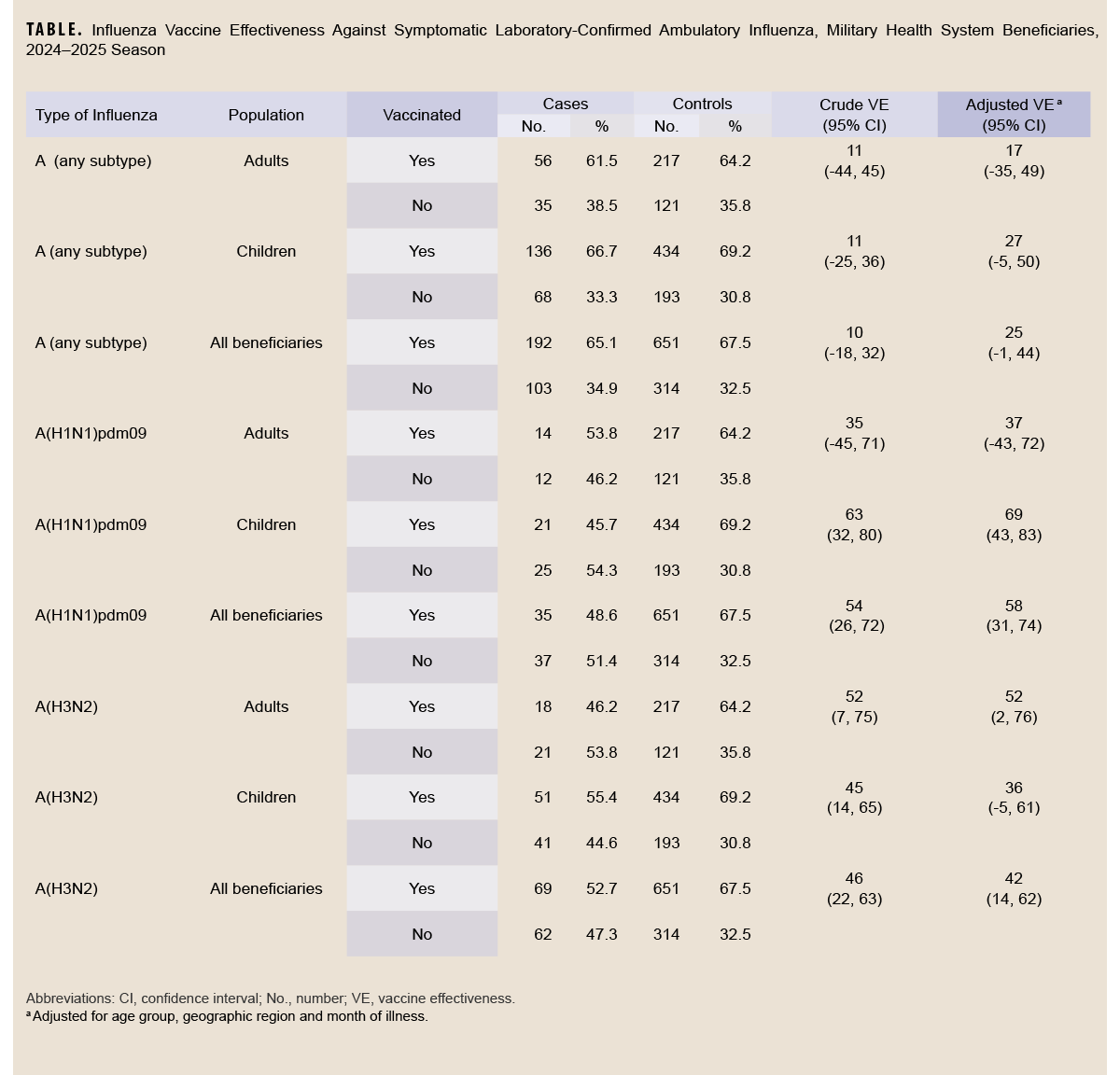
Specimens were analyzed at Landstuhl Regional Medical Center, Incirlik AB, and DCPH-D by real-time reverse transcriptase-polymerase chain reaction and/or viral culture (at DCPH-D only). VE analyses were conducted for influenza A (any subtype), influenza A(H1N1)pdm09, and A(H3N2) for all beneficiaries, adults as well as children. VE estimates were adjusted for confounding factors such as age group, month of illness, and geographic region. Service members, patients less than 6 months old, and individuals with unknown vaccination status were excluded from VE analysis. The analysis included 295 participants who tested positive for influenza and 965 controls who tested negative for influenza.
Adjusted VE estimates among all beneficiaries for influenza A (any subtypes), influenza A(H1N1)pdm09, and influenza A(H3N2) were 25% (95% confidence interval [CI] -1, 44), 58% (95% CI, 31, 74), and 42% (95% CI, 14, 62), respectively. Adjusted VE for children was 27% (95% CI, -5, 50), 69% (95% CI, 43, 83), and 36% (95% CI, -5, 61), while among adults it was 17% (95% CI, -35, 49), 37% (95% CI, -43, 72), and 52% (95% CI, 2, 76) for influenza A (any subtype), influenza A(H1N1)pdm09, and influenza A(H3N2), respectively. VE for influenza B was not calculated due to a small number of cases.
This study reports low to moderate VE, but not all estimates were significant. There was moderate effectiveness against influenza A(H1N1)pdm09 in all beneficiaries and children ages 6 months to 17 years. In adults (ages 18-64 years) and all beneficiaries there was moderate effectiveness against influenza A(H3N2). VE estimates against influenza A (any subtype) for all beneficiaries, children, and adults were non-significant and not effective among children for influenza A(H3N2) and in adults for influenza A(H1N1)pdm09.
Author Affiliations
Defense Centers for Public Health–Dayton, Defense Health Agency, Wright-Patterson Air Force Base, Dayton, OH: Mr. Kwaah, Ms. DeMarcus, Mr. Thervil, Ms. Jenkins, Ms. Hartless, Dr. Heh, Dr. Fries, Dr. Evengue, Mr. Gruner, Dr. Muehleman; JYG Innovations, LLC, Dayton: Mr. Gruner, Dr. Muehleman; Innovative Element, LLC, Beavercreek, OH: Mr. Kwaah, Ms. DeMarcus, Mr. Thervil, Ms. Jenkins, Ms. Hartless, Dr. Heh; U.S. Air Force School of Aerospace Medicine Epidemiology Laboratory, Wright-Patterson Air Force Base: Dr. Fries
Disclaimer
This study was funded by the Global Emerging Infections Surveillance Branch of the Armed Forces Health Surveillance Division, ProMIS ID P0114. The views expressed are those of the authors and do not reflect the official guidance nor position of the U.S. Government, Department of Defense, or Department of the Air Force.
References
- Kwaah B, Gruner WE, DeMarcus L, et al. Surveillance trends for SARS-CoV-2 and other respiratory pathogens among US military health system beneficiaries, 27 September 2020–2 October 2021. MSMR. 2022;29(7):2-10. Accessed Apr. 29, 2025. https://www.health.mil/news/articles/2022/07/01/sur-sar2-msmr
- Hu W, Gruner WE, DeMarcus LS, et al. Influenza surveillance trends and influenza vaccine effectiveness among Department of Defense beneficiaries during the 2019–2020 influenza season. MSMR. 2021;28(3):2-8. Accessed Apr. 29, 2025. https://www.health.mil/news/articles/2021/03/01/influenza-surv-msmr-2021
- Eick-Cost AA, Thervil JW, Hu Z, DeMarcus LS. Mid-season influenza vaccine effectiveness estimates among DOD populations: a composite of data presented at VRBPAC–the Vaccines and Related Biological Products Advisory Committee–2024 meeting on influenza vaccine strain selection for the 2024-2025 influenza season. MSMR. 2024;31(3):20-23. Accessed Apr. 29, 2025. https://www.health.mil/news/articles/2024/03/01/msmr-flu-vaccine-effectiveness