Surveillance Snapshot: Mid-Season Vaccine Effectiveness Estimates for Influenza: the Department of Defense Global Respiratory Pathogen Surveillance Program, 2024-2025 Season

Image of 9CDC_James Gathany_23214. The Department of Defense Global Respiratory Pathogen Surveillance Program assesses influenza vaccine effectiveness among Military Health System beneficiaries globally.
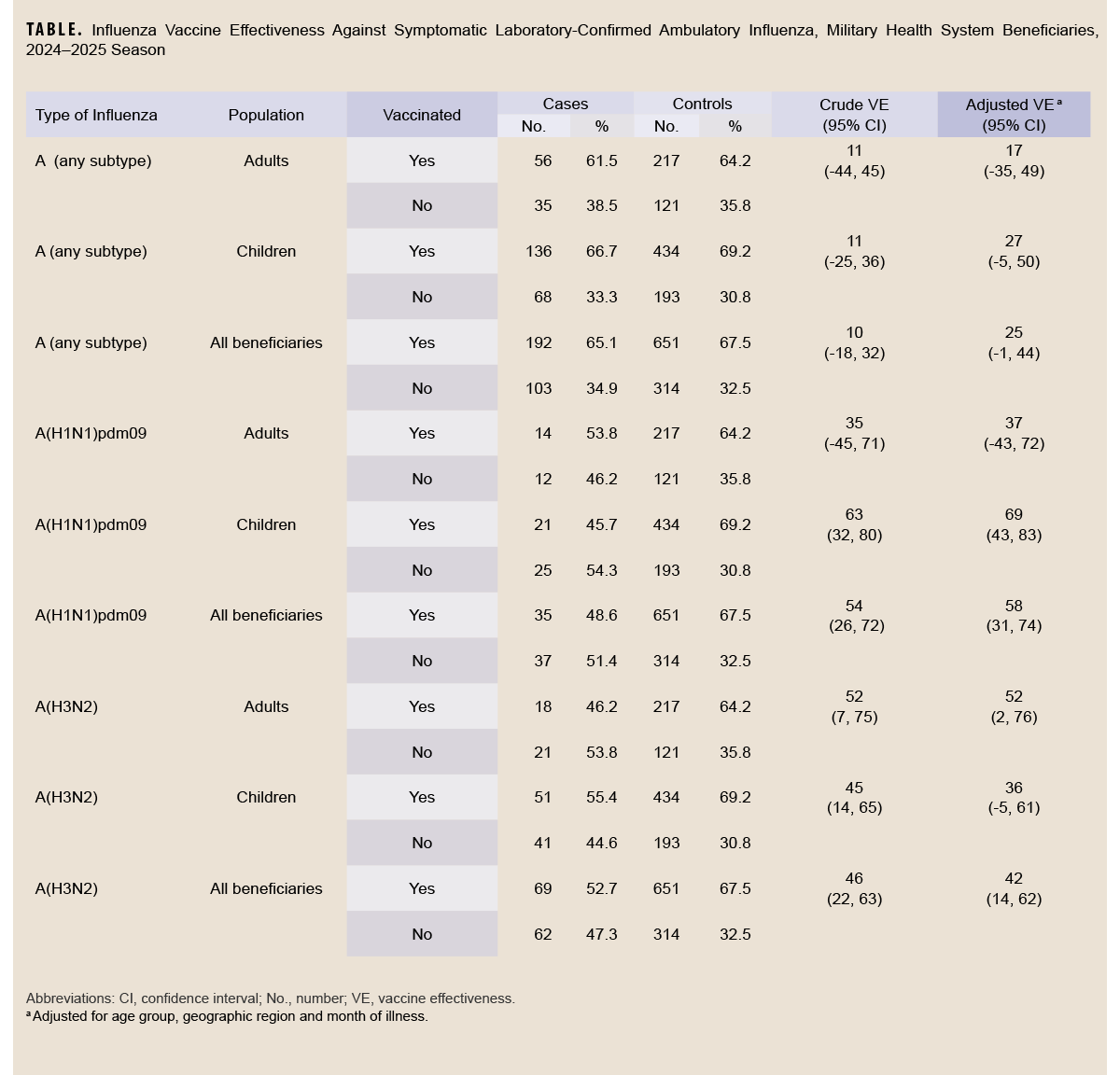
Click on the table to access a Section 508-compliant version

The Department of Defense Global Respiratory Pathogen Surveillance Program is an active sentinel respiratory surveillance program that resides at the Defense Centers for Public Health–Dayton, located at Wright-Patterson Air Force Base. The DoDGRPSP assesses influenza vaccine effectiveness among Military Health System beneficiaries at 118 sites worldwide.

This mid-season analysis includes respiratory specimens from MHS beneficiaries who sought outpatient medical care from November 24, 2024 through March 15, 2025 at a military hospital or clinic and met the influenza-like illness case definition. DoDGRPSP methods, including ILI case definition, questionnaire submission, vaccination ascertainment, specimen collection, transportation, testing, and sequencing, have been previously described.1

A test-negative, case-control study design was used to estimate influenza VE against symptomatic laboratory-confirmed influenza. Cases were defined as an ILI patient testing positive for any influenza virus (sub)type with control specimens that had tested negative for influenza. Vaccinated patients were those receiving the 2024-2025 influenza vaccine at least 14 days before symptom onset. Those vaccinated less than 14 days before specimen collection were excluded. VE methodology has previously been described.2,3

Specimens were analyzed at Landstuhl Regional Medical Center, Incirlik AB, and DCPH-D by real-time reverse transcriptase-polymerase chain reaction and/or viral culture (at DCPH-D only). VE analyses were conducted for influenza A (any subtype), influenza A(H1N1)pdm09, and A(H3N2) for all beneficiaries, adults as well as children. VE estimates were adjusted for confounding factors such as age group, month of illness, and geographic region. Service members, patients less than 6 months old, and individuals with unknown vaccination status were excluded from VE analysis. The analysis included 295 participants who tested positive for influenza and 965 controls who tested negative for influenza.

Adjusted VE estimates among all beneficiaries for influenza A (any subtypes), influenza A(H1N1)pdm09, and influenza A(H3N2) were 25% (95% confidence interval [CI] -1, 44), 58% (95% CI, 31, 74), and 42% (95% CI, 14, 62), respectively. Adjusted VE for children was 27% (95% CI, -5, 50), 69% (95% CI, 43, 83), and 36% (95% CI, -5, 61), while among adults it was 17% (95% CI, -35, 49), 37% (95% CI, -43, 72), and 52% (95% CI, 2, 76) for influenza A (any subtype), influenza A(H1N1)pdm09, and influenza A(H3N2), respectively. VE for influenza B was not calculated due to a small number of cases.

This study reports low to moderate VE, but not all estimates were significant. There was moderate effectiveness against influenza A(H1N1)pdm09 in all beneficiaries and children ages 6 months to 17 years. In adults (ages 18-64 years) and all beneficiaries there was moderate effectiveness against influenza A(H3N2). VE estimates against influenza A (any subtype) for all beneficiaries, children, and adults were non-significant and not effective among children for influenza A(H3N2) and in adults for influenza A(H1N1)pdm09.

Author Affiliations

Defense Centers for Public Health–Dayton, Defense Health Agency, Wright-Patterson Air Force Base, Dayton, OH: Mr. Kwaah, Ms. DeMarcus, Mr. Thervil, Ms. Jenkins, Ms. Hartless, Dr. Heh, Dr. Fries, Dr. Evengue, Mr. Gruner, Dr. Muehleman; JYG Innovations, LLC, Dayton: Mr. Gruner, Dr. Muehleman; Innovative Element, LLC, Beavercreek, OH: Mr. Kwaah, Ms. DeMarcus, Mr. Thervil, Ms. Jenkins, Ms. Hartless, Dr. Heh; U.S. Air Force School of Aerospace Medicine Epidemiology Laboratory, Wright-Patterson Air Force Base: Dr. Fries

Disclaimer

This study was funded by the Global Emerging Infections Surveillance Branch of the Armed Forces Health Surveillance Division, ProMIS ID P0114. The views expressed are those of the authors and do not reflect the official guidance nor position of the U.S. Government, Department of Defense, or Department of the Air Force.

References

  1. Kwaah B, Gruner WE, DeMarcus L, et al. Surveillance trends for SARS-CoV-2 and other respiratory pathogens among US military health system beneficiaries, 27 September 2020–2 October 2021. MSMR. 2022;29(7):2-10. Accessed Apr. 29, 2025. https://www.health.mil/news/articles/2022/07/01/sur-sar2-msmr 
  2. Hu W, Gruner WE, DeMarcus LS, et al. Influenza surveillance trends and influenza vaccine effectiveness among Department of Defense beneficiaries during the 2019–2020 influenza season. MSMR. 2021;28(3):2-8. Accessed Apr. 29, 2025. https://www.health.mil/news/articles/2021/03/01/influenza-surv-msmr-2021 
  3. Eick-Cost AA, Thervil JW, Hu Z, DeMarcus LS. Mid-season influenza vaccine effectiveness estimates among DOD populations: a composite of data presented at VRBPAC–the Vaccines and Related Biological Products Advisory Committee–2024 meeting on influenza vaccine strain selection for the 2024-2025 influenza season. MSMR. 2024;31(3):20-23. Accessed Apr. 29, 2025. https://www.health.mil/news/articles/2024/03/01/msmr-flu-vaccine-effectiveness

You also may be interested in...

Report
Jul 1, 2022

MSMR Vol. 29 No. 07 - July 2022

.PDF | 1.67 MB

A monthly publication of the Armed Forces Health Surveillance Division. This issue of the peer-reviewed journal contains the following articles: Surveillance trends for SARS-CoV-2 and other respiratory pathogens among U.S. Military Health System Beneficiaries, Sept. 27, 2020 – Oct. 2,2021; Establishment of SARS-CoV-2 genomic surveillance within the ...

Article
Jun 1, 2022

Morbidity Burdens Attributable to Various Illnesses and Injuries, Deployed Active and Reserve Component Service Members, U.S. Armed Forces, 2021

As in previous years, among service members deployed during 2021, injury/poisoning, musculoskeletal diseases and signs/symptoms accounted for more than half of the total health care burden during deployment. Compared to garrison disease burden, deployed service members had relatively higher proportions of encounters for respiratory infections, skin ...

Article
Jun 1, 2022

Absolute and Relative Morbidity Burdens Attributable to Various Illnesses and Injuries, Non-service Member Beneficiaries of the Military Health System, 2021

In 2021, mental health disorders accounted for the largest proportions of the morbidity and health care burdens that affected the pediatric and younger adult beneficiary age groups. Among adults aged 45–64 and those aged 65 or older, musculoskeletal diseases accounted for the most morbidity and health care burdens. As in previous years, this report ...

Article
Jun 1, 2022

Absolute and Relative Morbidity Burdens Attributable to Various Illnesses and Injuries, Active Component, U.S. Armed Forces, 2021

In 2021, as in prior years, the medical conditions associated with the most medical encounters, the largest number of affected service members, and the greatest number of hospital days were in the major categories of injuries, musculoskeletal disorders, and mental health disorders. Despite the pandemic, COVID-19 accounted for less than 2% of total ...

Article
Jun 1, 2022

Hospitalizations, Active Component, U.S. Armed Forces, 2021

The hospitalization rate in 2021 was 48.0 per 1,000 person-years (p-yrs), the second lowest rate of the most recent 10 years. For hospitalizations limited to military facilities, the rate in 2021 was the lowest for the entire period. As in prior years, the majority (71.2%) of hospitalizations were associated with diagnoses in the categories of mental ...

Article
Jun 1, 2022

Ambulatory Visits, Active Component, U.S. Armed Forces, 2021

In 2021, the overall numbers and rates of active component service member ambulatory care visits were the highest of any of the last 10 years. Most categories of illness and injury showed modest increases in numbers and rates. The proportions of ambulatory care visits that were accomplished via telehealth encounters fell to under 15% in 2021, compared ...

Article
Jun 1, 2022

Medical Evacuations out of the U.S. Central and U.S. Africa Commands, Active and Reserve Components, U.S. Armed Forces, 2021

The proportions of evacuations out of USCENTCOM that were due to battle injuries declined substantially in 2021. For USCENTCOM, evacuations for mental health disorders were the most common, followed by non-battle injury and poisoning, and signs, symptoms, and ill-defined conditions. For USAFRICOM, evacuations for non-battle injury and poisoning were ...

Article
May 1, 2022

Update: Sexually Transmitted Infections, Active Component, U.S. Armed Forces, 2013–2021

This illustration depicts a 3D computer-generated image of a number of drug-resistant Neisseria gonorrhoeae bacteria. CDC/James Archer

This report summarizes incidence rates of the 5 most common sexually transmitted infections (STIs) among active component service members of the U.S. Armed Forces during 2013–2021. In general, compared to their respective counterparts, younger service members, non-Hispanic Black service members, those who were single and other/unknown marital status, ...

Article
May 1, 2022

The Association Between Two Bogus Items, Demographics, and Military Characteristics in a 2019 Cross-sectional Survey of U.S. Army Soldiers

NIANTIC, CT, UNITED STATES 06.16.2022 U.S. Army Staff Sgt. John Young, an information technology specialist assigned to Joint Forces Headquarters, Connecticut Army National Guard, works on a computer at Camp Nett, Niantic, Connecticut, June 16, 2022. Young provided threat intelligence to cyber analysts that were part of his "Blue Team" during Cyber Yankee, a cyber training exercise meant to simulate a real world environment to train mission essential tasks for cyber professionals. (U.S. Army photo by Sgt. Matthew Lucibello)

Data from surveys may be used to make public health decisions at both the installation and the Department of the Army level. This study demonstrates that a vast majority of soldiers were likely sufficiently engaged and answered both bogus items correctly. Future surveys should continue to investigate careless responding to ensure data quality in ...

Refine your search