Surveillance Snapshot: Contraceptive Use Trends from the Periodic Health Assessment Among Female Active Duty U.S. Sailors and Marines, 2018–2023

Image of 66680994. Birth control methods are self-reported during annual Periodic Health Assessments of active duty U.S. service members.

This Surveillance Snapshot highlights trends in birth control methods among female active duty U.S. sailors and marines. Birth control methods are self-reported during annual Periodic Health Assessments of active duty U.S. service members. This analysis captures data on birth control use including long-acting reversible contraceptives, short-acting reversible contraceptives, intrauterine devices, implants, barrier methods, emergency contraception, sterilization, fertility awareness, or lack of use among individuals not actively taking steps to prevent pregnancy. These findings offer insights into active duty females’ preferences and behaviors beyond clinical data and may inform Defense Health Agency policies for enhancing female force readiness.
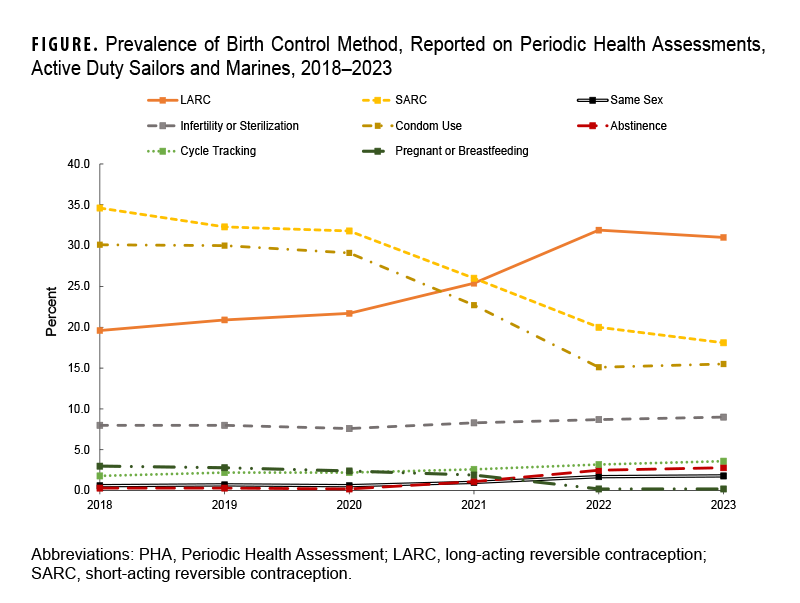
FIGURE. Prevalence of Birth Control Method, Reported on Periodic Health Assessments, Active Duty Sailors and Marines, 2018–2023. This figure presents a graph of eight discrete lines of data along the horizontal, or x-, axis. The eight lines of data along the x axis chart specific birth control methods: LARC (or long-acting reversible contraception), infertility or sterilization, cycle tracking, SARC (or short-acting reversible contraception), condom use, pregnant or breastfeeding, same sex, and abstinence. Each line connects six data points, with each point representing an individual year during the surveillance period. The vertical, or y-, axis measures the percent of use for each method, in units of 5, from 0 to 40. LARC use increased noticeably in 2021 and 2022, with a slight decline in 2023, from approximately 20 percent in 2020 to around 30 percent in 2023. At the beginning of the surveillance period, SARC and condom use were the most prevalent, at 35 and 30 percent, respectively, but both declined markedly as LARC use rose; in 2023 SARC use was approximately 18 percent and condom use was just over 15 percent. All other methods remained relatively constant, with infertility or sterilization the fourth most common, at just under 10 percent. All other methods were consistently below five percent.

This analysis examined responses to question 22 on PHA DD Form 3204, versions 1 and 2, for calendar years 2018–2023.1 The population included active duty female sailors and marines, ages 18-52 years. Version 2 of the form was introduced in August 2021 and retained the contraceptive questioning structure of version 1, allowing women to select why they may not be taking steps to prevent pregnancy. Contraceptive variables and free-text responses were used to determine prevalence of LARCs, SARCs, and other pregnancy prevention methods, which included infertility or sterilization (of the service member or partner), condom use, abstinence, fertility awareness methods, and pregnancy or breastfeeding. Alternatively, respondents could select a response indicating that pregnancy prevention was not needed (e.g., same sex partner[s], intention to conceive).

Among all PHAs completed and certified with medical provider signature (n=277,633), only 24.3% (n=67,430) included responses to assessment items on contraceptive methods. Among women with a response indicating at least one birth control method during the study period, the Figure illustrates the distribution of birth control methods by type. Self-reported SARC and condom use decreased from 34.6% to 18.1%, and 30.1% to 15.5%, respectively, from 2018 to 2023. Self-reported LARC use showed an upward trend, rising from 19.6% in 2018 to 31.0% in 2023. During the study period, the percentage of active duty women reporting same-sex relationships increased from 0.6% to 1.8%, but remained below 2%; abstinence increased from 0.3% to 2.8%, but remained below 3%; infertility increased from 8.0% to 9.0%; cycle tracking and family planning increased from 1.8% to 3.6%. Breastfeeding as a method to prevent pregnancy remained consistently low during the period of analysis, never exceeding 2.8% of responses. PHAs with free-text responses to ‘other’ contraceptive methods (n=1,713), which could not be classified into the categories described, were excluded from the analysis.

It is important to note that PHA data consist of self-reported physical health information and do not represent actual diagnoses, or prescriptions written, filled, or taken. Nevertheless, this information has value, providing insights into reproductive health trends affecting force readiness and resilience, for informed health care strategies.

Author Affiliations

Battelle Memorial Institute, supporting the Defense Centers for Public Health–Portsmouth, VA: Ms. Rodriguez, Ms. Gonzales; Defense Centers for Public Health–Portsmouth, EpiData Center, Defense Health Agency: Ms. Kelsey

Reference

  1. Department of Defense Forms Management Program. DD3024. Accessed Apr. 10, 2025. https://www.esd.whs.mil/directives/forms/dd3000_3499/dd3024

You also may be interested in...

Article
Apr 1, 2024

Reportable Medical Events at Military Health System Facilities Through Week 9, Ending March 2, 2024

This report provides a monthly updatea of Reportable Medical Events documented in the Disease Reporting System internet (DRSi) by health care providers and public health officials throughout the Military Health System. Reportable Medical Events are a critical tool for monitoring, controlling, and preventing the occurrence and spread of diseases of ...

Article
Mar 1, 2024

Tobacco and Nicotine Use Among Active Component U.S. Military Service Members: A Comparison of 2018 Estimates from the Health Related Behaviors Survey and the Periodic Health Assessment

This study compared estimates of the prevalence of and risk factors for tobacco and nicotine use obtained from the 2018 Health Related Behaviors Survey and Periodic Health Assessment survey. The HRBS and the PHA are important Department of Defense sources of data on health behavior collected from U.S. military service members.

Article
Mar 1, 2024

Mid-Season Influenza Vaccine Effectiveness Estimates Among DOD Populations: A Composite of Data Presented at VRBPAC—the Vaccines and Related Biological Products Advisory Committee—2024 Meeting on Influenza Vaccine Strain Selection for the 2024-2025 Influenza Season

This is an introduction to a composite of three Surveillance Snapshots of Department of Defense data on mid-season influenza vaccine effectiveness that were presented at the 2024 VRBPAC meeting.

Report
Mar 1, 2024

MSMR Vol. 31 No. 3 - March 2024

.PDF | 1.34 MB

The March 2024 MSMR features a comparison of 2018 estimates from the HRBS and the PHA on tobacco and nicotine use among the U.S. military active component; followed by a report on coverage of HIV PrEP among active duty service members in 2023; supplemented by a Surveillance Snapshot of HIV PrEP prescriptions in 2023 in the active component; then a ...

Article
Mar 1, 2024

Coverage of HIV Pre-Exposure Prophylaxis Within the Active Duty U.S. Military, 2023

This study provides the first estimate of HIV pre-exposure prophylaxis coverage in the U.S. military, defined as the proportion of the persons taking HIV PrEP out of the estimated number of persons who had indications for it, that is also comparable to U.S. civilian estimates. The population with indications for HIV PrEP was obtained from the ...

Refine your search