Surveillance Snapshot: Contraceptive Use Trends from the Periodic Health Assessment Among Female Active Duty U.S. Sailors and Marines, 2018–2023

Image of 66680994. Birth control methods are self-reported during annual Periodic Health Assessments of active duty U.S. service members.

This Surveillance Snapshot highlights trends in birth control methods among female active duty U.S. sailors and marines. Birth control methods are self-reported during annual Periodic Health Assessments of active duty U.S. service members. This analysis captures data on birth control use including long-acting reversible contraceptives, short-acting reversible contraceptives, intrauterine devices, implants, barrier methods, emergency contraception, sterilization, fertility awareness, or lack of use among individuals not actively taking steps to prevent pregnancy. These findings offer insights into active duty females’ preferences and behaviors beyond clinical data and may inform Defense Health Agency policies for enhancing female force readiness.
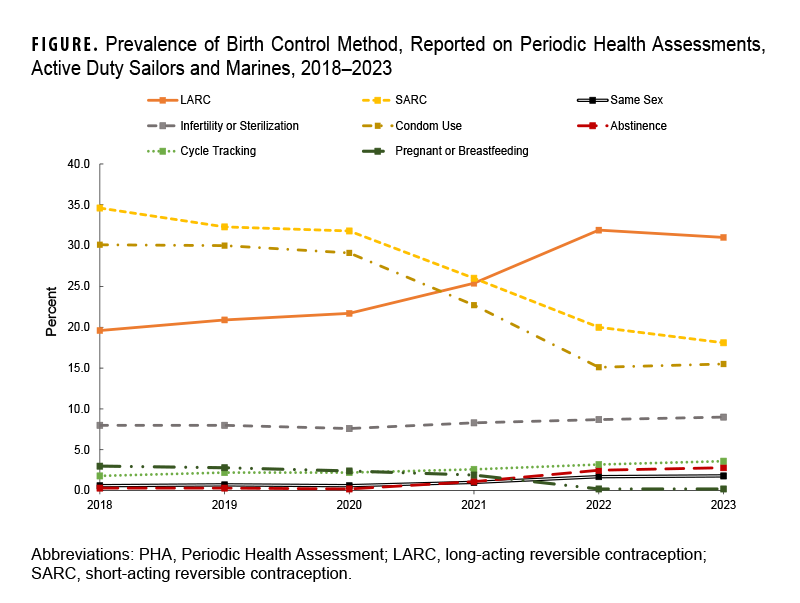
FIGURE. Prevalence of Birth Control Method, Reported on Periodic Health Assessments, Active Duty Sailors and Marines, 2018–2023. This figure presents a graph of eight discrete lines of data along the horizontal, or x-, axis. The eight lines of data along the x axis chart specific birth control methods: LARC (or long-acting reversible contraception), infertility or sterilization, cycle tracking, SARC (or short-acting reversible contraception), condom use, pregnant or breastfeeding, same sex, and abstinence. Each line connects six data points, with each point representing an individual year during the surveillance period. The vertical, or y-, axis measures the percent of use for each method, in units of 5, from 0 to 40. LARC use increased noticeably in 2021 and 2022, with a slight decline in 2023, from approximately 20 percent in 2020 to around 30 percent in 2023. At the beginning of the surveillance period, SARC and condom use were the most prevalent, at 35 and 30 percent, respectively, but both declined markedly as LARC use rose; in 2023 SARC use was approximately 18 percent and condom use was just over 15 percent. All other methods remained relatively constant, with infertility or sterilization the fourth most common, at just under 10 percent. All other methods were consistently below five percent.

This analysis examined responses to question 22 on PHA DD Form 3204, versions 1 and 2, for calendar years 2018–2023.1 The population included active duty female sailors and marines, ages 18-52 years. Version 2 of the form was introduced in August 2021 and retained the contraceptive questioning structure of version 1, allowing women to select why they may not be taking steps to prevent pregnancy. Contraceptive variables and free-text responses were used to determine prevalence of LARCs, SARCs, and other pregnancy prevention methods, which included infertility or sterilization (of the service member or partner), condom use, abstinence, fertility awareness methods, and pregnancy or breastfeeding. Alternatively, respondents could select a response indicating that pregnancy prevention was not needed (e.g., same sex partner[s], intention to conceive).

Among all PHAs completed and certified with medical provider signature (n=277,633), only 24.3% (n=67,430) included responses to assessment items on contraceptive methods. Among women with a response indicating at least one birth control method during the study period, the Figure illustrates the distribution of birth control methods by type. Self-reported SARC and condom use decreased from 34.6% to 18.1%, and 30.1% to 15.5%, respectively, from 2018 to 2023. Self-reported LARC use showed an upward trend, rising from 19.6% in 2018 to 31.0% in 2023. During the study period, the percentage of active duty women reporting same-sex relationships increased from 0.6% to 1.8%, but remained below 2%; abstinence increased from 0.3% to 2.8%, but remained below 3%; infertility increased from 8.0% to 9.0%; cycle tracking and family planning increased from 1.8% to 3.6%. Breastfeeding as a method to prevent pregnancy remained consistently low during the period of analysis, never exceeding 2.8% of responses. PHAs with free-text responses to ‘other’ contraceptive methods (n=1,713), which could not be classified into the categories described, were excluded from the analysis.

It is important to note that PHA data consist of self-reported physical health information and do not represent actual diagnoses, or prescriptions written, filled, or taken. Nevertheless, this information has value, providing insights into reproductive health trends affecting force readiness and resilience, for informed health care strategies.

Author Affiliations

Battelle Memorial Institute, supporting the Defense Centers for Public Health–Portsmouth, VA: Ms. Rodriguez, Ms. Gonzales; Defense Centers for Public Health–Portsmouth, EpiData Center, Defense Health Agency: Ms. Kelsey

Reference

  1. Department of Defense Forms Management Program. DD3024. Accessed Apr. 10, 2025. https://www.esd.whs.mil/directives/forms/dd3000_3499/dd3024

You also may be interested in...

Article
Jul 1, 2023

Absolute and Relative Morbidity Burdens Attributable to Various Illnesses and Injuries Among Non-Service Member Beneficiaries of the Military Health System, 2022

This report represents an updated summary of care provided to non-service members in the MHS during calendar year 2022. MHS beneficiaries are diverse and heterogeneous, including active component service members, activated National Guard and Reserve service members, active component immediate family, retirees, and their family members, with differing ...

Article
Jun 1, 2023

Absolute and Relative Morbidity Burdens Attributable to Various Illnesses and Injuries Among Active Component Members, U.S. Coast Guard, 2022

This report employs the same disease classification system and health care burden measures as employed in the MSMR burden analysis of the U.S. Armed Forces active component to quantify the impacts of various illnesses and injuries among members of the active component of the U.S. Coast Guard in 2022.

Article
Jun 1, 2023

Absolute and Relative Morbidity Burdens Attributable to Various Illnesses and Injuries Among Active Component Members, U.S. Armed Forces, 2022

This annual summary uses several health care burden measures to quantify the impacts of various illnesses and injuries in 2022 among members of the active component of the U.S. Armed Forces. Health care burden metrics include the total number of medical encounters, individuals affected, and hospital bed days.

Report
Jun 1, 2023

MSMR Vol. 30 No. 6 - June 2023

.PDF | 1.55 MB

This annual issue quantifies the impacts of various illnesses and injuries in 2022 among members of the active component of the U.S. Armed Forces as well as the U.S. Coast Guard; health care burden metrics include the total number of medical encounters, including hospitalizations and ambulatory services, as well as numbers and types of individuals ...

Report
May 1, 2023

MSMR Vol. 30 No. 5 - May 2023

.PDF | 1023.59 KB

The May 2023 MSMR reintroduces a monthly reportable medical event (RME) summary for the active component and MHS beneficiaries; then features a review of enhanced mpox outbreak case detection among MHS beneficiaries through ESSENCE (Electronic Surveillance System for the Early Notification of Community-based Epidemics); followed by a report on ...

Article
May 1, 2023

Enhanced Mpox Outbreak Case Detection Among MHS Beneficiaries Through Use of ESSENCE (Electronic Surveillance System for the Early Notification of Community-based Epidemics)

A colorized scanning electron microscopic image of the mpox virus on the surface of infected VERO E6 cells

This report describes how ESSENCE, which collects near real-time biosurveillance data globally on U.S. military personnel, monitored the mpox outbreak in 2002 and assesses its detection of confirmed/probable cases among MHS beneficiaries. ESSENCE systematically queries millions of health encounters to detect records of potential public health ...

Article
May 1, 2023

Increasing Incidence Rates of Eosinophilic Esophagitis in Active Component Service Members, U.S. Armed Forces, 2009–2021

A respiratory therapist visualizes the vocal chords of a patient using an endoscopy tool

This study examines the incidence of eosinophilic esophagitis among the active component of the U.S. Armed Forces from 2009 to 2021. Reported prevalence has been increasing worldwide, with a recent meta-analysis estimating 34.2 cases per 100,000 persons.

Article
May 1, 2023

Portable RT-PCR and MinION Nanopore Sequencing as a Proof-of-Concept SARS-CoV-2 Biosurveillance in Wastewater

Wastewater treatment facility

This study reports on the efficacy of 2 different portable nucleic acid detection technologies, RT-PCR and MinION Mk1C nanopore sequencing, which identified SARS-CoV-2 variants in wastewater collected at Tyndall AFB during a 2-month surveillance. This highly multiplexed approach circumvented signal dropout associated with the detection of newly ...

Refine your search