Surveillance Snapshot: Mid-Season Influenza Vaccine Effectiveness Against Laboratory-Confirmed Ambulatory Influenza Among U.S. Active Component Service Members, December 1, 2024–February 8, 2025

Image of 4CDC_Dan Higgins23224. The months of December through February constitute the period of peak activity for the annual influenza season.

This Surveillance Snapshot provides an overview of the 2024-2025 mid-season analysis of influenza vaccine effectiveness against medically-attended ambulatory influenza infections among active component U.S. service members.
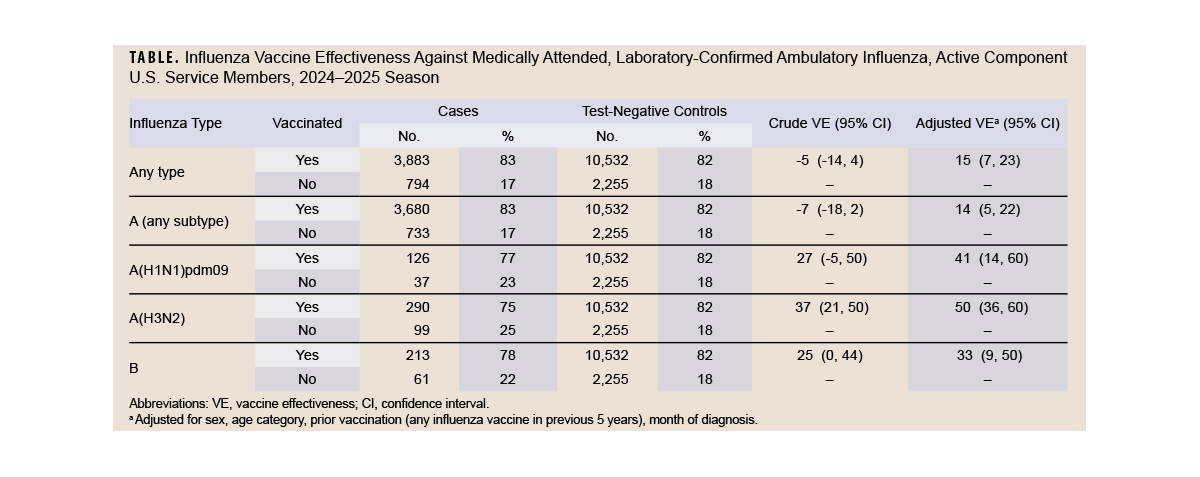
A case test-negative study design was implemented among the population of active component service members from all services who were tested for influenza between December 1, 2024 and February 8, 2025—the period of peak influenza activity for the season. Data from the Defense Medical Surveillance System and standardized laboratory data provided by the Defense Centers for Public Health–Portsmouth were used for this analysis.1 Cases were defined as individuals with a positive influenza result from a rapid antigen, reverse transcription polymerase chain reaction, or culture influenza assay. Test-negative controls were individuals with a negative influenza result from a RT-PCR or culture influenza assay. Crude odds ratios were calculated, and multivariate logistic regression was used to calculate adjusted ORs (adjusted for sex, age category, any influenza vaccination in the previous five years, and month of diagnosis) and 95% confidence intervals. Estimates of VE were defined as (1 – OR) x 100.

There were 4,677 cases (4,413 A any subtype, 389 A[H3N2], 163 A[H1N1]pdm09, 274 B any subtype) and 12,787 TNC. Ten cases were both influenza A- and influenza B-positive. VE varied by influenza type (Table). Adjusted VE estimates for all influenza types and subtypes reached statistical significance. The results indicate moderate mid-season protection against influenza A(H1N1)pdm09 (adjusted VE 41%; 95% CI, 14-60) and A(H3N2) (adjusted VE 50%; 95% CI, 36-60) and low mid-season protection against influenza A (any subtype) (adjusted VE 14%; 95% CI, 5-22) and influenza B (adjusted VE 33%; 95% CI, 9-50).

The results of this analysis show low to moderate mid-season protection of the 2024-2025 seasonal influenza vaccines against medically-attended influenza A and B infections that resulted in an ambulatory care visit among ACSMs. As these estimates were obtained during the middle of the influenza season, VE estimates and confidence intervals may change when data for the full season are available and the sample sizes increase.

Authors’ Affiliation

Epidemiology and Analysis Branch, Armed Forces Health Surveillance Division, Public Health Directorate, Defense Health Agency, Silver Spring, MD: Dr. Cost, Ms. Hu

References 

  1. Rubertone MV, Brundage JF. The Defense Medical Surveillance System and the Department of Defense serum repository: glimpses of the future of public health surveillance. Am J Public Health. 2002;92(12):1900-1904. doi:10.2105/ajph.92.12.1900

You also may be interested in...

Article
Jun 1, 2022

Hospitalizations, Active Component, U.S. Armed Forces, 2021

The hospitalization rate in 2021 was 48.0 per 1,000 person-years (p-yrs), the second lowest rate of the most recent 10 years. For hospitalizations limited to military facilities, the rate in 2021 was the lowest for the entire period. As in prior years, the majority (71.2%) of hospitalizations were associated with diagnoses in the categories of mental ...

Article
Jun 1, 2022

Medical Evacuations out of the U.S. Central and U.S. Africa Commands, Active and Reserve Components, U.S. Armed Forces, 2021

The proportions of evacuations out of USCENTCOM that were due to battle injuries declined substantially in 2021. For USCENTCOM, evacuations for mental health disorders were the most common, followed by non-battle injury and poisoning, and signs, symptoms, and ill-defined conditions. For USAFRICOM, evacuations for non-battle injury and poisoning were ...

Article
Jun 1, 2022

Morbidity Burdens Attributable to Various Illnesses and Injuries, Deployed Active and Reserve Component Service Members, U.S. Armed Forces, 2021

As in previous years, among service members deployed during 2021, injury/poisoning, musculoskeletal diseases and signs/symptoms accounted for more than half of the total health care burden during deployment. Compared to garrison disease burden, deployed service members had relatively higher proportions of encounters for respiratory infections, skin ...

Article
May 1, 2022

The Association Between Two Bogus Items, Demographics, and Military Characteristics in a 2019 Cross-sectional Survey of U.S. Army Soldiers

NIANTIC, CT, UNITED STATES 06.16.2022 U.S. Army Staff Sgt. John Young, an information technology specialist assigned to Joint Forces Headquarters, Connecticut Army National Guard, works on a computer at Camp Nett, Niantic, Connecticut, June 16, 2022. Young provided threat intelligence to cyber analysts that were part of his "Blue Team" during Cyber Yankee, a cyber training exercise meant to simulate a real world environment to train mission essential tasks for cyber professionals. (U.S. Army photo by Sgt. Matthew Lucibello)

Data from surveys may be used to make public health decisions at both the installation and the Department of the Army level. This study demonstrates that a vast majority of soldiers were likely sufficiently engaged and answered both bogus items correctly. Future surveys should continue to investigate careless responding to ensure data quality in ...

Article
May 1, 2022

Update: Sexually Transmitted Infections, Active Component, U.S. Armed Forces, 2013–2021

This illustration depicts a 3D computer-generated image of a number of drug-resistant Neisseria gonorrhoeae bacteria. CDC/James Archer

This report summarizes incidence rates of the 5 most common sexually transmitted infections (STIs) among active component service members of the U.S. Armed Forces during 2013–2021. In general, compared to their respective counterparts, younger service members, non-Hispanic Black service members, those who were single and other/unknown marital status, ...

Article
Mar 1, 2022

Obesity prevalence among active component service members prior to and during the COVID-19 pandemic, January 2018–July 2021

Maintaining a healthy weight is important for military members to stay fit to fight. The body mass index is a tool that can be used to determine if an individual is at an appropriate weight for their height. A person’s index is determined by their weight in kilograms divided by the square of height in meters. (U.S. Air Force photo illustration by Airman 1st Class Destinee Sweeney)

This study examined monthly prevalence of obesity and exercise in active component U.S. military members prior to and during the COVID-19 pandemic. These results suggest that the COVID-19 pandemic had a small effect on the trend of obesity in the active component U.S. military and that obesity prevalence continues to increase.

Article
Mar 1, 2022

Update: Malaria, U.S. Armed Forces, 2021

Mosquitos – like this one, collected as part of a military study in North Carolina – were used during USAMRDC’s initial RTS,S vaccine studies nearly 40 years ago. (Photo courtesy: AFC Kimberly Barrera)

Malaria infection remains an important health threat to U.S. service members who are located in endemic areas because of long-term duty assignments, participation in shorter-term contingency operations, or personal travel. In 2021, a total of 20 service members were diagnosed with or reported to have malaria.

Refine your search