Surveillance Snapshot: Non-Hodgkin Lymphoma Incidence in Active Component U.S. Service Members, 2017–2023

Image of 42079174. Non-Hodgkin lymphoma is one of the 10 most diagnosed cancers in the U.S. for both men and women.

Lymphomas are defined into two categories: Hodgkin lymphomas, which present with Reed-Sternberg cells, and non-Hodgkin lymphomas, which do not.1 While the narrowly-defined Hodgkin lymphomas, which comprise about 10% of cases, tend to respond well to treatment, the prognoses for NHLs, which account for 90% of lymphomas, vary widely based on a cancer’s subgroup within its greater designation.2 Variable treatment successes can be partly explained by difficulties in diagnosis and a wider range of tumor aggression between subtypes.3

NHL is 1 of the 10 most diagnosed cancers in the U.S. for both men and women. Generally diagnosed after the age of 60,3-5 the incidence rate of all NHL within the U.S. general population in 2021 was 22.1 per 100,000 persons in men and 15.2 in women6; for those under age 50 years, rates declined to 5.3 and 3.9, respectively.7 A recent study suggests that some cancer rates in military personnel differ from the general population, but no prior analyses nor determinations of historical rates of NHL within the U.S. military population exist.7

This analysis utilized an updated case definition developed by the Armed Forces Health Surveillance Division, based on consultation with subject matter experts and previous literature, which divides the International Classification of Diseases, 10th Revision codes for NHL into six subgroups.8 Follicular, non-follicular, and mature T/NK cell lymphomas (Table) refer to specific cancer subgroups, while the other cancer types denote broader subgroup categories.8 These definitions were applied to the data in the Defense Medical Surveillance System’s inpatient and outpatient records from January 2017 through December 2023 for active component service members. An incident case was defined as one qualifying inpatient diagnosis in the first diagnostic position, a diagnosis in the second diagnostic position with a qualifying treatment code in the first diagnostic position, or three outpatient visits with qualifying diagnoses within 90 days of one another.8 Only the first lifetime diagnosis was considered incident. The total person time for all eligible ACSMs was then calculated to define the incidence rates for each subgroup (Table).
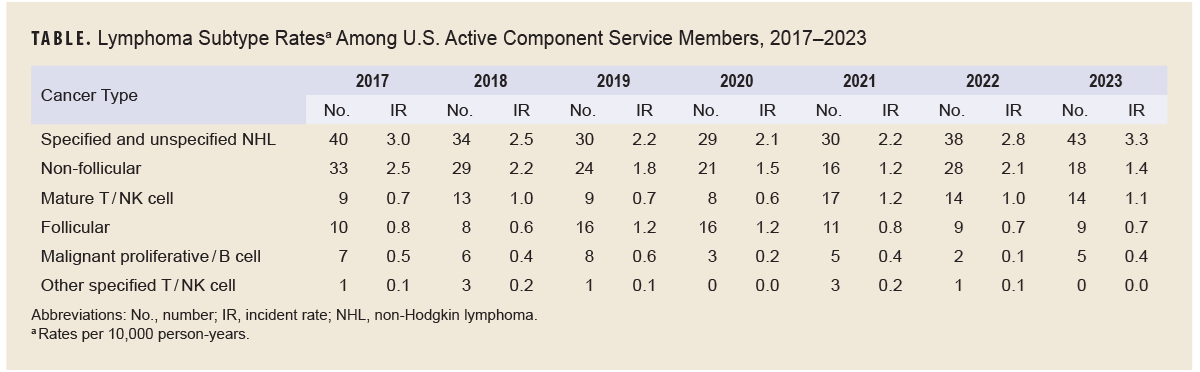
Table of lymphoma subtype rates

A total of 621 incident cases in this study contributed to the overall IR of 6.6 cases per 100,000 person-years (p-yrs). The number and IR were higher among men (n=535, IR 6.8 per 100,000 p-yrs) compared to women (n=86, IR 5.39 per 100,000 p-yrs), and a majority of men (n=327) were of non-Hispanic White race or ethnicity (data not shown). These results are consistent with the population distribution of the U.S. military, which is majority non-Hispanic White male, and do not suggest any race-based effects on lymphoma diagnosis.

FIGURE. Non-Hodgkin Lymphoma Subtype and Overall Rates Among Active Component U.S. Service Members, 2017–2023. This graph comprises six discrete lines on the horizontal, or x-, axis that depict incidence rates non-Hodgkin lymphomas among active component U.S. service members, from 2017 through 2023. The horizontal, or x-, axis is divided into seven units of measure, each representing an individual year during the surveillance period. The vertical, or y-, axis presents the incidence rate per 100,000 person-years, on a scale of 0.0 through 3.5, in units of 0.5. The highest line on the graph represents both specified and unspecified non-Hodgkin lymphoma cases, and the five lower lines each represent a specified type of non-Hodgkin lymphoma. The specified and unspecified rates were at just over 3.0 per 100,000 person-years in 2017, and gradually declined to a rate of 2.5 by 2019, where it remained for three years. In 2022, however, the rate for specified and unspecified non-Hodgkin lymphomas climbed nearly to 3.0 and exceeded that rate in 2023, registering around 3.25 per 100,000 person-years at the end of the surveillance period. Non-follicular non-Hodgkin lymphoma had the highest rates of specified non-Hodgkin lymphomas, and followed a similar pattern of the specified and unspecified overall rate, with two exceptions: Rather than plateauing for the three years, 2019 through 2022, non-follicular non-Hodgkin lymphoma continued its gradual decline through 2022, to under 1.5 per 100,000 person-years; it then similarly increased sharply in 2023 but, in contrast to the overall specified and unspecified rate, non-follicular non-Hodgkin lymphoma fell dramatically in 2023, to just over 1.5 per 100,000, its second lowest rate during the surveillance period. Mature T/NK cell non-Hodgkin lymphoma was the specified non-Hodgkin lymphoma that had the most significant rate increase, from approximately 0.6 per 100,000 person-years in 2017 to nearly 1.2 in 2023, with only two years of slightly declining rates, in 2018 and 2019. In 2017 the rate of follicular non-Hodgkin lymphoma was only slightly higher than the mature T/NK cell rate, and surpassed mature T/NK in 2019 and 2020, but as mature T/NK cell non-Hodgkin lymphoma increased in 2021, follicular non-Hodgkin lymphoma began a gradual decline and remained at a rate of approximately 0.7 per 100,000 person-years for the final three years. Malignant proliferative/B cell and other specified T/NK cell non-Hodgkin lymphomas both expressed relatively steady and low rates, at or below 0.5 per 100,000 person-years.

Specified and Unspecified NHL had the highest overall IR (2.6 per 100,000 p-yrs) over the surveillance period (Figure). There is a modest increase in IR, especially among Specified and Unspecified NHL diagnoses over the 7-year surveillance period (Figure). These rates are far lower than the non-age stratified reported national rates—19.0 per 100,000 for men and 15.8 for women—because the military population is much younger, with most cases occurring between ages 20 and 45 years, with only 1 in the older than age 60 years demographic (data not shown). Overall, lymphoma rates were low among ACSMs during the surveillance period.

Authors’ Affiliation

Epidemiology and Analysis Branch, Armed Forces Health Surveillance Division, Public Health Directorate, Defense Health Agency, Silver Spring, MD

References

  1. Aggarwal P, Limaiem F. Reed Sternberg Cells. StatPearls Publishing;2024. Accessed Nov. 20, 2024. https://www.ncbi.nlm.nih.gov/books/NBK542333 
  2. Majhail NS, Bajorunaite R, Lazarus HM, et al. Long-term survival and late relapse in 2-year survivors of autologous haematopoietic cell transplantation for Hodgkin and non-Hodgkin lymphoma. Br J Haematol. 2009;147(1):129-139. doi:10.1111/j.1365-2141.2009.07798.x 
  3. Shankland K, Armitage J, Hancock B. Non-Hodgkin lymphoma. Lancet. 2012;380(9844):848-857. Accessed Nov. 20, 2024. dx.doi.org/10.1016/S0140-6736(12)60605-9 
  4. El-Fattah MA. Non-Hodgkin lymphoma of the liver: a US population-based analysis. J Clin Transl Hepatol. 2017;5(2):83-91. doi:10.14218/jcth.2017.00015 
  5. Mabila S, Dreyer E. Surveillance snapshot: the top 10 incident cancers among active component service members, 2018-2022. MSMR. 2023;30(9):17. Accessed Nov. 20, 2024.
  6. SEER*Explorer: An Interactive Website for SEER Cancer Statistics. Surveillance Research Program, National Cancer Institute. Nov. 5, 2024. Accessed Nov. 21, 2024. https://seer.cancer.gov/statistics-network/explorer 
  7. Vazirani A. Study of the Incidence of Cancer Diagnosis and Mortality Among Military Aviators and Aviation Support Personnel. Office of the Under Secretary of Defense. May 9, 2024. Accessed Dec. 19, 2024. 
  8. Armed Forces Health Surveillance Division. Non-Hodgkin Lymphoma: Includes Follicular, Non-Follicular and Mature T/NK-Cell Lymphomas. June 2024. Accessed Nov. 20, 2024.

You also may be interested in...

Article
Apr 1, 2024

Reportable Medical Events at Military Health System Facilities Through Week 9, Ending March 2, 2024

This report provides a monthly updatea of Reportable Medical Events documented in the Disease Reporting System internet (DRSi) by health care providers and public health officials throughout the Military Health System. Reportable Medical Events are a critical tool for monitoring, controlling, and preventing the occurrence and spread of diseases of ...

Article
Mar 1, 2024

Tobacco and Nicotine Use Among Active Component U.S. Military Service Members: A Comparison of 2018 Estimates from the Health Related Behaviors Survey and the Periodic Health Assessment

This study compared estimates of the prevalence of and risk factors for tobacco and nicotine use obtained from the 2018 Health Related Behaviors Survey and Periodic Health Assessment survey. The HRBS and the PHA are important Department of Defense sources of data on health behavior collected from U.S. military service members.

Article
Mar 1, 2024

Mid-Season Influenza Vaccine Effectiveness Estimates Among DOD Populations: A Composite of Data Presented at VRBPAC—the Vaccines and Related Biological Products Advisory Committee—2024 Meeting on Influenza Vaccine Strain Selection for the 2024-2025 Influenza Season

This is an introduction to a composite of three Surveillance Snapshots of Department of Defense data on mid-season influenza vaccine effectiveness that were presented at the 2024 VRBPAC meeting.

Report
Mar 1, 2024

MSMR Vol. 31 No. 3 - March 2024

.PDF | 1.34 MB

The March 2024 MSMR features a comparison of 2018 estimates from the HRBS and the PHA on tobacco and nicotine use among the U.S. military active component; followed by a report on coverage of HIV PrEP among active duty service members in 2023; supplemented by a Surveillance Snapshot of HIV PrEP prescriptions in 2023 in the active component; then a ...

Article
Mar 1, 2024

Coverage of HIV Pre-Exposure Prophylaxis Within the Active Duty U.S. Military, 2023

This study provides the first estimate of HIV pre-exposure prophylaxis coverage in the U.S. military, defined as the proportion of the persons taking HIV PrEP out of the estimated number of persons who had indications for it, that is also comparable to U.S. civilian estimates. The population with indications for HIV PrEP was obtained from the ...

Refine your search