Reportable Medical Events at Military Health System Facilities Through Week 1, Ending January 4, 2025

Image of RMEs. Reportable medical events are documented in the Disease Reporting System internet to monitor, control, and prevent the occurrence and spread of diseases of public health interest or readiness importance.

Reportable Medical Events are documented in the Disease Reporting System internet by health care providers and public health officials throughout the Military Health System for monitoring, controlling, and preventing the occurrence and spread of diseases of public health interest or readiness importance. These reports are reviewed by each service’s public health surveillance hub. The DRSi collects reports on over 70 different RMEs, including infectious and non-infectious conditions, outbreak reports, STI risk surveys, and tuberculosis contact investigation reports. A complete list of RMEs is available in the 2022 Armed Forces Reportable Medical Events Guidelines and Case Definitions.1 Data reported in these tables are considered provisional and do not represent conclusive evidence until case reports are fully validated.
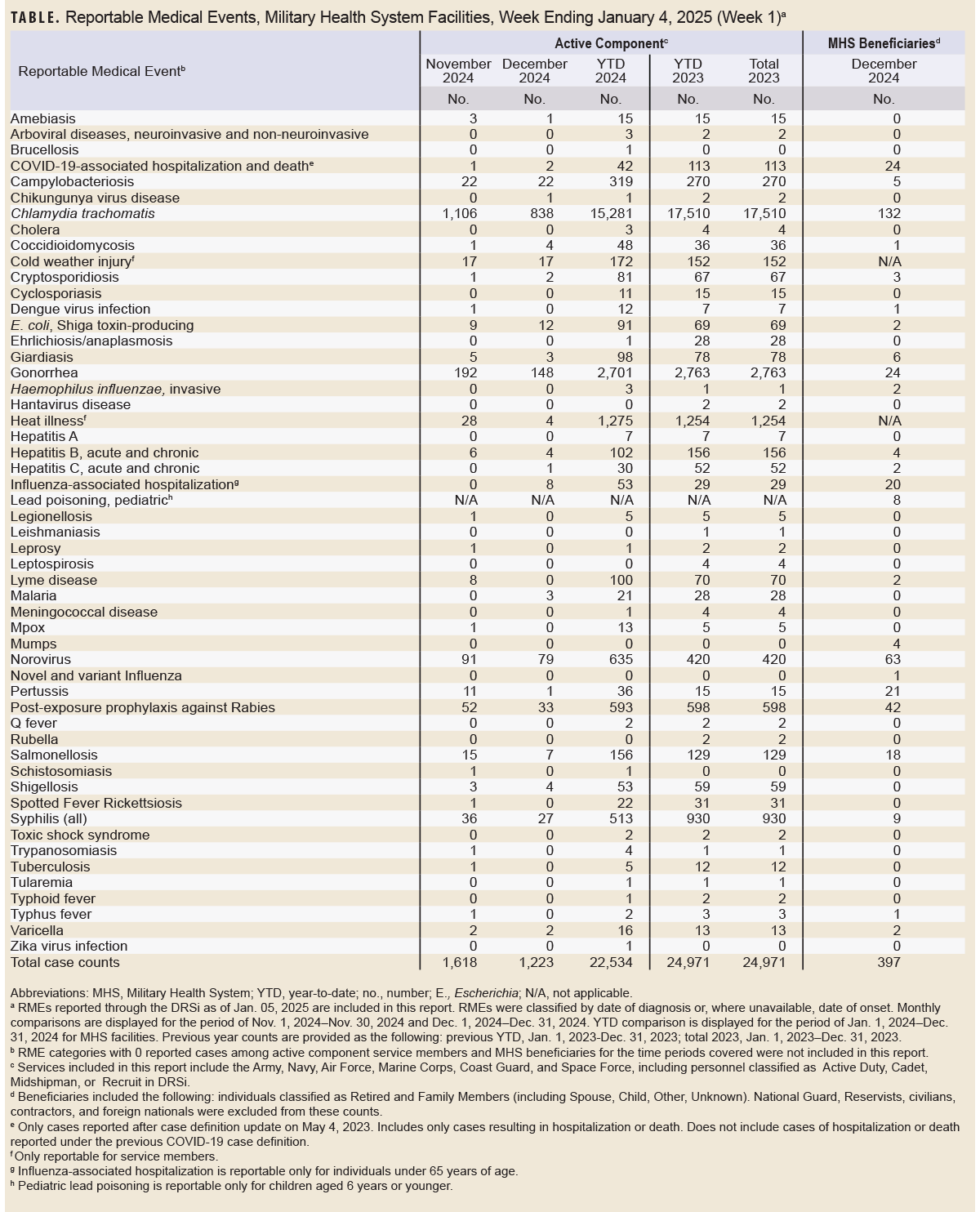
Table of reportable medical events week ending Jan. 4, 2025

Total active component cases reported per week are displayed for the top five RMEs for the previous year. Each month, the graph is updated with the top five RMEs, and is presented with the current month’s (December 2024) top five RMEs, which may differ from previous months. COVID-19 is excluded from these graphs due to changes in reporting and case definition updates in 2023.
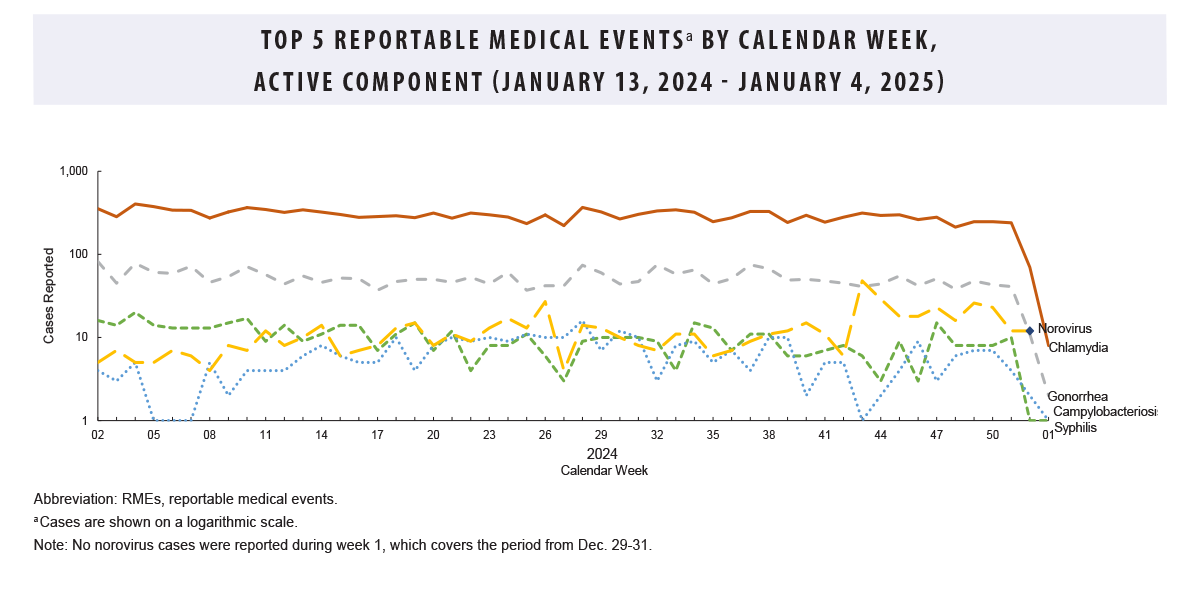
FIGURE. Top 5 Reportable Medical Events by Calendar Week, Active Component (January 13, 2024-January 4, 2025). This graph comprises five discrete lines on the horizontal, or x-, axis that depict case counts for the five most frequent reportable medical event conditions among active component service members during the past 52 weeks. The horizontal, or x-, axis is divided into 52 units of measure, each representing an individual week during the preceding year. The vertical, or y-, axis is presented on a logarithmic scale, in segments of one through 10, then 10 through 100, and 100, through 1,000. Chlamydia is consistently the most common reportable medical condition, normally around 300 per week. All reported cases for each condition, with the exception of norovirus, dropped significantly in the last two weeks of the reporting period, likely due to end of year data reporting issues. Consequently, norovirus was the most frequently reported medical event during the first week of 2025, at around 20 cases per week.

For questions about this report, please contact the Disease Epidemiology Branch at the Defense Centers for Public Health–Aberdeen. Email: dha.apg.pub-health-a.mbx.disease-epidemiologyprogram13@health.mil

Authors' Affiliation

Defense Health Agency, Disease Epidemiology Branch, Defense Centers for Public Health–Aberdeen

References

  1. Armed Forces Health Surveillance Division. Armed Forces Reportable Medical Events. Accessed Feb. 28, 2024. https://health.mil/reference-center/publications/2022/11/01/armed-forces-reportable-medical-events-guidelines 
  2. Defense Manpower Data Center. Department of Defense Active Duty Military Personnel by Rank/Grade of Service. Accessed Feb. 28, 2024. https://dwp.dmdc.osd.mil/dwp/app/dod-data-reports/workforce-reports 
  3. Defense Manpower Data Center. Armed Forces Strength Figures for January 31, 2023. Accessed Feb. 28, 2024. https://dwp.dmdc.osd.mil/dwp/app/dod-data-reports/workforce-reports 
  4. Navy Medicine. Surveillance and Reporting Tools–DRSI: Disease Reporting System Internet. Accessed Feb. 28, 2024. https://www.med.navy.mil/navy-marine-corps-public-health-center/preventive-medicine/program-and-policy-support/disease-surveillance/drsI

You also may be interested in...

Article
Jul 1, 2023

Absolute and Relative Morbidity Burdens Attributable to Various Illnesses and Injuries Among Non-Service Member Beneficiaries of the Military Health System, 2022

This report represents an updated summary of care provided to non-service members in the MHS during calendar year 2022. MHS beneficiaries are diverse and heterogeneous, including active component service members, activated National Guard and Reserve service members, active component immediate family, retirees, and their family members, with differing ...

Article
Jun 1, 2023

Absolute and Relative Morbidity Burdens Attributable to Various Illnesses and Injuries Among Active Component Members, U.S. Coast Guard, 2022

This report employs the same disease classification system and health care burden measures as employed in the MSMR burden analysis of the U.S. Armed Forces active component to quantify the impacts of various illnesses and injuries among members of the active component of the U.S. Coast Guard in 2022.

Article
Jun 1, 2023

Absolute and Relative Morbidity Burdens Attributable to Various Illnesses and Injuries Among Active Component Members, U.S. Armed Forces, 2022

This annual summary uses several health care burden measures to quantify the impacts of various illnesses and injuries in 2022 among members of the active component of the U.S. Armed Forces. Health care burden metrics include the total number of medical encounters, individuals affected, and hospital bed days.

Report
Jun 1, 2023

MSMR Vol. 30 No. 6 - June 2023

.PDF | 1.55 MB

This annual issue quantifies the impacts of various illnesses and injuries in 2022 among members of the active component of the U.S. Armed Forces as well as the U.S. Coast Guard; health care burden metrics include the total number of medical encounters, including hospitalizations and ambulatory services, as well as numbers and types of individuals ...

Report
May 1, 2023

MSMR Vol. 30 No. 5 - May 2023

.PDF | 1023.59 KB

The May 2023 MSMR reintroduces a monthly reportable medical event (RME) summary for the active component and MHS beneficiaries; then features a review of enhanced mpox outbreak case detection among MHS beneficiaries through ESSENCE (Electronic Surveillance System for the Early Notification of Community-based Epidemics); followed by a report on ...

Article
May 1, 2023

Enhanced Mpox Outbreak Case Detection Among MHS Beneficiaries Through Use of ESSENCE (Electronic Surveillance System for the Early Notification of Community-based Epidemics)

A colorized scanning electron microscopic image of the mpox virus on the surface of infected VERO E6 cells

This report describes how ESSENCE, which collects near real-time biosurveillance data globally on U.S. military personnel, monitored the mpox outbreak in 2002 and assesses its detection of confirmed/probable cases among MHS beneficiaries. ESSENCE systematically queries millions of health encounters to detect records of potential public health ...

Article
May 1, 2023

Increasing Incidence Rates of Eosinophilic Esophagitis in Active Component Service Members, U.S. Armed Forces, 2009–2021

A respiratory therapist visualizes the vocal chords of a patient using an endoscopy tool

This study examines the incidence of eosinophilic esophagitis among the active component of the U.S. Armed Forces from 2009 to 2021. Reported prevalence has been increasing worldwide, with a recent meta-analysis estimating 34.2 cases per 100,000 persons.

Article
May 1, 2023

Portable RT-PCR and MinION Nanopore Sequencing as a Proof-of-Concept SARS-CoV-2 Biosurveillance in Wastewater

Wastewater treatment facility

This study reports on the efficacy of 2 different portable nucleic acid detection technologies, RT-PCR and MinION Mk1C nanopore sequencing, which identified SARS-CoV-2 variants in wastewater collected at Tyndall AFB during a 2-month surveillance. This highly multiplexed approach circumvented signal dropout associated with the detection of newly ...

Refine your search