2023-2024 Mid-Season Influenza Vaccine Effectiveness Against Laboratory-Confirmed Ambulatory Influenza: DOD TRICARE Beneficiaries

Image of 48088663. This study presents the results of a vaccine effectiveness estimate against ambulatory influenza infections among Department of Defense TRICARE beneficiaries.

The DOD Global Respiratory Pathogen Surveillance Program1 used a matched case-test negative control study design to determine VE estimates against ambulatory influenza among DOD TRICARE beneficiaries. Specimens were collected from October 1, 2023 to February 17, 2024 among individuals with an influenza-like illness medical encounter, then analyzed either at the United States Air Force School of Aerospace Medicine or Landstuhl Regional Medical Center. An ILI encounter was defined as presenting with a fever (≥100.4°F) and cough, fever (≥100.4°F) and two or more additional symptoms (fatigue, body aches, sore throat, headache, sinus congestion, shortness of breath, chills, runny nose, loss of taste or smell, acute respiratory distress) or a physician-diagnosed ILI. The study excluded service members, who were evaluated separately by the Armed Forces Health Surveillance Division. 

Cases were individuals with a laboratory-confirmed positive influenza specimen, while controls were those with a specimen testing negative for influenza. An attempt was made to match each case to four controls by the month of specimen collection, but due to control availability, some analyses only had one case to three controls. Vaccination status was determined by utilizing the Aeromedical Services Information Management System or self-reporting through DODGRPSP questionnaires. Individuals were considered vaccinated if they received the vaccine at least 14 days prior to specimen collection, with exclusions for vaccines received within 14 days. Adjusted ORs and 95% CIs were calculated via multivariable logistic regression, adjusting for age group and geographic region. Adjusted VE estimates were computed as (1 - aOR) x 100. 
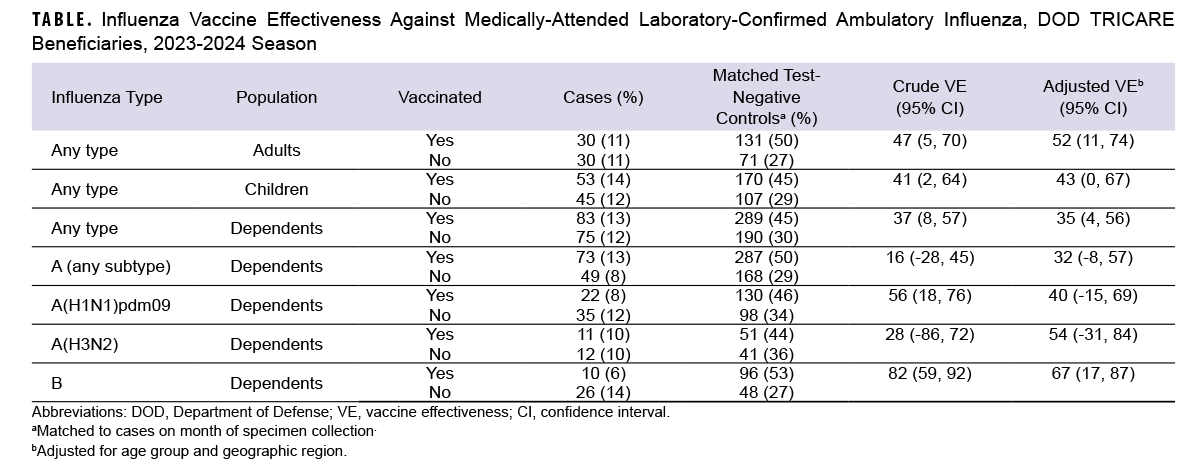
Click on the table to access a 508-compliant PDF version

The study identified 158 cases and 479 controls. Adjusted VE estimates for all DOD beneficiaries showed 35% effectiveness (CI: 4, 56) against overall influenza, 32% (CI: -8, 57) against overall influenza A, 40% (CI: -15, 69) against influenza A(H1N1)pdm09, 54% (CI: -31, 84) against influenza A(H3N2), and 67% (CI: 17, 87) against influenza B. For children, the adjusted VE estimate was 43% (CI: 0, 67) against overall influenza, while for adults it was 52% (CI: 11, 74) against overall influenza. 

VE estimates suggest statistically significant, low to moderate protection against overall influenza among all DOD TRICARE beneficiaries and adults, as well as against influenza B among all DOD TRICARE beneficiaries. VE estimates against overall influenza for children, overall influenza A for all DOD TRICARE beneficiaries, influenza A(H1N1)pdm09, and influenza A(H3N2) for all DOD TRICARE beneficiaries indicate low to moderate protection, but these results did not reach statistical significance. 

Reference

  1. Kwaah B, Gruner WE, DeMarcus L, et al. Surveillance trends for SARS-CoV-2 and other respiratory pathogens among US military health system beneficiaries, 27 September 2020–2 October 2021. MSMR. 2022;29(7):2-10.

You also may be interested in...

Article
Mar 1, 2022

Obesity prevalence among active component service members prior to and during the COVID-19 pandemic, January 2018–July 2021

Maintaining a healthy weight is important for military members to stay fit to fight. The body mass index is a tool that can be used to determine if an individual is at an appropriate weight for their height. A person’s index is determined by their weight in kilograms divided by the square of height in meters. (U.S. Air Force photo illustration by Airman 1st Class Destinee Sweeney)

This study examined monthly prevalence of obesity and exercise in active component U.S. military members prior to and during the COVID-19 pandemic. These results suggest that the COVID-19 pandemic had a small effect on the trend of obesity in the active component U.S. military and that obesity prevalence continues to increase.

Article
Mar 1, 2022

Update: Malaria, U.S. Armed Forces, 2021

Mosquitos – like this one, collected as part of a military study in North Carolina – were used during USAMRDC’s initial RTS,S vaccine studies nearly 40 years ago. (Photo courtesy: AFC Kimberly Barrera)

Malaria infection remains an important health threat to U.S. service members who are located in endemic areas because of long-term duty assignments, participation in shorter-term contingency operations, or personal travel. In 2021, a total of 20 service members were diagnosed with or reported to have malaria.

Article
Mar 1, 2022

Brief Report: Refractive Surgery Trends at Tri-Service Refractive Surgery Centers and the Impact of the COVID-19 Pandemic, Fiscal Years 2000–2020

Cadet Saverio Macrina, U.S. Military Academy West Point, receives corneal cross-linking procedure at Fort Belvoir Community Hospital, Va., Nov. 21, 2016. (DoD photo by Reese Brown)

Since the official introduction of laser refractive surgery into clinical practice throughout the Military Health System (MHS) in fiscal year 2000, these techniques have been heavily implemented in the tri-service community to better equip and improve the readiness of the U.S. military force.

Article
Mar 1, 2022

Brief report: Using syndromic surveillance to monitor MIS-C associated with COVID-19 in Military Health System beneficiaries

Air Force 1st Lt. Anthony Albina, a critical care nurse assigned to Joint Base Andrews, Md., checks a patient’s breathing and heart rate during an intubation procedure while supporting COVID-19 response operations in Cleveland, Jan. 20, 2022.

SARS CoV-2 and the illness it causes, COVID-19, have exacted a heavy toll on the global community. Most of the identified disease has been in the elderly and adults. The goal of this analysis was to ascertain if user-built ESSENCE queries applied to records of outpatient MHS health care encounters are capable of detecting MIS-C cases that have not ...

Article
Mar 1, 2022

Surveillance Snapshot: Medical Separation from Service Among Incident Cases of Osteoarthritis and Spondylosis, Active Component, U.S. Armed Forces, 2016–2020

Marines hike to the next training location during Exercise Baccarat in Aveyron, Occitanie, France, Oct.16, 2021. Exercise Baccarat is a three-week joint exercise with Marines and the French Foreign Legion that challenges forces with physical and tactical training. Photo By: Marine Corps Lance Cpl. Jennifer Reyes

Osteoarthritis (OA) is the most common adult joint disease and predominantly involves the weight-bearing joints. This condition, including spondylosis (OA of the spine), results in significant disability and resource utilization and is a leading cause of medical separation from military service.

Fact Sheet
Mar 30, 2017

Demographic and Military Traits of Service Members Diagnosed as Traumatic Brain Injury Cases

.PDF | 283.00 KB

This fact sheet provides details on the demographic and military traits of service members diagnosed as traumatic brain injury (TBI) cases during a 16-year surveillance period from 2001 through 2016, a total of 276,858 active component service members received first-time diagnoses of TBI - a structural alteration of the brain or physiological ...

Fact Sheet
Mar 30, 2017

Rhabdomyolysis by Location, Active Component, U.S. Armed Forces, 2012-2016 Fact Sheet

.PDF | 313.80 KB

This fact sheet provides details on Rhabdomyolysis by location for active component, U.S. Armed Forces during a five-year surveillance period from 2012 through 2016. The medical treatment facilities at nine installations diagnosed at least 50 cases each and, together approximately half (49.9%) of all diagnosed cases.

Refine your search