2023-2024 Mid-Season Influenza Vaccine Effectiveness Against Laboratory-Confirmed Ambulatory Influenza: DOD TRICARE Beneficiaries

Image of 48088663. This study presents the results of a vaccine effectiveness estimate against ambulatory influenza infections among Department of Defense TRICARE beneficiaries.

The DOD Global Respiratory Pathogen Surveillance Program1 used a matched case-test negative control study design to determine VE estimates against ambulatory influenza among DOD TRICARE beneficiaries. Specimens were collected from October 1, 2023 to February 17, 2024 among individuals with an influenza-like illness medical encounter, then analyzed either at the United States Air Force School of Aerospace Medicine or Landstuhl Regional Medical Center. An ILI encounter was defined as presenting with a fever (≥100.4°F) and cough, fever (≥100.4°F) and two or more additional symptoms (fatigue, body aches, sore throat, headache, sinus congestion, shortness of breath, chills, runny nose, loss of taste or smell, acute respiratory distress) or a physician-diagnosed ILI. The study excluded service members, who were evaluated separately by the Armed Forces Health Surveillance Division. 

Cases were individuals with a laboratory-confirmed positive influenza specimen, while controls were those with a specimen testing negative for influenza. An attempt was made to match each case to four controls by the month of specimen collection, but due to control availability, some analyses only had one case to three controls. Vaccination status was determined by utilizing the Aeromedical Services Information Management System or self-reporting through DODGRPSP questionnaires. Individuals were considered vaccinated if they received the vaccine at least 14 days prior to specimen collection, with exclusions for vaccines received within 14 days. Adjusted ORs and 95% CIs were calculated via multivariable logistic regression, adjusting for age group and geographic region. Adjusted VE estimates were computed as (1 - aOR) x 100. 
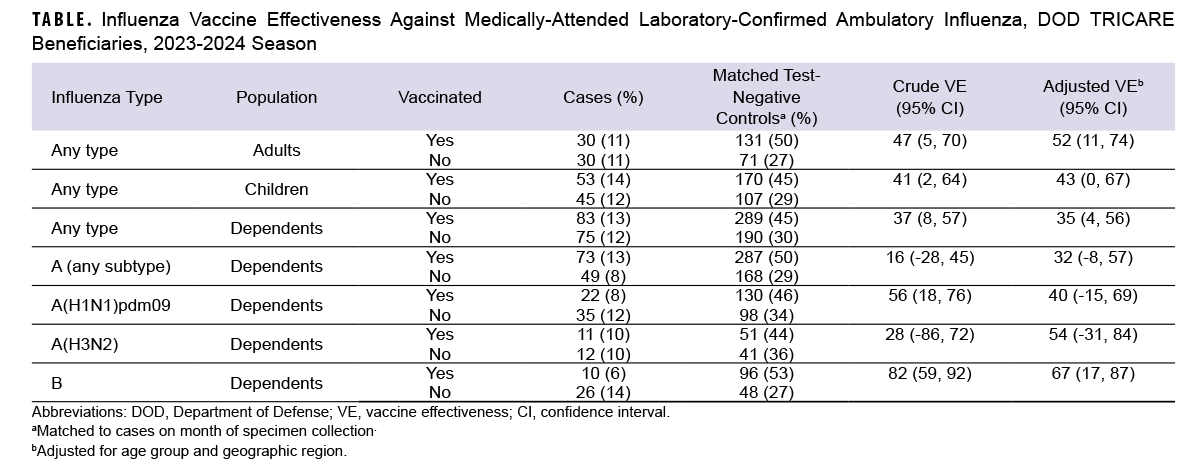
Click on the table to access a 508-compliant PDF version

The study identified 158 cases and 479 controls. Adjusted VE estimates for all DOD beneficiaries showed 35% effectiveness (CI: 4, 56) against overall influenza, 32% (CI: -8, 57) against overall influenza A, 40% (CI: -15, 69) against influenza A(H1N1)pdm09, 54% (CI: -31, 84) against influenza A(H3N2), and 67% (CI: 17, 87) against influenza B. For children, the adjusted VE estimate was 43% (CI: 0, 67) against overall influenza, while for adults it was 52% (CI: 11, 74) against overall influenza. 

VE estimates suggest statistically significant, low to moderate protection against overall influenza among all DOD TRICARE beneficiaries and adults, as well as against influenza B among all DOD TRICARE beneficiaries. VE estimates against overall influenza for children, overall influenza A for all DOD TRICARE beneficiaries, influenza A(H1N1)pdm09, and influenza A(H3N2) for all DOD TRICARE beneficiaries indicate low to moderate protection, but these results did not reach statistical significance. 

Reference

  1. Kwaah B, Gruner WE, DeMarcus L, et al. Surveillance trends for SARS-CoV-2 and other respiratory pathogens among US military health system beneficiaries, 27 September 2020–2 October 2021. MSMR. 2022;29(7):2-10.

You also may be interested in...

Article
Jul 1, 2023

Absolute and Relative Morbidity Burdens Attributable to Various Illnesses and Injuries Among Non-Service Member Beneficiaries of the Military Health System, 2022

This report represents an updated summary of care provided to non-service members in the MHS during calendar year 2022. MHS beneficiaries are diverse and heterogeneous, including active component service members, activated National Guard and Reserve service members, active component immediate family, retirees, and their family members, with differing ...

Article
Jun 1, 2023

Absolute and Relative Morbidity Burdens Attributable to Various Illnesses and Injuries Among Active Component Members, U.S. Coast Guard, 2022

This report employs the same disease classification system and health care burden measures as employed in the MSMR burden analysis of the U.S. Armed Forces active component to quantify the impacts of various illnesses and injuries among members of the active component of the U.S. Coast Guard in 2022.

Article
Jun 1, 2023

Absolute and Relative Morbidity Burdens Attributable to Various Illnesses and Injuries Among Active Component Members, U.S. Armed Forces, 2022

This annual summary uses several health care burden measures to quantify the impacts of various illnesses and injuries in 2022 among members of the active component of the U.S. Armed Forces. Health care burden metrics include the total number of medical encounters, individuals affected, and hospital bed days.

Report
Jun 1, 2023

MSMR Vol. 30 No. 6 - June 2023

.PDF | 1.55 MB

This annual issue quantifies the impacts of various illnesses and injuries in 2022 among members of the active component of the U.S. Armed Forces as well as the U.S. Coast Guard; health care burden metrics include the total number of medical encounters, including hospitalizations and ambulatory services, as well as numbers and types of individuals ...

Report
May 1, 2023

MSMR Vol. 30 No. 5 - May 2023

.PDF | 1023.59 KB

The May 2023 MSMR reintroduces a monthly reportable medical event (RME) summary for the active component and MHS beneficiaries; then features a review of enhanced mpox outbreak case detection among MHS beneficiaries through ESSENCE (Electronic Surveillance System for the Early Notification of Community-based Epidemics); followed by a report on ...

Article
May 1, 2023

Enhanced Mpox Outbreak Case Detection Among MHS Beneficiaries Through Use of ESSENCE (Electronic Surveillance System for the Early Notification of Community-based Epidemics)

A colorized scanning electron microscopic image of the mpox virus on the surface of infected VERO E6 cells

This report describes how ESSENCE, which collects near real-time biosurveillance data globally on U.S. military personnel, monitored the mpox outbreak in 2002 and assesses its detection of confirmed/probable cases among MHS beneficiaries. ESSENCE systematically queries millions of health encounters to detect records of potential public health ...

Article
May 1, 2023

Increasing Incidence Rates of Eosinophilic Esophagitis in Active Component Service Members, U.S. Armed Forces, 2009–2021

A respiratory therapist visualizes the vocal chords of a patient using an endoscopy tool

This study examines the incidence of eosinophilic esophagitis among the active component of the U.S. Armed Forces from 2009 to 2021. Reported prevalence has been increasing worldwide, with a recent meta-analysis estimating 34.2 cases per 100,000 persons.

Article
May 1, 2023

Portable RT-PCR and MinION Nanopore Sequencing as a Proof-of-Concept SARS-CoV-2 Biosurveillance in Wastewater

Wastewater treatment facility

This study reports on the efficacy of 2 different portable nucleic acid detection technologies, RT-PCR and MinION Mk1C nanopore sequencing, which identified SARS-CoV-2 variants in wastewater collected at Tyndall AFB during a 2-month surveillance. This highly multiplexed approach circumvented signal dropout associated with the detection of newly ...

Refine your search