Reportable Medical Events at Military Health System Facilities Through Week 39, Ending September 30, 2023
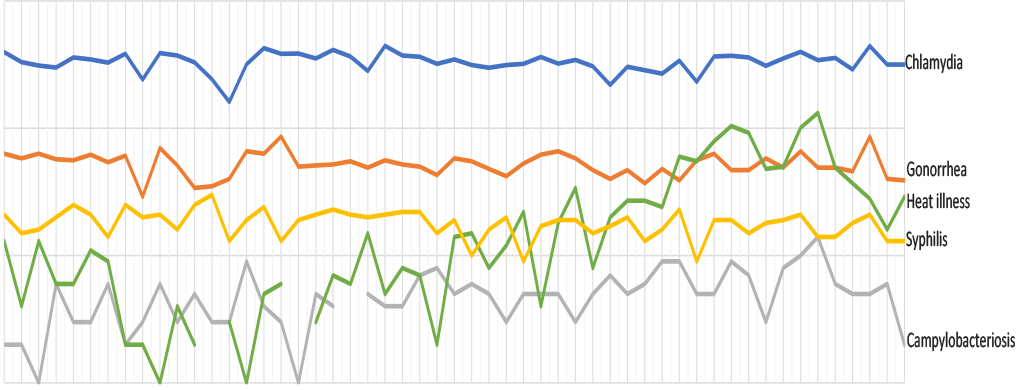 Reportable Medical Events are documented in the Disease Reporting System internet by health care providers and public health officials throughout the MHS.
11/1/2023
By:
Matthew W.R. Allman, MPH; Anthony R. Marquez, MPH; Katherine S. Kotas, MPH
Reportable Medical Events are documented in the Disease Reporting System internet by health care providers and public health officials throughout the Military Health System for monitoring, controlling, and preventing the occurrence and spread of diseases of public health interest or readiness importance. These reports are reviewed by each service’s public health surveillance hub. The DRSi collects reports on over 70 different RMEs, including infectious and non-infectious conditions, outbreak reports, STI risk surveys, and tuberculosis contact investigation reports. A complete list of RMEs is available in the 2022 Armed Forces Reportable Medical Events Guidelines and Case Definitions.1 Data reported in these tables are considered provisional and do not represent conclusive evidence until case reports are fully validated.
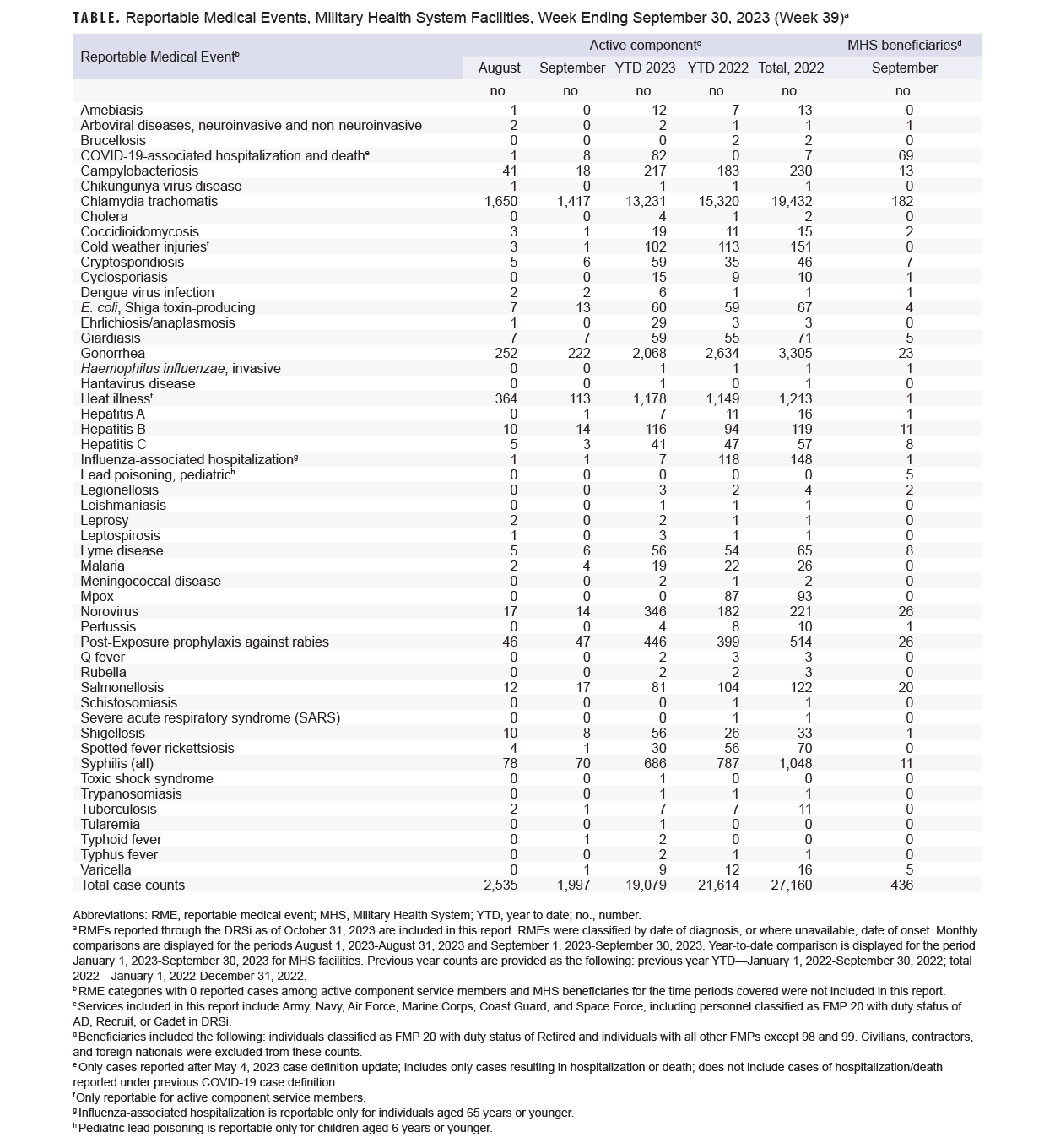
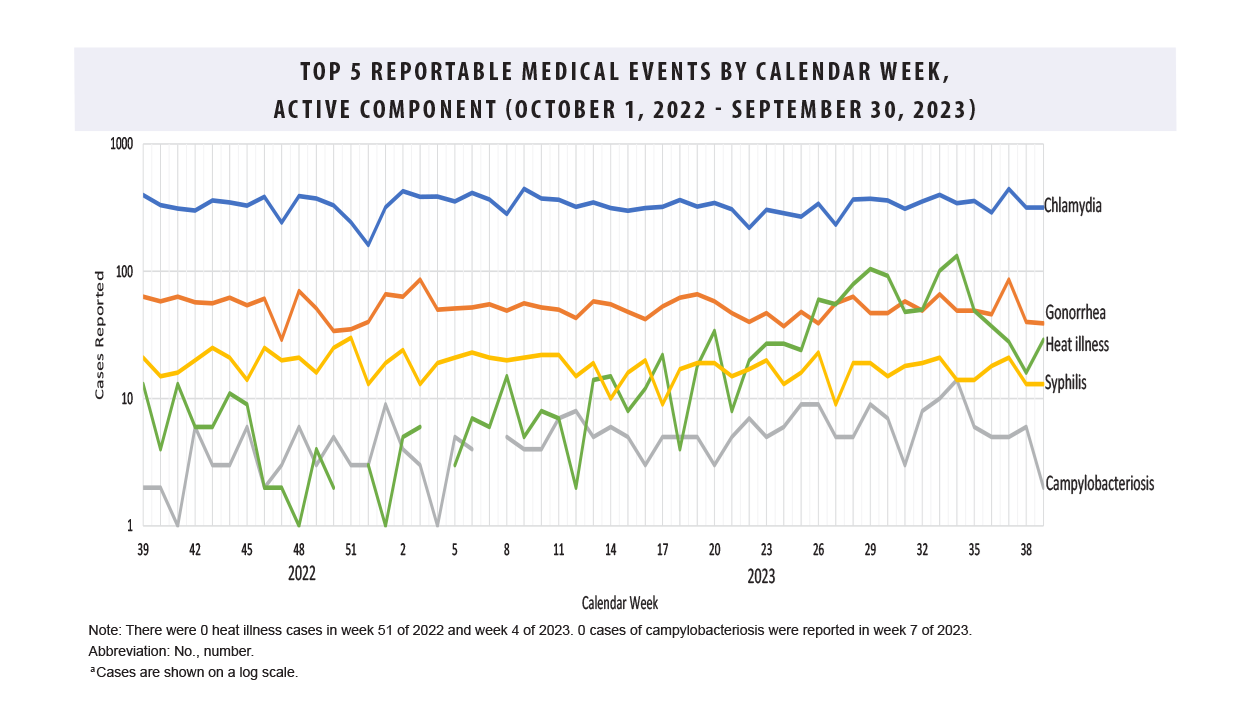
Total active component cases reported per week are displayed for the top five RMEs for the previous year. Each month, the graph is updated with the five leading RMEs, and is presented with the current month’s (September 2023) five leading RMEs, which may differ from previous months. COVID-19 is excluded from these graphs due to changes in reporting and case definition updates in 2023.
For questions about this report, please contact the Disease Epidemiology Branch at the Defense Centers for Public Health–Aberdeen. Email: dha.apg.pub-health-a.mbx.disease-epidemiologyprogram13@health.mil.
References
- Armed Forces Health Surveillance Division. Armed Forces Reportable Medical Events. Accessed Sep. 6, 2023. https://health.mil/Reference-Center/Publications/2022/11/01/Armed-Forces-Reportable-Medical-Events-Guidelines
- Defense Manpower Data Center. Department of Defense Active Duty Military Personnel by Rank/Grade of Service, October 31, 2022. https://dwp.dmdc.osd.mil/dwp/app/dod-data-reports/workforce-reports
- Defense Manpower Data Center. Armed Forces Strength Figures for January 31, 2023. https://dwp.dmdc.osd.mil/dwp/app/dod-data-reports/workforce-reports
- Navy Medicine. Surveillance and Reporting Tools–DRSI: Disease Reporting System Internet. https://www.med.navy.mil/Navy-Marine-Corps-Public-Health-Center/Preventive-Medicine/Program-and-Policy-Support/Disease-Surveillance/DRSI
You also may be interested in...
Article
Oct 1, 2022
Immunization Among U.S. Armed Forces Healthcare Workers
Report
Oct 1, 2022
 .PDF |
1.41 MB
.PDF |
1.41 MB
A monthly publication of the Armed Forces Health Surveillance Division. This issue of the peer-reviewed journal contains the following articles: Surveillance trends for SARS-CoV-2 and other respiratory pathogens among U.S. Military Health System Beneficiaries, Sept. 27, 2020 – Oct. 2,2021; Establishment of SARS-CoV-2 genomic surveillance within the ...
Article
Sep 1, 2022
Menstrual suppression allows for the control or complete suppression of menstrual periods through hormonal contraceptive methods. In addition to preventing pregnancy, suppression can alleviate medical conditions and symptoms associated with menstruation such as iron deficiency anemia,1 eliminate logistical hygiene-related challenges, and improve ...
Article
Sep 1, 2022
This report provides an update through June 2022 of routine screening results for antibodies to the human immunodeficiency virus (HIV) among members of the active and reserve components of the U.S. Armed Forces. During the full 5 and 1/2-year surveillance period, the HIV seropositivity rates for active component service members were 0.21 positives per ...
Article
Sep 1, 2022
We read with interest the brief report regarding the prevalence of Hepatitis C Virus (HCV) infection in basic military trainee blood donors by Kasper and colleagues in the November 2021 issue of the Medical Surveillance Monthly Report (MSMR),1 an update of a previous similar report
Article
Sep 1, 2022
The validity of military hepatitis C virus (HCV) surveillance data is uncertain due to the potential for misclassification introduced when using administrative databases for surveillance purposes. The objectives of this study were to assess the validity of the surveillance case definition used by the Medical Surveillance Monthly Report (MSMR) for HCV ...
Report
Sep 1, 2022
.PDF |
2.12 MB
A monthly publication of the Armed Forces Health Surveillance Division. This issue of the peer-reviewed journal contains the following articles: Surveillance trends for SARS-CoV-2 and other respiratory pathogens among U.S. Military Health System Beneficiaries, Sept. 27, 2020 – Oct. 2,2021; Establishment of SARS-CoV-2 genomic surveillance within the ...
Article
Aug 1, 2022
The post-9/11 U.S. military conflicts in Iraq and Afghanistan lasted over a decade and yielded the most combat casualties since the Vietnam War. While patient survivability increased to the highest level in history, a changing epidemiology of combat injuries emerged whereby focus shifted to addressing an array of long-term sequelae, including ...
Article
Aug 1, 2022
During calendar year 2019, the estimated prevalence of myopia, hyperopia, and astigmatism were 17.5%, 2.1%, and 11.2% in the active component of the U.S. Armed Forces and 10.1%, 1.2%, and 6.1% of the U.S. Coast Guard, respectively.
Article
Aug 1, 2022
Musculoskeletal (MSK) injuries are costly and the leading cause of medical visits and disability in the U.S. military.1,2 Within training environments, MSK injuries may lead to a loss of training, deferment to a future class, or voluntary disenrollment from a training pipeline, all of which are impediments to maintaining full levels of manpower and ...
Report
Aug 1, 2022
.PDF |
822.83 KB
A monthly publication of the Armed Forces Health Surveillance Division. This issue of the peer-reviewed journal contains the following articles: Surveillance trends for SARS-CoV-2 and other respiratory pathogens among U.S. Military Health System Beneficiaries, Sept. 27, 2020 – Oct. 2,2021; Establishment of SARS-CoV-2 genomic surveillance within the ...
Article
Jul 1, 2022
This report describes SARS-CoV-2 genomic surveillance conducted by the Department of Defense (DOD) Global Emerging Infections Surveillance Branch and the Next-Generation Sequencing and Bioinformatics Consortium (NGSBC) in response to the COVID-19 pandemic. Samples and sequence data were from SARS-CoV-2 infections occurring among Military Health System ...
Article
Jul 1, 2022
Respiratory pathogens, such as influenza and adenovirus, have been the main focus of the Department of Defense Global Respiratory Pathogen Surveillance Program (DoDGRPSP) since 1976.1. However, DoDGRPSP also began focusing on SARS-CoV-2 when COVID-19 was declared a pandemic illness in early March 2020.2. Following this declaration, the DOD quickly ...
Article
Jul 1, 2022
Lesbian, gay, and bisexual (LGB) individuals are at a particularly high risk for suicidal behavior in the general population of the United States. This study aims to determine if there are differences in the frequency of lifetime suicide ideation and suicide attempts between heterosexual, lesbian/gay, and bisexual service members in the active ...
Article
Jul 1, 2022
The Armed Forces Health Surveillance Division, as part of its surveillance mission, periodically conducts studies of cancer incidence among U.S. military service members. However, service members are likely lost to follow-up from the Department of Defense cancer registry and Military Health System data sets after leaving service and during periods of ...
You are leaving Health.mil
The appearance of hyperlinks does not constitute endorsement by the Department of Defense of non-U.S. Government sites or the information, products, or services contained therein. Although the Defense Health Agency may or may not use these sites as additional distribution channels for Department of Defense information, it does not exercise editorial control over all of the information that you may find at these locations. Such links are provided consistent with the stated purpose of this website.
You are leaving Health.mil
View the external links disclaimer.
Last Updated: December 01, 2023