Surveillance Snapshot: Pseudofolliculitis barbae Cases in Active Component Service Members, 2000–2022

Image of Cover4_7614288. Current grooming standards of the U.S. military mandate facial shaving to ensure adequate fitting and sealing of protective masks, but a shaving waiver may be issued for medical reasons such as Pseudofolliculitis barbae, or for religious reasons, among others.

Pseudofolliculitis barbae, also known as “razor bumps” or “shaving bumps,” results from an inflammatory, foreign body reaction of the skin, caused by shortened and sharpened hair piercing to the epidermis and dermis.1 While PFB can affect any person who regularly shaves, literature demonstrates an increased prevalence for persons with tightly curly hair, particularly African American and Hispanic individuals, including service members in the U.S. military.1-3 Current grooming standards in the U.S. military mandate facial shaving to ensure adequate fitting and sealing of protective masks.1 A shaving waiver may be issued for medical reasons such as PFB, or for religious reasons, among others.1,4 

This Surveillance Snapshot describes the frequency of PFB cases among active component service members of the U.S. military from 2000 through 2022. A PFB case was counted once per year if the ACSM demonstrated either two outpatient or theater medical data store encounters within 60 days, or one inpatient encounter within the year. Overall, the frequency of PFB cases increased over the surveillance period and varied greatly by race/ethnicity, disproportionally affecting Non-Hispanic Black service members (Figure). Non-Hispanic Blacks, who have historically comprised 16-18% of the U.S military in the past 20 years,5-7 constitute a majority (63.5%) of PFB cases. The frequency trend is well out of proportion to the change in troop strength. The increase in reported cases from 50 in 2000 to 2,404 in 2022 may warrant further study. 
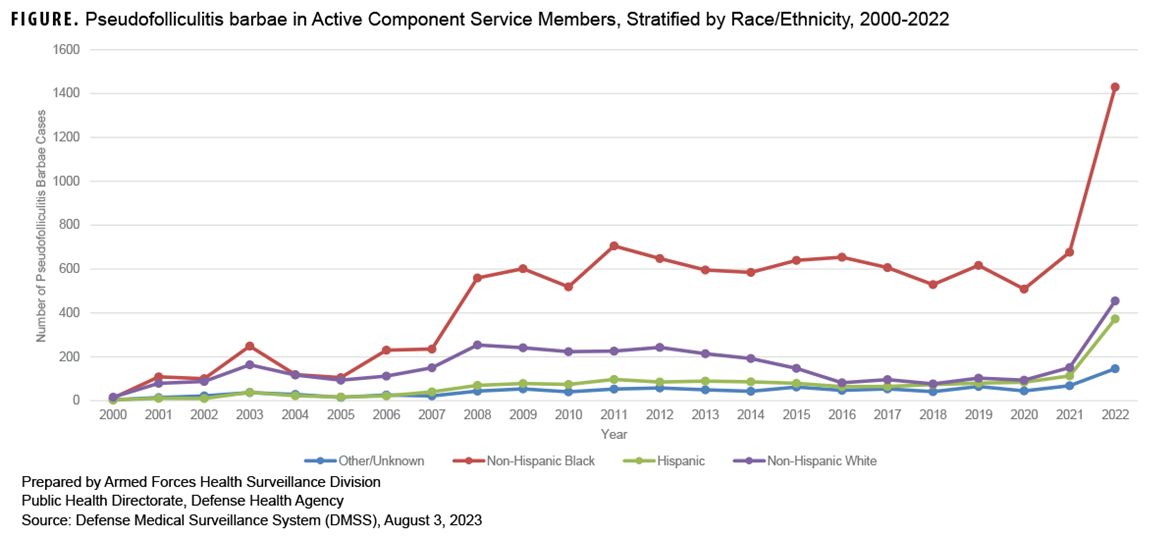
This graph depicts the frequency of Pseudofolliculitis barbae (PFB) cases according to race/ethnicity among active component service members of the U.S. military from 2000 through 2022. Four lines on the x-, or horizontal, axis represent 3 racial/ethnic groups, namely Hispanic, Non-Hispanic Black, and Non-Hispanic White, while a fourth line represents “Other/unknown” service members. Each line connects data points that chart, on the y-axis, the annual numbers of reported PFB case counts for each racial/ethnic group for every year from 2000 to 2022. Overall, the frequency of PFB cases increased over the surveillance period, but with a noticeable rise in cases between 2021 and 2022 for all racial/ethnic group categories. Starting in 2006, Non-Hispanic Black service members consistently had far higher numbers of PFB cases, noticeably increasing between 2007 and 2008, and spiking dramatically from 2021 to 2022. From 2008 until 2021, Non-Hispanic Black service members reported around 600 cases per year; that number exceeded 1,400 cases in 2022. From 2008 until 2014, Non-Hispanic White service members reported just in excess of 200 PFB cases per year, but from 2015 to 2021 those cases fell to under 100, in line with Hispanic and Other/unknown service member case numbers. In 2022 Non-Hispanic White service members reported nearly 450 cases, Hispanic service members reported just under 400 cases, and Other/unknown service members reported around 150 cases.

References

  1. Tshudy T, Cho S. Pseudofolliculitis barbae in the U.S. military, a review. Mil Med. 2021;186(1-2):52-57. https://doi.org/10.1093/milmed/usaa243
  2. Perry P, Cook-Bolden F, Rahman Z, Jones E, Taylor S. Defining Pseudofolliculitis barbae in 2001: a review of the literature and current trends. J Am Acad Dermatol. 2002;46(2):113-119. https://doi.org/10.1067/mjd.2002.120789
  3. Gelman A, Norton S, Valdes-Rodriguez R, Yosipovitch G. A review of skin conditions in modern warfare and peacekeeping operations. Mil Med. 2015;180(1):32-37. https://doi.org/10.7205/MILMED-D-14-00240
  4. Department of Defense. DoD Instruction 1300.17: Religious Liberty in the Military Services. 2020. Accessed August 1, 2023. https://www.esd.whs.mil/Portals/54/Documents/DD/issuances/dodi/130017p.pdf
  5. Barroso A. The changing profile of the U.S. military: smaller in size, more diverse, more women in leadership. 2019. Pew Research Center. Accessed August 2, 2023. https://www.pewresearch.org/short-reads/2019/09/10/the-changing-profile-of-the-u-s-military
  6. Department of Defense. 2017 Demographics Profile of the Military Community. 2017. Accessed August 2, 2023. https://download.militaryonesource.mil/12038/MOS/Reports/2017-demographics-report.pdf
  7. Department of Defense. 2021 Demographics Profile of the Military Community. 2021. Accessed August 2, 2023. https://download.militaryonesource.mil/12038/MOS/Reports/2021-demographics-report.pdf

Author Affiliations

Defense Health Agency, Armed Forces Health Surveillance Division, Epidemiology and Analysis Section

You also may be interested in...

Article
Feb 1, 2025

Surveillance Snapshot: Non-Hodgkin Lymphoma Incidence in Active Component U.S. Service Members, 2017–2023

This analysis utilizes an updated case definition for non-Hodgkin lymphoma developed by the Armed Forces Health Surveillance Division, based on consultation with subject matter experts and previous literature, to establish non-Hodgkin lymphoma incidence within the U.S. Armed Forces active component, from 2017 through 2023.

Article
Feb 1, 2025

Development of a New Fleet Disease and Injury Surveillance Capability Using ESSENCE

This report details the steps taken to develop a timely, accurate, and comprehensive Navy fleet disease and injury surveillance capability, utilizing ESSENCE (Electronic Surveillance System for the Early Notification of Community-based Epidemics), including the successes and challenges that will guide further refinement and expansion of this tool.

Article
Feb 1, 2025

External Cause Coding of Injury Encounters in the Military Health System Among Active Component U.S. Service Members, 2016–2019

Knowledge of injury causes is essential for prevention. This article describes causes of injury for all U.S. service members, from 2016 through 2019, and identifies variations in injury cause coding over time, and by branch of military service, type of health care visit and facility, and diagnosis category.

Article
Jan 1, 2025

Use of Positive Predictive Value to Evaluate the Armed Forces Health Surveillance Division Brain Cancer Incidence Rules, Active Component Department of the Air Force Pediatric Dependent Population, January 1, 2010–December 31, 2020

This study applied the Armed Forces Health Surveillance Division (AFHSD) case definition for the identification of malignant brain tumors among U.S. active service members to the dependent pediatric population of the active component of the U.S. Air Force, to determine the positive predictive value of this case definition for a pediatric population.

Article
Dec 1, 2024

Syphilis Cases Among Pregnant Women and Newborns in the Military Health System, 2012–2022

This report presents the rates of maternal syphilis among pregnant women and congenital syphilis among newborns in the Military Health System beneficiary population from 2012 to 2022. Between 2012 and 2021, cases of congenial syphilis in the U.S. increased by 755%, and rates of maternal and congenital syphilis within the Military Health System ...

Article
Dec 1, 2024

Post-Acute Sequelae of SARS-CoV-2 and Kidney Events in U.S. Active Component Service Members, March 1, 2020–September 30, 2022

This study assessed the incidence and incidence rate ratio of selected kidney events among U.S. active component service members that occurred from 31 days to six months after a COVID-19 test. Early evidence suggests that COVID-19 is linked to kidney-related events in older and hospitalized patients but has not been examined among a younger, healthy ...

Refine your search