Surveillance Snapshot: Pseudofolliculitis barbae Cases in Active Component Service Members, 2000–2022

Image of Cover4_7614288. Current grooming standards of the U.S. military mandate facial shaving to ensure adequate fitting and sealing of protective masks, but a shaving waiver may be issued for medical reasons such as Pseudofolliculitis barbae, or for religious reasons, among others.

Pseudofolliculitis barbae, also known as “razor bumps” or “shaving bumps,” results from an inflammatory, foreign body reaction of the skin, caused by shortened and sharpened hair piercing to the epidermis and dermis.1 While PFB can affect any person who regularly shaves, literature demonstrates an increased prevalence for persons with tightly curly hair, particularly African American and Hispanic individuals, including service members in the U.S. military.1-3 Current grooming standards in the U.S. military mandate facial shaving to ensure adequate fitting and sealing of protective masks.1 A shaving waiver may be issued for medical reasons such as PFB, or for religious reasons, among others.1,4 

This Surveillance Snapshot describes the frequency of PFB cases among active component service members of the U.S. military from 2000 through 2022. A PFB case was counted once per year if the ACSM demonstrated either two outpatient or theater medical data store encounters within 60 days, or one inpatient encounter within the year. Overall, the frequency of PFB cases increased over the surveillance period and varied greatly by race/ethnicity, disproportionally affecting Non-Hispanic Black service members (Figure). Non-Hispanic Blacks, who have historically comprised 16-18% of the U.S military in the past 20 years,5-7 constitute a majority (63.5%) of PFB cases. The frequency trend is well out of proportion to the change in troop strength. The increase in reported cases from 50 in 2000 to 2,404 in 2022 may warrant further study. 
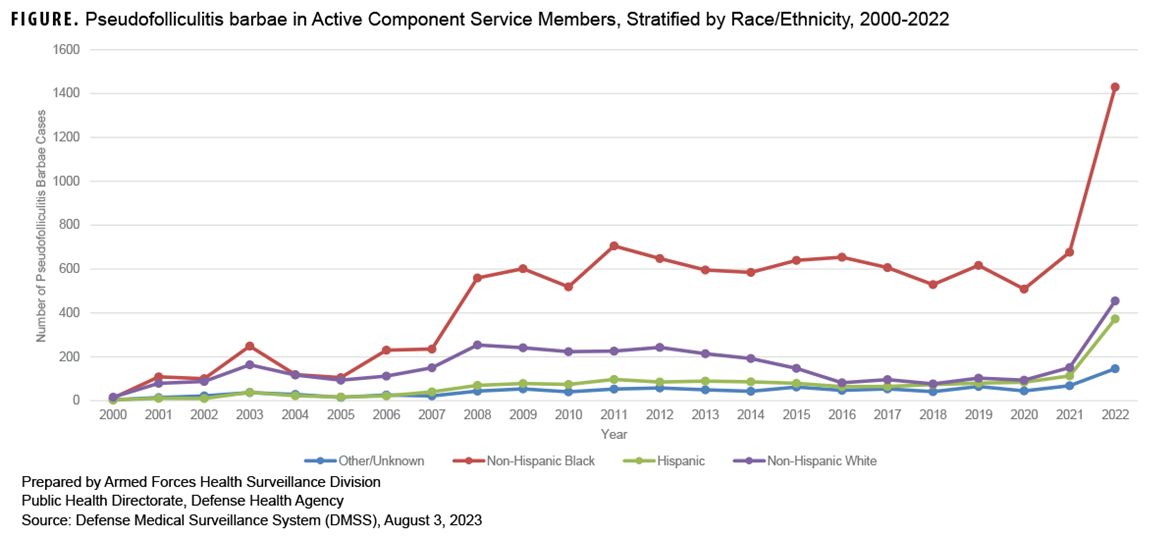
This graph depicts the frequency of Pseudofolliculitis barbae (PFB) cases according to race/ethnicity among active component service members of the U.S. military from 2000 through 2022. Four lines on the x-, or horizontal, axis represent 3 racial/ethnic groups, namely Hispanic, Non-Hispanic Black, and Non-Hispanic White, while a fourth line represents “Other/unknown” service members. Each line connects data points that chart, on the y-axis, the annual numbers of reported PFB case counts for each racial/ethnic group for every year from 2000 to 2022. Overall, the frequency of PFB cases increased over the surveillance period, but with a noticeable rise in cases between 2021 and 2022 for all racial/ethnic group categories. Starting in 2006, Non-Hispanic Black service members consistently had far higher numbers of PFB cases, noticeably increasing between 2007 and 2008, and spiking dramatically from 2021 to 2022. From 2008 until 2021, Non-Hispanic Black service members reported around 600 cases per year; that number exceeded 1,400 cases in 2022. From 2008 until 2014, Non-Hispanic White service members reported just in excess of 200 PFB cases per year, but from 2015 to 2021 those cases fell to under 100, in line with Hispanic and Other/unknown service member case numbers. In 2022 Non-Hispanic White service members reported nearly 450 cases, Hispanic service members reported just under 400 cases, and Other/unknown service members reported around 150 cases.

References

  1. Tshudy T, Cho S. Pseudofolliculitis barbae in the U.S. military, a review. Mil Med. 2021;186(1-2):52-57. https://doi.org/10.1093/milmed/usaa243
  2. Perry P, Cook-Bolden F, Rahman Z, Jones E, Taylor S. Defining Pseudofolliculitis barbae in 2001: a review of the literature and current trends. J Am Acad Dermatol. 2002;46(2):113-119. https://doi.org/10.1067/mjd.2002.120789
  3. Gelman A, Norton S, Valdes-Rodriguez R, Yosipovitch G. A review of skin conditions in modern warfare and peacekeeping operations. Mil Med. 2015;180(1):32-37. https://doi.org/10.7205/MILMED-D-14-00240
  4. Department of Defense. DoD Instruction 1300.17: Religious Liberty in the Military Services. 2020. Accessed August 1, 2023. https://www.esd.whs.mil/Portals/54/Documents/DD/issuances/dodi/130017p.pdf
  5. Barroso A. The changing profile of the U.S. military: smaller in size, more diverse, more women in leadership. 2019. Pew Research Center. Accessed August 2, 2023. https://www.pewresearch.org/short-reads/2019/09/10/the-changing-profile-of-the-u-s-military
  6. Department of Defense. 2017 Demographics Profile of the Military Community. 2017. Accessed August 2, 2023. https://download.militaryonesource.mil/12038/MOS/Reports/2017-demographics-report.pdf
  7. Department of Defense. 2021 Demographics Profile of the Military Community. 2021. Accessed August 2, 2023. https://download.militaryonesource.mil/12038/MOS/Reports/2021-demographics-report.pdf

Author Affiliations

Defense Health Agency, Armed Forces Health Surveillance Division, Epidemiology and Analysis Section

You also may be interested in...

Article
Mar 1, 2022

Brief Report: Refractive Surgery Trends at Tri-Service Refractive Surgery Centers and the Impact of the COVID-19 Pandemic, Fiscal Years 2000–2020

Cadet Saverio Macrina, U.S. Military Academy West Point, receives corneal cross-linking procedure at Fort Belvoir Community Hospital, Va., Nov. 21, 2016. (DoD photo by Reese Brown)

Since the official introduction of laser refractive surgery into clinical practice throughout the Military Health System (MHS) in fiscal year 2000, these techniques have been heavily implemented in the tri-service community to better equip and improve the readiness of the U.S. military force.

Article
Mar 1, 2022

Brief report: Using syndromic surveillance to monitor MIS-C associated with COVID-19 in Military Health System beneficiaries

Air Force 1st Lt. Anthony Albina, a critical care nurse assigned to Joint Base Andrews, Md., checks a patient’s breathing and heart rate during an intubation procedure while supporting COVID-19 response operations in Cleveland, Jan. 20, 2022.

SARS CoV-2 and the illness it causes, COVID-19, have exacted a heavy toll on the global community. Most of the identified disease has been in the elderly and adults. The goal of this analysis was to ascertain if user-built ESSENCE queries applied to records of outpatient MHS health care encounters are capable of detecting MIS-C cases that have not ...

Article
Mar 1, 2022

Surveillance Snapshot: Medical Separation from Service Among Incident Cases of Osteoarthritis and Spondylosis, Active Component, U.S. Armed Forces, 2016–2020

Marines hike to the next training location during Exercise Baccarat in Aveyron, Occitanie, France, Oct.16, 2021. Exercise Baccarat is a three-week joint exercise with Marines and the French Foreign Legion that challenges forces with physical and tactical training. Photo By: Marine Corps Lance Cpl. Jennifer Reyes

Osteoarthritis (OA) is the most common adult joint disease and predominantly involves the weight-bearing joints. This condition, including spondylosis (OA of the spine), results in significant disability and resource utilization and is a leading cause of medical separation from military service.

Publication
Sep 30, 2020

2000-2019 DoD Worldwide Numbers for TBI

.PDF | 586.61 KB

DVBIC is the Defense Department’s office of responsibility for tracking TBI data in the U.S. military. On this page you’ll find data on the number of active-duty service members — anywhere U.S. forces are located — with a first-time TBI diagnosis from 2000-2019.

Publication
Aug 10, 2020

2012 DoD Worldwide Numbers for TBI

.PDF | 2.93 MB

DVBIC is the Defense Department’s office of responsibility for tracking TBI data in the U.S. military. On this page you’ll find annual and quarterly reports that provide data on the number of active-duty service members — anywhere U.S. forces are located — with a first-time TBI diagnosis since 2000.

Publication
Aug 10, 2020

2011 DoD Worldwide Numbers for TBI

.PDF | 3.34 MB

DVBIC is the Defense Department’s office of responsibility for tracking TBI data in the U.S. military. On this page you’ll find annual and quarterly reports that provide data on the number of active-duty service members — anywhere U.S. forces are located — with a first-time TBI diagnosis since 2000.

Publication
Aug 10, 2020

2013 DoD Worldwide Numbers for TBI

.PDF | 3.33 MB

DVBIC is the Defense Department’s office of responsibility for tracking TBI data in the U.S. military. On this page you’ll find annual and quarterly reports that provide data on the number of active-duty service members — anywhere U.S. forces are located — with a first-time TBI diagnosis since 2000.

Publication
Aug 10, 2020

2015 DoD Worldwide Numbers for TBI

.PDF | 2.73 MB

DVBIC is the Defense Department’s office of responsibility for tracking TBI data in the U.S. military. On this page you’ll find annual and quarterly reports that provide data on the number of active-duty service members — anywhere U.S. forces are located — with a first-time TBI diagnosis since 2000.

Publication
Aug 10, 2020

2014 DoD Worldwide Numbers for TBI

.PDF | 2.67 MB

DVBIC is the Defense Department’s office of responsibility for tracking TBI data in the U.S. military. On this page you’ll find annual and quarterly reports that provide data on the number of active-duty service members — anywhere U.S. forces are located — with a first-time TBI diagnosis since 2000.

Refine your search