Reportable Medical Events, Military Health System Facilities, Week 22, Ending June 3, 2023
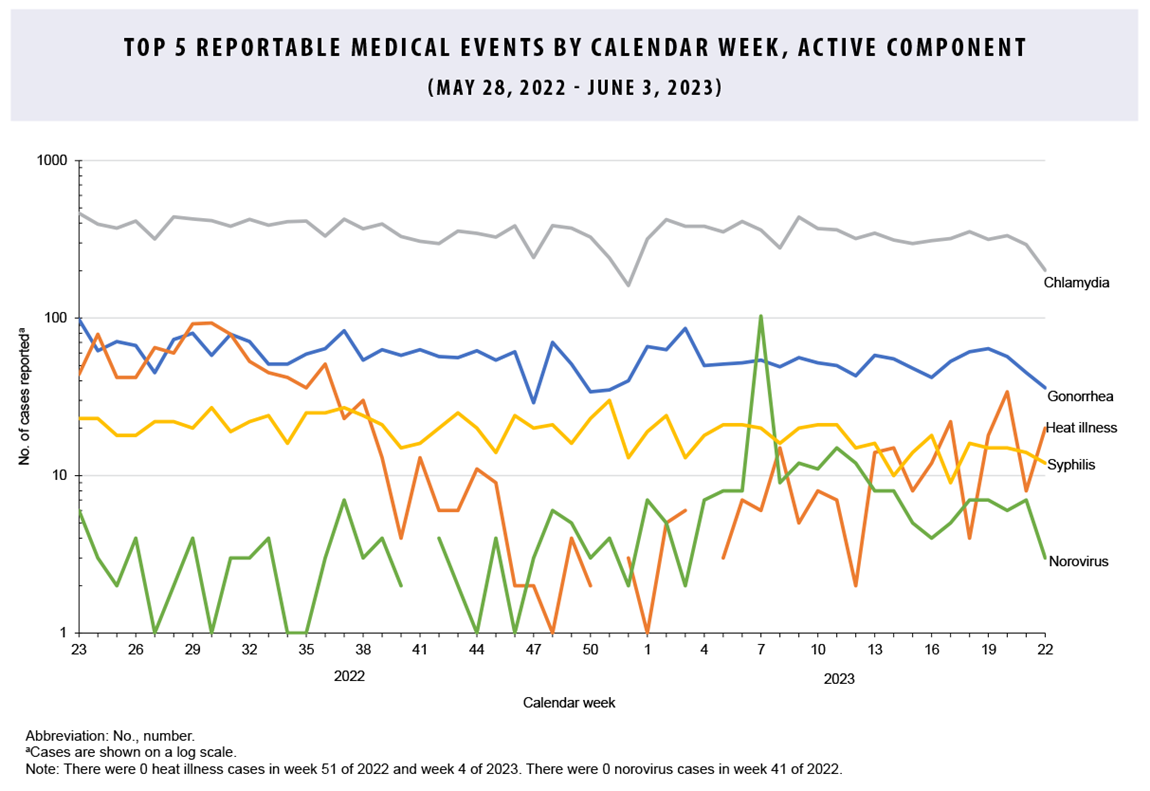
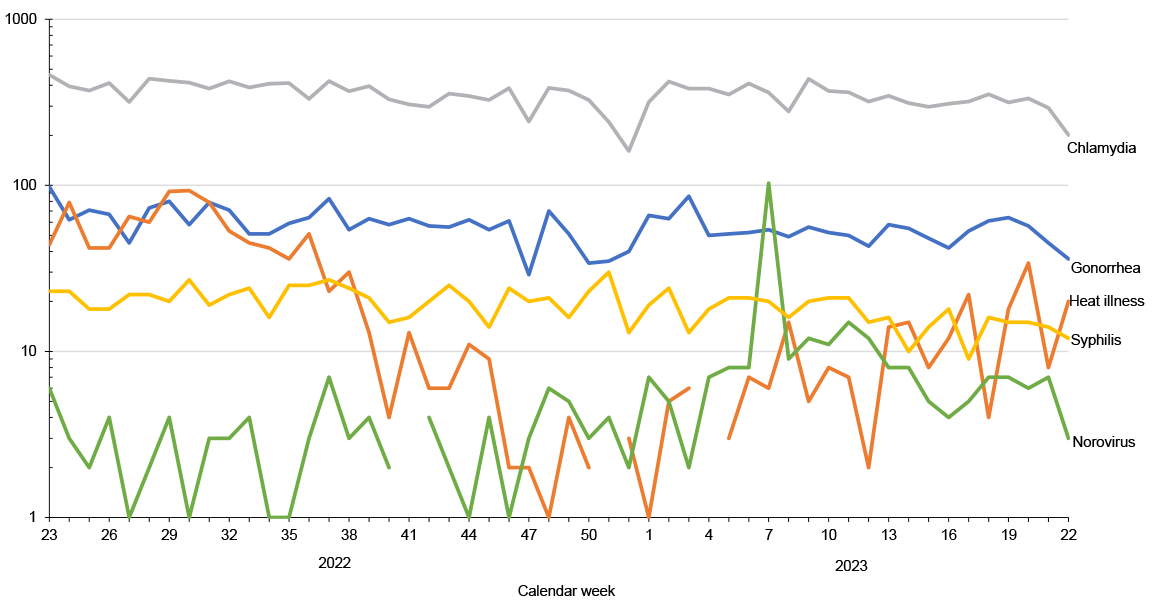 Graph depicting the frequency of the five most common reportable medical events within the Military Health System over the preceding year.
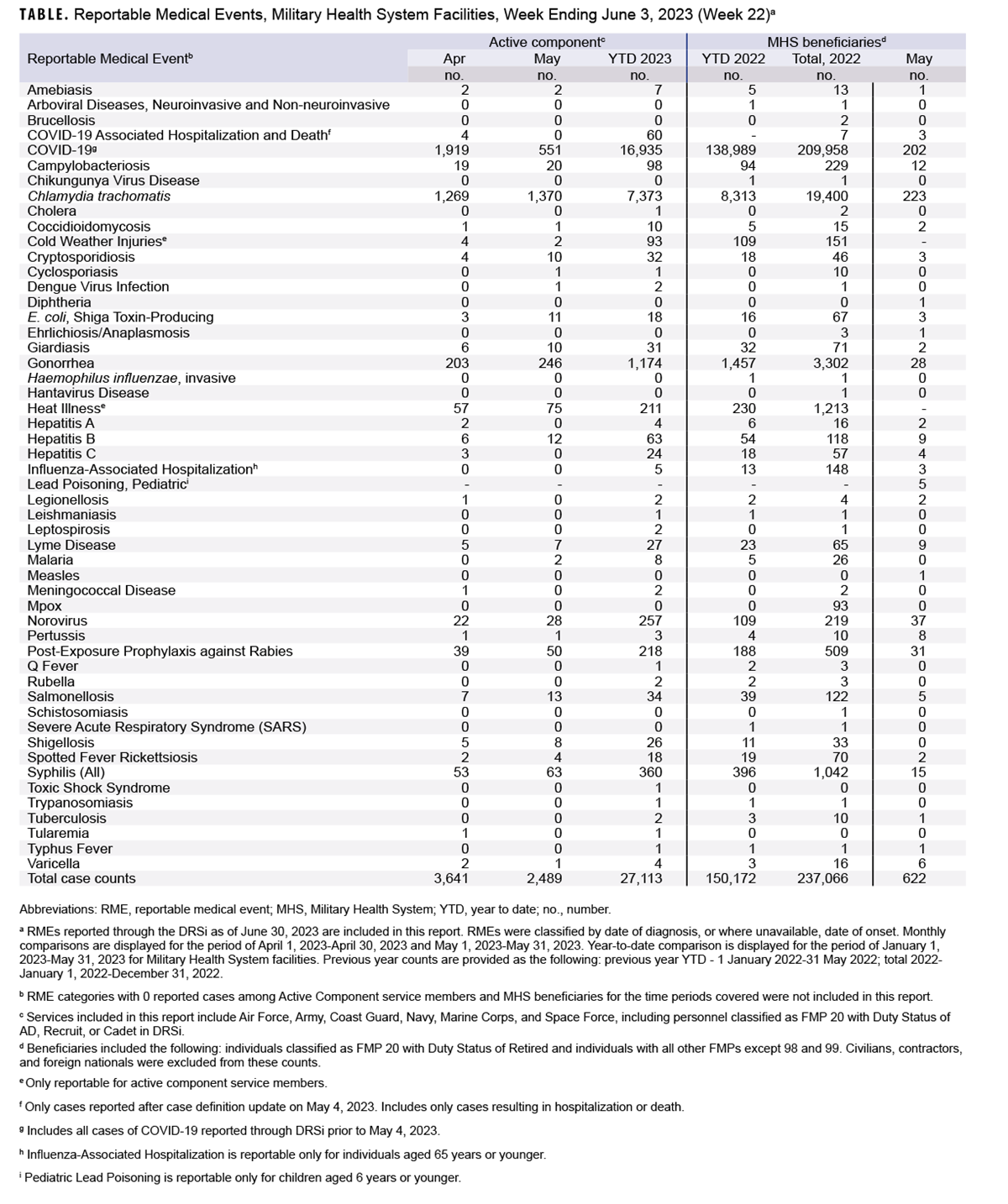
Reportable Medical Events are documented in the Disease Reporting System internet by health care providers and public health officials across the Military Health System for the purpose of monitoring, controlling, and preventing the occurrence and spread of diseases of public health interest or readiness importance. These reports are reviewed by each service’s public health surveillance hub. The DRSi collects reports on over 70 different RMEs, including infectious and non-infectious conditions, outbreak reports, STI risk surveys, and tuberculosis contact investigation reports. A complete list of RMEs is available in the 2022 Armed Forces Reportable Medical Events Guidelines and Case Definitions.1 Data reported in these tables are considered provisional and do not represent conclusive evidence until case reports are fully validated.
Total active component cases reported per week are displayed for the top five RMEs for the previous year. Each month, the graph is updated with the top five RMEs, and is presented with the current month’s (May 2023) top five RMEs, which may differ from previous months. COVID-19 is excluded from these graphs due to changes in reporting/case definition updates in 2023.
References
- Armed Forces Health Surveillance Division. Armed Forces Reportable Medical Events. Accessed April 6, 2023. https://www.health.mil/Military-Health-Topics/Health-Readiness/AFHSD/Reports-and-Publications/Armed-Forces-Reportable-Medical-Events
- Defense Manpower Data Center. Department of Defense Active Duty Military Personnel by Rank/Grade of Service, October 31, 2022. https://dwp.dmdc.osd.mil/dwp/app/dod-data-reports/workforce-reports
- Defense Manpower Data Center. Armed Forces Strength Figures for January 31, 2023. https://dwp.dmdc.osd.mil/dwp/app/dod-data-reports/workforce-reports
- Navy Medicine. Surveillance and Reporting Tools–DRSI: Disease Reporting System Internet. https://www.med.navy.mil/Navy-Marine-Corps-Public-Health-Center/Preventive-Medicine/Program-and-Policy-Support/Disease-Surveillance/DRSI
You also may be interested in...
Article
Jan 14, 2025
As the new year begins, soldiers, their families and U.S. Army civilians have a variety of tools and programs available to support their overall well-being. From holistic health and fitness initiatives to spiritual readiness resources, free counseling, sleep assistance, and family support programs, the U.S. Army is committed to fostering resilience ...
Article
Jan 7, 2025
The Environmental Protection Agency has designated January as National Radon Action Month, and the Centers for Disease Control and Prevention has chosen the last week of January as Radon Awareness Week. This is the perfect time to think about testing your home for radon.
Article
Jan 1, 2025
This study applied the Armed Forces Health Surveillance Division (AFHSD) case definition for the identification of malignant brain tumors among U.S. active service members to the dependent pediatric population of the active component of the U.S. Air Force, to determine the positive predictive value of this case definition for a pediatric population.
Article
Jan 1, 2025
Reportable medical events documented in the Disease Reporting System internet by health care providers and public health officials throughout the Military Health System are reported monthly in MSMR.
Article
Jan 1, 2025
As part of the Armed Forces Health Surveillance Division, within the Public Health Directorate of the Defense Health Agency, MSMR offers a forum for peer-reviewed public health reports that are disseminated on a variety of digital platforms: published online at health.mil, the official website of the Military Health System, in addition to indexing on ...
Article
Jan 1, 2025
This retrospective cohort study examined ovarian dysfunction diagnosis incidence among female active component service members in the U.S. military from 2014 to 2023 using medical encounter data from the Defense Medical Surveillance System.
Article
Jan 1, 2025
This analysis measures the association of traumatic brain injury with medical readiness for active duty military service, which could inform future traumatic brain injury screening, referral, and patient management protocols.
Report
Jan 1, 2025
 .PDF |
1.17 MB
.PDF |
1.17 MB
MSMR volume 32 number 1, January 2025 issue
Article
Dec 27, 2024
Several years ago, I was stationed in Colorado. I’d never snow skied, but after my first initiation-by-fire trip, I was feeling comfortable and actually considered myself a somewhat fearless skier. I would go hard and fast until I hit something or just fell. Ski equipment would scatter from where I fell to where I slid to a stop—meaning I spent a lot ...
Topic
Mar 4, 2025
AFHSD established the Integrated Biosurveillance division to serve as a central biosurveillance coordination unit to meet the needs of Department of Defense medical and public health components and leadership.
Video
Dec 9, 2024
Lance Cpl Sara Vanegas is a Marine with the Wounded Warriors Batallion East at Walter Reed National Military Medical Center in Bethesda, MD. She is a talented artist who is finding community through her art and the Warrior Care Program. Learn more about the many resources and programs available at health.mil/warriorcare.
Article
Dec 2, 2024
Each military service selects its physical fitness tests to meet its unique mission needs. All services’ fitness tests include measures of aerobic fitness, such as a timed run, and muscular health, such as the push-up. Depending on the service, the fitness test can include sprinting, carrying weighted items, or deadlifts.
Article
Dec 1, 2024
This report presents the rates of maternal syphilis among pregnant women and congenital syphilis among newborns in the Military Health System beneficiary population from 2012 to 2022. Between 2012 and 2021, cases of congenial syphilis in the U.S. increased by 755%, and rates of maternal and congenital syphilis within the Military Health System ...
Article
Dec 1, 2024
Reportable medical events documented in the Disease Reporting System internet by health care providers and public health officials throughout the Military Health System are reported monthly in MSMR.
Article
Dec 1, 2024
This report summarizes the numbers, types, and rates of incident mental health disorder diagnoses among U.S. active component service members over a 5-year surveillance period, from 2019 through 2023, during which a total of 541,672 service members were diagnosed with at least one mental health disorder.
You are leaving Health.mil
The appearance of hyperlinks does not constitute endorsement by the Department of Defense of non-U.S. Government sites or the information, products, or services contained therein. Although the Defense Health Agency may or may not use these sites as additional distribution channels for Department of Defense information, it does not exercise editorial control over all of the information that you may find at these locations. Such links are provided consistent with the stated purpose of this website.
You are leaving Health.mil
View the external links disclaimer.
Last Updated: August 24, 2023