Reportable Medical Events, Military Health System Facilities, Week 22, Ending June 3, 2023
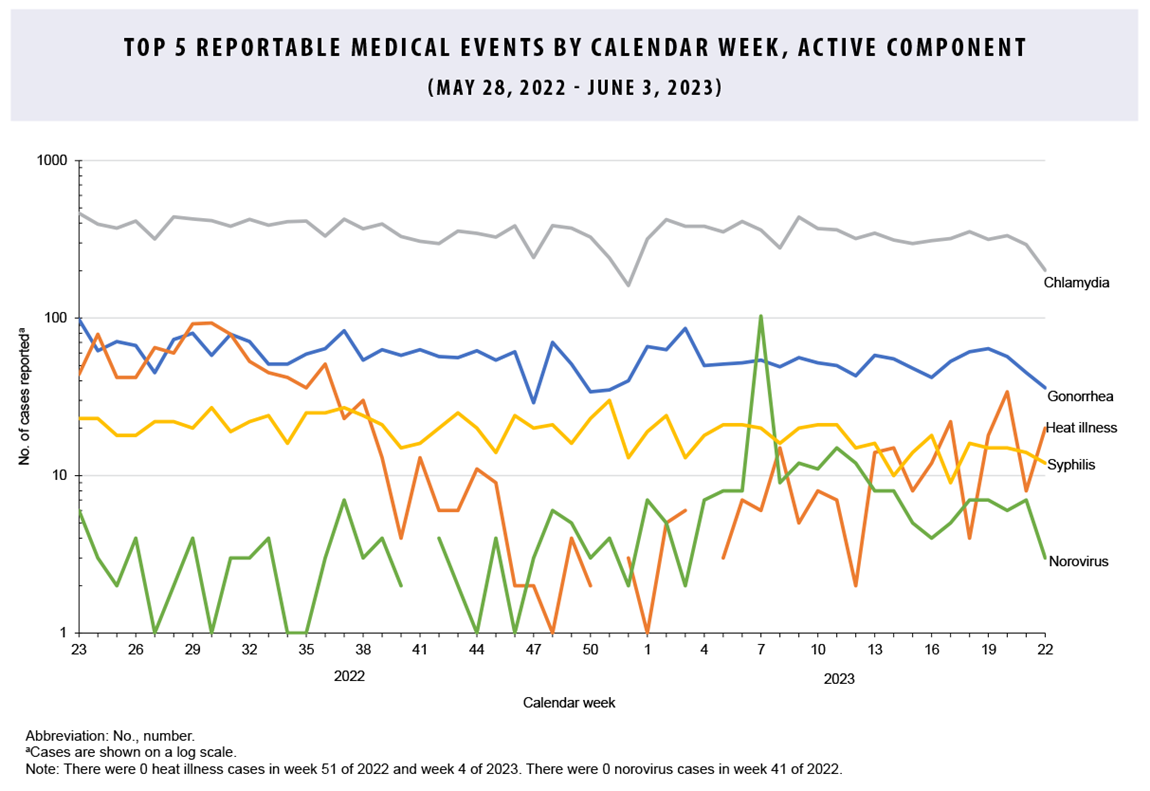
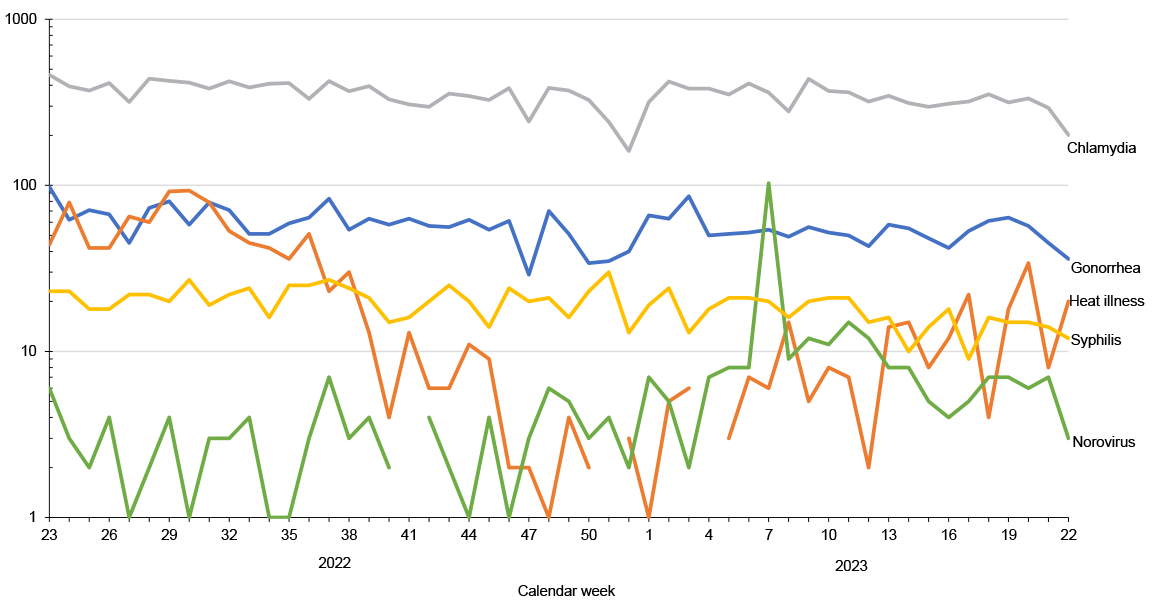 Graph depicting the frequency of the five most common reportable medical events within the Military Health System over the preceding year.
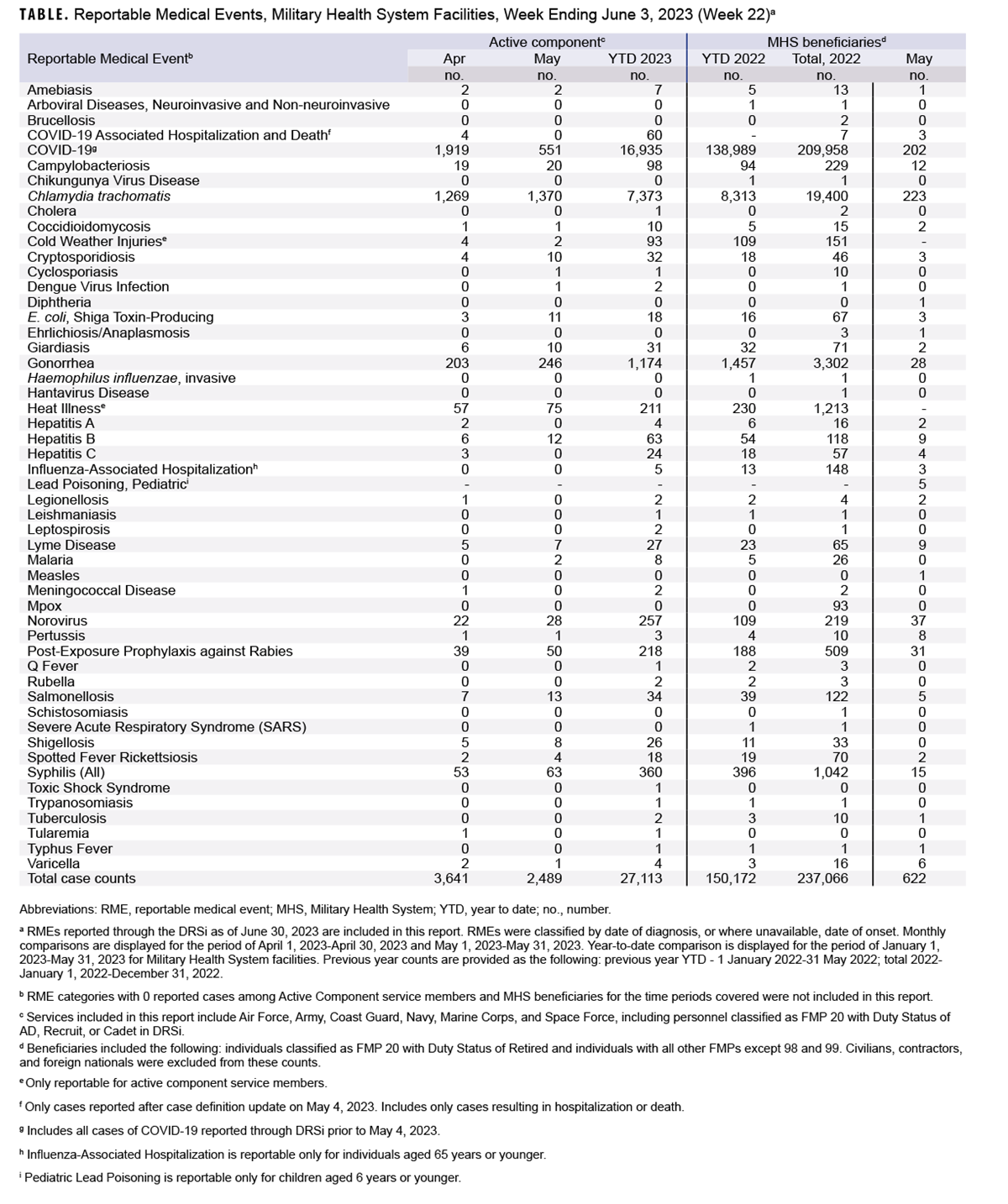
Reportable Medical Events are documented in the Disease Reporting System internet by health care providers and public health officials across the Military Health System for the purpose of monitoring, controlling, and preventing the occurrence and spread of diseases of public health interest or readiness importance. These reports are reviewed by each service’s public health surveillance hub. The DRSi collects reports on over 70 different RMEs, including infectious and non-infectious conditions, outbreak reports, STI risk surveys, and tuberculosis contact investigation reports. A complete list of RMEs is available in the 2022 Armed Forces Reportable Medical Events Guidelines and Case Definitions.1 Data reported in these tables are considered provisional and do not represent conclusive evidence until case reports are fully validated.
Total active component cases reported per week are displayed for the top five RMEs for the previous year. Each month, the graph is updated with the top five RMEs, and is presented with the current month’s (May 2023) top five RMEs, which may differ from previous months. COVID-19 is excluded from these graphs due to changes in reporting/case definition updates in 2023.
References
- Armed Forces Health Surveillance Division. Armed Forces Reportable Medical Events. Accessed April 6, 2023. https://www.health.mil/Military-Health-Topics/Health-Readiness/AFHSD/Reports-and-Publications/Armed-Forces-Reportable-Medical-Events
- Defense Manpower Data Center. Department of Defense Active Duty Military Personnel by Rank/Grade of Service, October 31, 2022. https://dwp.dmdc.osd.mil/dwp/app/dod-data-reports/workforce-reports
- Defense Manpower Data Center. Armed Forces Strength Figures for January 31, 2023. https://dwp.dmdc.osd.mil/dwp/app/dod-data-reports/workforce-reports
- Navy Medicine. Surveillance and Reporting Tools–DRSI: Disease Reporting System Internet. https://www.med.navy.mil/Navy-Marine-Corps-Public-Health-Center/Preventive-Medicine/Program-and-Policy-Support/Disease-Surveillance/DRSI
You also may be interested in...
Article
May 1, 2025
This cross-sectional study examines univariate associations of self-reported recurring headache with demographics and women’s health characteristics.
Article
May 1, 2025
This study applies the same methods as study of 10 million U.S. women to reveal trends in cervical cancer screening among active component service women in response to 2012 guideline changes and compares Military Health System trends to reported trends in the U.S. population.
Report
May 1, 2025
 .PDF |
3.62 MB
.PDF |
3.62 MB
Section 508-compliant May 2025 MSMR, volume 32 number 5
Article
Apr 25, 2025
This year marks a significant milestone for the Medical Surveillance Monthly Report as we celebrate its 30th anniversary.
Throughout its three decades, MSMR has continuously improved its content with the goal of providing readers with unbiased, scientifically rigorous, evidence-based medical surveillance information on the current status, trends, ...
Article
Apr 1, 2025
This brief article discusses two ship explosions during the Second World War that caused mass U.S. casualties without any enemy intervention.
Article
Apr 1, 2025
Throughout its 30-year history, MSMR has continuously sought to improve its content with the ultimate goal of providing its readers with unbiased, scientifically rigorous, evidence-based information on the current status, trends, and determinants of the physical and mental health of U.S. military service members.
Article
Apr 1, 2025
The Long Short-Term Memory model is a machine-learning method with potential to improve forecasting accuracy for respiratory disease surveillance. This report assesses the model's performance for potential future Department of Defense influenza forecasting.
Article
Apr 1, 2025
This brief article describes how the Walter Reed Army Institute of Research (WRAIR) worked collaboratively with local partners to discover an effective treatment for scrub typhus, a deadly illness that killed thousands of Allied soldiers in the Pacific during World War II.
Article
Apr 1, 2025
This editorial discusses the U.S. Department of Defense Global Respiratory Pathogen Surveillance Program, a cornerstone of U.S. Department of Defense respiratory disease surveillance, and its surveillance network of 115 active sentinel sites in addition to other participating sites, deployed locations, and partner laboratories across the globe.
Article
Apr 1, 2025
This retrospective analysis examines HIV antibody seropositivity rates in the U.S. Armed Forces and characterizes shifts in the epidemiological profile of HIV cases during the course of the evolving HIV epidemic.
Article
Apr 1, 2025
For over 200 years, the U.S. military has consistently utilized the best data it could collect, analyze, and disseminate, to protect the health and lives of its personnel, improve current medical knowledge and practice, and advance scientific discovery.
Article
Apr 1, 2025
This editorial evaluates the clinical utility of increasingly common respiratory viral panel diagnostic assays and how they can improve force health protection and Military Health System beneficiary public health surveillance.
Article
Apr 1, 2025
Since 1999, MSMR has published regular updates on malaria incidence among U.S. service members. This update describes the epidemiological patterns of malaria incidence among service members in the active and reserve components of the U.S. Armed Forces from 2015 through 2024.
Article
Apr 1, 2025
Reportable medical events are documented in the Disease Reporting System internet by health care providers and public health officials throughout the Military Health System and are reported monthly in MSMR.
Report
Apr 1, 2025
.PDF |
6.14 MB
Section 508-compliant PDF of MSMR April 2025 issue, volume 32, number 4
You are leaving Health.mil
The appearance of hyperlinks does not constitute endorsement by the Department of Defense of non-U.S. Government sites or the information, products, or services contained therein. Although the Defense Health Agency may or may not use these sites as additional distribution channels for Department of Defense information, it does not exercise editorial control over all of the information that you may find at these locations. Such links are provided consistent with the stated purpose of this website.
You are leaving Health.mil
View the external links disclaimer.
Last Updated: August 24, 2023