Felisha Garcia, Psy.D., Halima Ahmed, M.A., and U.S. Navy Lt. Cmdr. Nicholas Grant, Ph.D., ABPP
Jan. 22, 2025
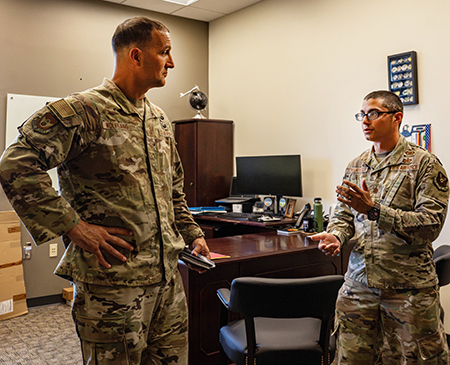
U.S. Air Force photo by Senior Airman Rhea BeilHave you ever wondered: Are people drawn to you willingly, or do they engage with you out of obligation? Would someone choose to speak to you if they didn’t have to? Are you fostering meaningful, professional relationships, or are your interactions limited to giving directions, making decisions, and delegating tasks? When was the last time you offered a genuine, personal compliment — one that wasn’t a general statement made in front of others? Do you strike a healthy balance between talking and listening in your daily interactions? And perhaps the most important question: Does any of this matter to you, or is the manner of communication insignificant as long as you get the response you desire? For some, these are easy questions to answer. Others may have more difficulty.
Communication is one of the most powerful tools we have to influence, connect with, and inspire others. It can build strong, lasting relationships, or it can tear them down.1 Communication is remarkably diverse, with nearly every species in the animal kingdom having its own form of expression. Yet, at its core, communication is simple: it involves a message sent and a message received.2 Each part is essential, yet both are filled with delicate intricacies that can determine whether the message is successfully delivered or lost in misinterpretation.1 Radio operators, coders, and cryptographers are highly valued experts whose skills in transmitting and interpreting messages are critical to the success of missions and prevention of catastrophic consequences.3 Their work reminds us that communication is not just about speaking; it is about ensuring that the message is understood.
The Impact of Communication: Silence, Missteps, and Connection
The absence of communication can be a double-edged sword. For some, silence comes as a reprieve; for others it can be a deafening void. Some people may choose to stay silent to avoid conflict or to preserve what remains of a fragile relationship.4 However, silence can also lead to further decay, creating distance and misunderstanding. Conflicts in communication can contribute to stress and avoidant behaviors which can affect your daily functioning and psychological health.4
For example, military spouses navigating deployments often face unique communication challenges. Technical difficulties, vast distances, time constraints, and uncertainty of responses can create frustration and strain.5 Over time, these barriers can erode the foundation of a relationship. What happens when communication becomes so strained that you no longer want to engage? When communication becomes toxic, it can lead to hurt feelings, distrust, and emotional distancing. In some cases, third parties (like friends, coworkers, or children), are pulled into the role of mediators, which can place undue stress on them.4
Poor communication doesn’t just affect relationships — it affects us physically and emotionally. Anticipating a difficult conversation can cause anxiety, both before and after the interaction.4 On the other hand, when communication is healthy, it strengthens relationships and fosters trust, leaving us feeling good about our connections.
Roadblocks to Communication: Why We Struggle to Connect
“That is not what I said.”
“Are you even listening?”
Sound familiar? These phrases highlight the common roadblocks we encounter in communication.6 What you say and how you say it directly impacts how your message is received and interpreted. Delivery matters. You may have a valid point, but poor delivery can undermine your message and prevent successful communication.6
It’s important to remember that a listener’s inability to understand your message doesn’t necessarily reflect incompetence on their part.7,8 Often, the issue lies in how the message is conveyed. Communication is a two-way street — both parties share responsibility for its success.
One of the most common barriers to effective communication is the failure to actively listen, which involves fully focusing on, understanding, and responding to the speaker without distractions or preconceived judgments. People often assume they are on different pages when they may be aligned but haven’t paused to truly hear each other. This lack of active listening can lead to frustration, misinterpretation, and, ultimately, anger — a powerful destroyer of communication.7 What’s the point of having a good idea if your audience didn’t understand it? Effective communication is the bridge between intention and understanding. Let’s explore strategies to convey your message clearly and meaningfully:
How to Effectively Send a Message
- Prioritize the conversation: Set aside time for the conversation and eliminate distractions by putting away electronic devices.9
- Plan your words: Think about what you want to say and organize your thoughts before speaking.9 Preparation prevents missteps and ensures clarity.
- Pay attention to nonverbal cues: Communication is largely nonverbal, so maintain a neutral tone, steady volume, and open body language.10
- Use “I-statements” instead of “You-statements:” Phrases such as “I need,” “I want,” and “I feel,” express your perspective without placing blame, reducing defensiveness, and fostering collaboration.8
- Balance positives and negatives: Use nonjudgmental language and share positives to balance any constructive feedback.9,11
- Stick to facts, not assumptions: Avoid jumping to conclusions. Instead, rely on facts and ask clarifying questions to prevent misinterpretations.9,11
- Focus on the present and future: Keep the conversation forward-looking and proactive, rather than dwelling on past mistakes. This approach encourages solutions and progress.9,11
- Engage in dialogue, not debate: Communicate with the goal of understanding the other person, not defeating them. Collaboration builds trust and strengthens relationships.7
How to be an Effective Active Listener
Sending a message is meaningless if the listener does not receive it. Active listening is the key to ensuring your communication is understood and valued. Here’s how to listen effectively:
- Respond thoughtfully. A lack of response, whether verbal, nonverbal, or written, can feel very dismissive and negative. Acknowledge the speaker’s message to show you’re engaged.10,11
- Show genuine interest. Use comfortable eye contact (if culturally appropriate), nodding, and facial expressions to demonstrate attentiveness.10,11
- Adopt open body language. Face the speaker directly, keep your hands uncrossed, shoulders relaxed, and feet firmly on the ground to convey openness and receptivity.10,11
- Level the playing field. Sit or stand on the same level as the speaker to avoid creating a sense of hierarchy or intimidation.10
- Listen without interrupting. Allow the speaker to finish their thoughts without interjecting. Interruptions can derail the conversation and signal a lack of respect.10,11
- Confirm understanding. Repeat back what you heard to ensure clarity. If something is unclear, ask for clarification or repetition to avoid miscommunication.9,10,11
Understanding Communication Styles
Communication styles vary depending on the situation, the people involved, and even life stages.
The four basic communication styles are:12
- Aggressive: Dominates the conversation, often at the expense of others.
- Passive: Avoids expressing needs or opinions, leading to frustration or resentment.
- Passive-aggressive: Indirectly expresses dissatisfaction, often through sarcasm or subtle digs.
- Assertive: Balances respect for self and others, expressing thoughts and feelings clearly and calmly.
The most effective communication style is assertive, as it conveys respect, while fostering mutual understanding.12 To communicate assertively:
- Recognize your needs. Remind yourself that your needs and opinions are just as important as anyone else’s.12
- Express yourself clearly. Share your thoughts and feelings calmly and directly, avoiding emotional outbursts.12
- Practice saying “no.” Assertive communication includes setting boundaries without guilt or discomfort.12
- Maintain a neutral tone and body language. Use a steady tone and open body language to reinforce your message and avoid misinterpretation.12
When a message is sent and received assertively, it creates a foundation for trust, openness, and mutual respect. Even in difficult conversations, both parties feel heard and valued. Assertive communication strengthens relationships by establishing a safe space for honesty and collaboration. Over time, this builds comfort, credibility, and healthier interactions. Effective communication impacts all types of relationships, whether between supervisors and supervisees, coworkers, partners, teachers and student, friends, parents and children, or neighbors. Actively practicing these skills not only nurtures these relationships but also prevents toxic environments in both personal and professional settings. By prioritizing clear, respectful communication, you can create a positive ripple effect that benefits everyone involved.
Additional Resources:
References:
- Dartiguelongue, J. B., & Cafiero, P. J. (2021). Communication in health care teams. La comunicación en los equipos de salud. Archivos argentinos de pediatria, 119(6), e589–e593. https://doi.org/10.5546/aap.2021.eng.e589
- Martin-Champetier, A., & Dabadie, A. (2025). How to talk to parents. Pediatric radiology, 55(2), 242–251. https://doi.org/10.1007/s00247-024-06146-6
- Tohe, L. (2022). Code Talkers Were America’s Secret Weapon in World War II. National Endowment for the Humanities. Humanities. 43(3). https://www.neh.gov/article/code-talkers-were-americas-secret-weapon-world-war-ii
- Mahmudah, S., Astutik, F., Diana, Rahayu, D., & Handayani, N. (2025). Coping Strategies in the Toxic Relationships: A Phenomenological Study of Emerging Adults. International Journal of Body, Mind and Culture, 12(3), 35–50. https://doi.org/10.61838/ijbmc.v12i3.869
- Pessoa dos Santos, R., Francisco, R., Ribeiro, M. T., & Roberto, M. S. (2021). Psychological and emotional experiences during a military mission: A longitudinal study with soldiers and spouses. Couple and Family Psychology: Research and Practice, 10(1), 38–53. https://doi.org/10.1037/cfp0000157
- Gregory J. (2024). Understanding the communication skills that support nurses to provide person-centered care. Nursing standard (Royal College of Nursing (Great Britain):1987), 39(2), 61–66. https://doi.org/10.7748/ns.2024.e12132
- Yun, D., & Jung, H. (2022). Anger Expression in Negotiation: The Effects of Communication Channels and Anger Intensity. Frontiers in psychology, 13, 879063. https://doi.org/10.3389/fpsyg.2022.879063
- Pettit, C., Hellwig, A. F., Costello, M. A., Hunt, G. L., & Allen, J. P. (2024). You-talk in young adult couples' conflict: Family-of-origin roots and adult relational aggression sequelae. Journal of social and personal relationships, 41(12), 3641–3664. https://doi.org/10.1177/02654075241270998
- Germaine, P., Catanzano, T., Patel, A., Mohan, A., Patel, K., Pryluck, D., & Cooke, E. (2021). Communication Strategies and Our Learners. Current problems in diagnostic radiology, 50(3), 297–300. https://doi.org/10.1067/j.cpradiol.2020.10.009
- Collins H. K. (2022). When listening is spoken. Current opinion in psychology, 47, 101402. https://doi.org/10.1016/j.copsyc.2022.101402
- Kelly, A., Carey, J., Powell, M., & McColl, E. (2023). Top tips for effective clinical communication. British Dental Journal, 234(10), 716–718. https://doi.org/10.1038/s41415-023-5920-8
- Richard, C., Lussier, M. T., Millette, B., & Tanoubi, I. (2023). Healthcare providers and patients: an essay on the importance of professional assertiveness in healthcare today. Medical education online, 28(1), 2200586. https://doi.org/10.1080/10872981.2023.2200586
Felisha Garcia, Psy.D., is a licensed clinical psychologist and contracted subject matter expert for the Psychological Health Center of Excellence. She specializes in forensic psychology with extensive experience in the treatment of anxiety and trauma.
Halima Ahmed, M.A., is a contracted program manager for PHCoE. She provides consistent, efficient, and quality support by aiding in the successful production and execution of project goals.
U.S. Navy Lt. Cmdr. Nicholas Grant, Ph.D., ABPP, is a double board-certified clinical psychologist and subject matter expert at PHCoE where he serves as the action officer for the Real Warriors Campaign.