By Lt. Col. Dan Cassidy, Ph.D., ABPP, U.S. Air Force
Jan. 29, 2025
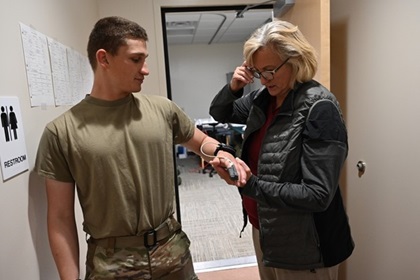
U.S. Army photo by Maddi Langweil
‘Innovation in health care’ – the phrase implies engineering marvels like smart pills, artificial intelligence, and wearable biosensors. I imagine you share my desire to live in whatever version of the near future sees full integration of these and a thousand other technologies into routine care. But what if even this isn’t enough to meaningfully improve most peoples’ health outcomes?
Pessimists will note that we are not on average living longer or better, despite all that we have discovered about illness, injury, treatment, and prevention.1, 2 Perhaps you are now recalling that annual health care spend in the United States is nearly 20% of gross domestic product and pondering how, in this system of inputs and outputs, two plus two sums inexplicably to three.3 To extract benefit from innovation, we must first strengthen the weakest links in the value chain.4 For healthcare providers, challenge lurks in the gap between knowledge and action.5, 6, 7 What follows is a figurative bridge across that chasm, built of insights from behavioral science.
Each of Us is a Time Traveler
Ask experts what differentiates homo sapiens from other animals and you will get a wide range of responses: we have opposable thumbs; we are bipedal; we problem-solve. But koalas also have opposable thumbs, ostriches are bipedal, and ravens are excellent problem-solvers. It is the ensemble of such characteristics that matters most – the advantages of bipedalism are not so substantial without arms, for example. Still, if pressed to nominate a single capability as most important for human advantage, language almost certainly is the frontrunner.8
Animals like parrots and gorillas share with us a basic capacity for language, but theirs is constrained to concrete relationships between and among objects. A parrot may with training tell you which of two objects is physically smaller (e.g., the dime, and not the nickel), but cannot grasp that the nickel is figuratively smaller than the dime.9 Relational Frame Theory emphasizes our uniquely human ability to leverage language for abstraction.10 We have, as a result, the ability to parse ‘I, here, now’ from ‘you, there, then’. Out of these “relational frames” emerges our ability to envision and plan for potential future states of the world.
So, you and I are in some important sense time travelers; we can imagine the future, worry about it, and plan for it. Does your patient wish to feel rested and refreshed tomorrow morning? They can plan for this with an earlier bedtime. But perhaps they wish, also, to watch yet another episode of some fabulous, just released television series. It’s getting late. Which do they choose, sleep or entertainment?
Conflicting Preferences
Let us imagine that your patient wants entertainment now, in which case more television is the rational choice. Probably they also want alertness tomorrow, relative to which staying awake for another hour is ill-advised. Their preferences conflict, yet both are accurate and must be reconciled at a single moment in time – now. Here are just a few clinically relevant examples:
- Behavioral Activation: I wish eventually to feel happier and more engaged with life, but I also will be more comfortable tonight staying home rather than joining my friend for dinner as scheduled.
- Exposure Therapy: I’d like to enjoy a wider range of activities outside the house, but I also anticipate that visiting a crowded store this afternoon will be acutely unpleasant.
- Planned Physical Activity: I’m confident that I will feel more energetic once in better shape, but I feel tired this afternoon and wish now to sit and read a book.
Medication adherence, colonoscopies, sleep health – the list goes on and on. We have conflicting preferences and act frequently in ways which betray our longer-term interests. Innovation in biosensors, genomics, and therapeutics expands what is possible for human health. Innovation in behavioral science can make those benefits more probable for real patients whose preferences conflict. Research suggests that your patient’s capacity for ‘time travel’ can be leveraged in the clinical setting to narrow the gap between knowledge and action.11
Back to the Future
We tend to discount the value of an outcome as the delay to its payout increases – a phenomenon dubbed ‘temporal discounting’.12, 13 For example, a new car tomorrow is for most people more tangible than the return from incremental investment in an index fund over a period of three decades. But we can, using our species’ capacity for language-based time travel, help patients steer out of this rut.11, 14
Clinical conversations about the future that evoke strong emotion can strengthen a patient’s resolve for positive change in the present. The tools for such dialogues are well-defined under the banner of ‘Motivational Interviewing’ 15, 16:
- Spirit: Engage your conversational partner with acceptance and genuine curiosity.
- Talk Time: Aim to do no more than 20% of the talking. Create space for your patient to contemplate their values and most important reasons for change.
- Evocation: Pull for ‘change talk’ – their desire, reasons, ability, and need for change.
- Reflective listening: Summarize and extend your patient’s words. Strive for a two-to-one ratio of reflections to questions.
Like a pair of binoculars, Motivational Interviewing brings the distant future into focus. Perhaps you help your patient connect the prospect of better sleep to what they really value, personally and professionally. The temptation to watch another hour of television remains, but the fight is now fair, and their ambivalence breaks for an earlier bedtime.
We Have the Technology
Wearables and cutting-edge pharmaceuticals are indeed innovative and hold great promise for healthcare improvement. But reaping full benefit from such progress requires corresponding innovation in one of our oldest culturally evolved technologies - language. Motivational Interviewing strengthens a weak link in the healthcare value chain – that from knowledge to action – enabling exciting new technologies to reach their full potential in support of human health. So, let’s make more probable that which is now possible. We have the technology.
References
- Woolf, S. H. (2023). Falling behind: the growing gap in life expectancy between the United States and other countries, 1933–2021. American Journal of Public Health, 113(9), 970-980.
- Hacker, K. (2024). The burden of chronic disease. Mayo Clinic Proceedings: Innovations, Quality & Outcomes, 8(1), 112-119.
- Congressional Budget Office (2020). The 2020 Long-Term Budget Outlook. U.S. Government Printing Office. Accessed at: https://www.cbo.gov/system/files/2020-09/56516-LTBO.pdf
- Kremer, M. (1993). The O-ring theory of economic development. The Quarterly Journal of Economics, 108(3), 551-575.
- Foley, L., Larkin, J., Lombard-Vance, R., Murphy, A. W., Hynes, L., Galvin, E., & Molloy, G. J. (2021). Prevalence and predictors of medication non-adherence among people living with multimorbidity: a systematic review and meta-analysis. BMJ open, 11(9), e044987.
- Parati, G., Lombardi, C., Pengo, M., Bilo, G., & Ochoa, J. E. (2021). Current challenges for hypertension management: From better hypertension diagnosis to improved patients' adherence and blood pressure control. International Journal of Cardiology, 331, 262-269.
- Wells, S. Y., Morland, L. A., Hurst, S., Jackson, G. L., Kehle-Forbes, S. M., Jaime, K., & Aarons, G. A. (2023). Veterans’ reasons for dropping out of prolonged exposure therapy across three delivery modalities: A qualitative examination. Psychological Services, 20(3), 483.
- Houmanfar, R. A., Alavosius, M. P., Ghezzi, E. L., & Olla, R. (2024). Verbal repertoires and contextual factors in cultural change. The Psychological Record, 1-17.
- Hughes, S., & Barnes-Holmes, D. (2014). Associative concept learning, stimulus equivalence, and relational frame theory: Working out the similarities and differences between human and non-human behavior. Journal of the Experimental Analysis of Behavior, 101(1), 156-160.
- Hayes, S. C. (2001). Relational frame theory: A post-Skinnerian account of human language and cognition. Plenum Press.
- Cole, S. A., Sannidhi, D., Jadotte, Y. T., & Rozanski, A. (2023). Using motivational interviewing and brief action planning for adopting and maintaining positive health behaviors. Progress in Cardiovascular Diseases, 77, 86-94.
- Ainslie, G. (1991). Derivation of" rational" economic behavior from hyperbolic discount curves. The American Economic Review, 81(2), 334-340.
- Villmoare, B., Klein, D., Liénard, P., & McHale, T. S. (2024). Evolutionary origins of temporal discounting: Modeling how time and uncertainty constrain optimal decision-making strategies across taxa. PloS one, 19(11), e0310658.
- Rozanski, A. (2023). New principles, the benefits, and practices for fostering a physically active lifestyle. Progress in Cardiovascular Diseases, 77, 37-49.
- Rollnick, S., Miller, W. R., Butler, C. C., & Aloia, M. S. (2008). Motivational interviewing in health care: helping patients change behavior.
- Papageorgiou, D., & Karekla, M. (2024). Using values interventions to improve exposure therapy engagement in specific phobias. Journal of Psychotherapy Integration, 34(1), 75.
U.S. Air Force Lt. Col. Dan Cassidy, Ph.D., ABPP, is a board-certified clinical health psychologist at the PHCoE with research and applied interests in population science and health behavior change.