By Erin McNett, Psy.D., Philip R. Magaletta, Ph.D., and Marie Manteuffel, PharmD, MPH, MADSS
Dec. 16, 2025
PHCoE GraphicLine leaders, chaplains, and care providers alike know the impact stress can have on the well-being of a service member, their family, and even their unit. You also understand the importance of addressing stress-related problems when they arise. Research shows psychological distress is on the rise globally1 and adjustment and anxiety disorders are the most common mental health conditions treated in the military health system.2 Concerningly, rates of these conditions among service members have been steadily rising.2 But what about the stressors associated with disciplinary and legal involvement? How can we support service members coping with these unique challenges?
What Do Disciplinary and Legal Involvement Look Like?
In 2023, a U.S. soldier facing disciplinary action crossed the border into North Korea in a case that drew international attention. Of course, most disciplinary and legal involvement is not this public and extreme. Service member disciplinary involvement may include infractions ranging from misconduct or fraternization to criminal behavior. Service members may also experience legal involvement in civilian courts, such as child custody or property disputes. Given that psychological stress can impact work performance,3 managing stress associated with disciplinary and legal involvement may prevent harm to affected service members and help maintain operational readiness.
The mental health impacts of disciplinary and legal involvement can be significant. Data support a possible correlation between suicide and disciplinary and legal involvement. In 2023, 29% of service members who died by suicide had known administrative or legal problems.4 Research also points to an increased risk for suicide and homelessness amongst veterans dishonorably discharged (suggestive of disciplinary or legal involvement) compared to those discharged with honorable characterizations of service.5,6 Being the subject of an investigation can leave an individual feeling isolated or ostracized.7 Even an accusation or the possibility of an investigation may generate shame or fear of incarceration or career or relationship consequences that can be overwhelming.
Mapping Service Members to the Right Resource at the Right Time
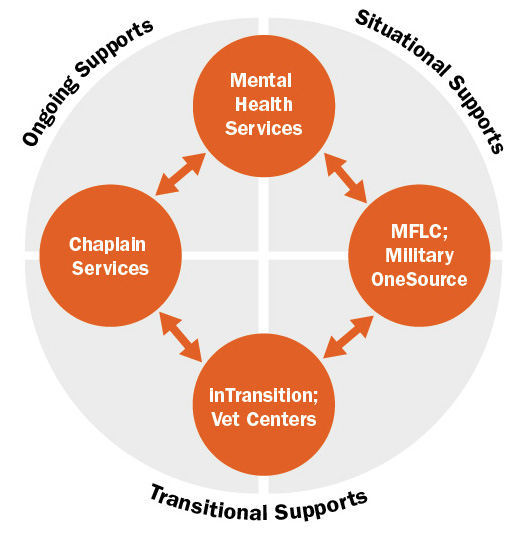
Service members facing significant or stressful life events may have varied needs that require different types of support. These needs may also change over time. Just as navigation apps guide us on road trips, being equipped with the right resource map can help you better guide and support service members experiencing disciplinary and legal involvement. As seen in the graphic, there are three interconnected and phase-based supports available. Ongoing supports, like those from a military health provider or a chaplain, may be useful for service members anticipating or facing disciplinary or legal action. Situational supports like those from Military OneSource or Military and Family Life Counseling may benefit service members and their families who need counseling or assistance navigating daily aspects of life like finances, housing, or health negatively impacted because of disciplinary and legal involvement. If a case results in separation or a change of duty station, transitional supports like those from inTransition and Veteran’s Affairs Vet Centers can help service members connect with mental health care and/or other resources during these processes.
Make A Real Difference: Recognize. Refer. Reassess.
No matter your role, you can support service members by remembering these three R’s:
- Recognize. Disciplinary and legal involvement may or may not be the reason a service member engages with you: Recognize it as a stressor and evaluate its impact on him or her.
- Refer. Not all service members facing disciplinary and legal involvement need mental health treatment or the same support service: Refer service members to available supports as needed.
- Reassess. Disciplinary and legal processes take time: Reassess service members’ stress levels as their situations evolve and respond with additional referrals if necessary.
Resources
Supporting service members with disciplinary and legal involvement is a team effort: Educational materials and support tools are available for line leaders and service members. Materials are also available about ostracism. Share them broadly within your network.
References
- Daly, M., & Macchia, L. (2023). Global trends in emotional distress. PNAS, 120(14), e2216207120. https://doi.org/10.1073/pnas.2216207120
- Armed Forces Health Surveillance Division. (2024). Update: Diagnoses of mental health disorders among active component U.S. Armed Forces, 2019-2023. MSMR, 31(12), 2-9. https://health.mil/Reference-Center/Reports/2024/12/01/MSMR-Vol-31-No-12-Dec-2024
- Flood, A., & Keegan, R. J. (2022). Cognitive resilience to psychological stress in military personnel. Frontiers in Psychology, 13. https://doi.org/10.3389/fpsyg.2022.809003
- Department of Defense. (2024). Annual Report on Suicide in the Military. https://www.dspo.mil/Portals/113/2024/documents/annual_report/ARSM_CY23_final_508c.pdf
- Reger, M. A., Ravindran, C., Morley, S. W., Devendorf, A., Vescera, K. J., & Stephens, B. M. (2025). Character of discharge from the US military and suicide mortality. JAMA Network Open, 8(5), e2512081. https://doi.org/10.1001/jamanetworkopen.2025.12081
- Naifeh, J. A., Capaldi, V. F., Chu, C., King, A. J., Koh, K. A., Marx, B. P., Montgomery, A. E., O’Brien, R. W., Sampson, N. A., Stanley, I. H., Tsai, J., Vogt, D., Ursano, R. J., Stein, M. B., & Kessler, R. C. (2023). Prospective associations of military discharge characterization with post-active duty suicide attempts and homelessness: Results from the study to assess risk and resilience in servicemembers – longitudinal study (STARRS-LS). Military Medicine, 188(7/8), e2197-e2207. https://doi.org/10.1093/milmed/usac232
- Department of Defense (2022). Preventing suicide in the U.S. military: Recommendations from the Suicide Prevention and Response Independent Review Committee. https://media.defense.gov/2023/feb/24/2003167430/-1/-1/0/sprirc-final-report.pdf
Erin McNett, Psy.D. is a clinical psychologist and contractor supporting the Psychological Health Center of Excellence. Her professional interests include the assessment and treatment of mental health problems and the intersection of psychology and the law.
Philip R. Magaletta, Ph.D. is a clinical psychologist and contractor supporting the Psychological Health Center of Excellence. He conducts psychological research, training and administration in public health and safety systems and has professional interests in 12-step approaches to change, psychotherapy and workforce development.
Marie Manteuffel, PharmD, MPH, MADSS, is chief of the Research Adoption branch of DHA’s Psychological Health Center of Excellence in Silver Spring, Md., where she leads efforts to advance the implementation of evidence-based practices.