Halima Ahmed, MA., Felisha Garcia, Psy.D., and LCDR Nicholas Grant, Ph.D., ABPP, MSC, USN
Oct. 7, 2025
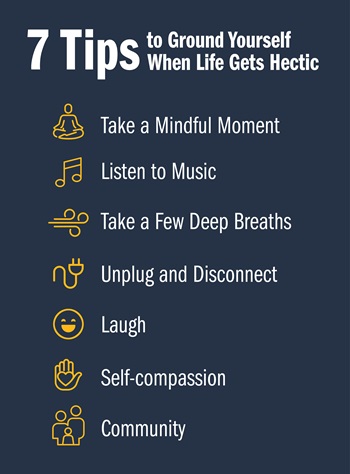
PHCoE graphicWe would not be researchers if we did not start with a quick, but voluntary, assessment: please take a moment to pause, and on a scale of 0–10 (0=not stressed, 10=overwhelmed), how stressed are you feeling right now? Remember this number and let us see if we can improve that number by the time you finish reading this blog. As you read, we encourage you try out at least one of the seven tips we share and notice if it makes a difference.
According to a 2024 study by Amna Alotiby, stress does not just affect our minds, it impacts our entire well-being—mentally, physically, and spiritually.1 Unresolved stress can become a lens through which we see our world. It can shape how we speak and listen, care for ourselves and others, and even how we think. If we remain stuck in an anxious state of being, without pausing to care for ourselves, then the impact can be detrimental.
In the military, service members may get lost in the day-to-day grind of their duties, sometimes even functioning on autopilot, and letting their minds wander to anxious insecurities.2 Grounding techniques help to reconnect to the present. They shift focus from stressful thoughts to promote awareness of your physical and emotional state, by creating space for restoration, gratitude, stillness, and peace.3 Brief moments of mindfulness can have a significant impact on reducing physiological and psychological stress markers, while reducing cortisol levels.4 Even in chaos, a moment of stillness may create clarity in thought, which can gift you a healthier perspective or prevent you from uttering words that cannot be unsaid to a loved one.2 Let’s explore some ways to ground yourself when life gets hectic.
Seven Tips to Ground Yourself When Life Gets Hectic
-
Take a mindful moment. Ask yourself, “what do I need right now?” For some, it might mean going outside and basking in nature, which can improve mood and reduces stress.5 For others, it could be finding a quiet, dimmed room to recharge. Whatever it is, seek your moment and embrace what brings you joy and relaxation.
- Listen to music. Maybe you need to listen to something uplifting. Music has been linked to improved emotional regulation.6
- Take a few deep breaths. Breathwork calms the nervous system and reduces stress.7 Take a moment now to inhale for four counts…. hold for four…. and exhale for six. Repeat a few times. Then check in with yourself, how does that feel?
- Unplug and disconnect. Take a break from screens. Set aside specific times each day where you are not looking at a screen, even if it is for a few minutes, rest your eyes. Excessive screen time can have a negative impact on overall wellbeing.8
- Laugh. Laughter reduces cortisol levels so watch a funny video or share a laugh or two with a friend.9
- Self-compassion. Self-compassion strengthens resilience so treat yourself with patience, grace, appreciation, and comfort. Provide yourself with the same generosity and compassion you give to others.10
- Community. Embrace others, give and receive love, and surround yourself with people who have got your six. Strong social connections promote psychological well-being.11
Do you remember your number from the beginning? How are you feeling now? Did it improve, even a little? That shift matters, especially with the current stressors affecting our daily lives. You can battle these stressors by taking control and grounding themselves in proactive, enjoyable moments.
Resources from the Real Warriors Campaign
References
-
Alotiby A. (2024). Immunology of Stress: A Review Article. Journal of clinical medicine, 13(21), 6394. https://doi.org/10.3390/jcm13216394
- Jha, A. P., Izaguirre, M. K., & Adler, A. B. (2025). Mindfulness Training in Military Settings: Emerging Evidence and Best-Practice Guidance. Current psychiatry reports, 27(6), 393–407. https://doi.org/10.1007/s11920-025-01608-6
- Gherardi-Donato, E. C. D. S., Gimenez, L. B. H., Fernandes, M. N. F., Lacchini, R., Camargo Júnior, E. B., Díaz-Serrano, K. V., Melchior, M., Pérez, R. G., Riquelme-Galindo, J., & Reisdorfer, E. (2023). Mindfulness Practice Reduces Hair Cortisol, Anxiety and Perceived Stress in University Workers: Randomized Clinical Trial. Healthcare (Basel, Switzerland), 11(21), 2875. https://doi.org/10.3390/healthcare11212875
- Koncz, A., Demetrovics, Z., & Takacs, Z. K. (2021). Meditation interventions efficiently reduce cortisol levels of at-risk samples: a meta-analysis. Health psychology review, 15(1), 56–84. https://doi.org/10.1080/17437199.2020.1760727
- Jimenez, M. P., DeVille, N. V., Elliott, E. G., Schiff, J. E., Wilt, G. E., Hart, J. E., & James, P. (2021). Associations between Nature Exposure and Health: A Review of the Evidence. International journal of environmental research and public health, 18(9), 4790. https://doi.org/10.3390/ijerph18094790
- Zaatar, T., Alhakim, K., Enayeh, M., & Tamer, R. (2023). The transformative power of music: Insights into neuroplasticity, health, and disease. Brain, Behavior, & Immunity – Health, 27, 100716. https://doi.org/10.1016/j.bbih.2023.100716
- Balban, M. Y., Neri, E., Kogon, M. M., Weed, L., Nouriani, B., Jo, B., Holl, G., Zeitzer, J. M., Spiegel, D., & Huberman, A. D. (2023). Brief structured respiration practices enhance mood and reduce physiological arousal. Cell reports. Medicine, 4(1), 100895. https://doi.org/10.1016/j.xcrm.2022.100895
- Nakshine, V. S., Thute, P., Khatib, M. N., & Sarkar, B. (2022). Increased Screen Time as a Cause of Declining Physical, Psychological Health, and Sleep Patterns: A Literary Review. Cureus, 14(10), e30051. https://doi.org/10.7759/cureus.30051
- Kramer, C. K., & Leitao, C. B. (2023). Laughter as medicine: A systematic review and meta-analysis of interventional studies evaluating the impact of spontaneous laughter on cortisol levels. PloS one, 18(5), e0286260. https://doi.org/10.1371/journal.pone.0286260
- Gao, P., Mosazadeh, H., & Nazari, N. (2023). The buffering role of self-compassion in the association between loneliness and depressive symptoms: A cross-sectional survey study among older adults living in residential care homes during COVID-19. International Journal of Mental Health and Addiction, 21, 2706–2726. https://doi.org/10.1007/s11469-023-01014-0
- Holt-Lunstad J. (2024). Social connection as a critical factor for mental and physical health: evidence, trends, challenges, and future implications. World psychiatry: official journal of the World Psychiatric Association (WPA), 23(3), 312–332. https://doi.org/10.1002/wps.21224
Halima Ahmed, M.A., is a contracted program manager for the Defense Health Agency, Psychological Health Center of Excellence. She provides consistent, efficient, and quality support by aiding in the successful production and execution of project goals.
Felisha Garcia, Psy.D., is a licensed clinical psychologist and contracted subject matter expert for PHCoE. She specializes in forensic psychology with extensive experience in the treatment of anxiety and trauma.
LCDR Nicholas Grant, Ph.D., is a double board-certified clinical psychologist and subject matter expert at the DHA PHCoE where he serves as the Action Officer for the Real Warriors Campaign.